The right propane stove turns your RV campsite into a functioning kitchen — the wrong one has you waiting 12 minutes for water while everyone stares at you. Five options cover every setup, from 40,000 BTU powerhouses down to under $60, with all specs pulled from verified listings.
| Photo |
Top Pick

|
Versatile
|
Budget

|
Best Value

|
Best for Reliability
|
|---|---|---|---|---|---|
| Product | Camp Chef Everest 2X Two-Burner Stove | Coleman Triton+ 2-Burner Propane Camping Stove | Coleman Classic 3-Burner Propane Camping Stove | Blackstone 1813 Original 22-Inch Tabletop Griddle with Hood | Coleman Classic 2-Burner Propane Camping Stove |
| Burners | 2 | 2 | 3 | 2 (H-style) | 2 |
| Ignition | Matchless | InstaStart push-button | InstaStart push-button | Push-button | Match/lighter required |
| Btu output | 40,000 total (2x 20,000) | 22,000 total | 28,000 total | 24,000 total | 20,000 total |
| Wind protection | ✓ | ✓ | ✓ | ✗ | ✓ |
| Buy Now | Check Price → | Check Price → | Check Price → | Check Price → | Check Price → |
Quick Tips
Run a bulk propane hose adapter from your RV's onboard tank instead of burning through 1-lb canisters every two days — most stoves on this list support it.
Set your stove on a level surface before igniting: uneven ground causes uneven heat distribution and grease pooling on griddle-style tops.
Season cast iron or steel griddle surfaces before your first trip out — a thin layer of oil baked in at home means nothing sticks at the campsite.
In cold temps below 40 degrees F, warm your propane canister in your hands for 30 seconds before connecting — cold tanks drop pressure and cut your BTUs significantly.
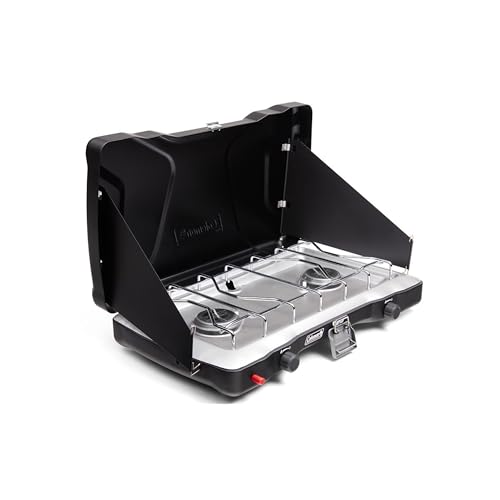
Camp Chef Everest 2X 2-Burner Portable Camping Stove
Best for high-BTU RV cooking with serious wind protection
Camp Chef Everest 2X 2-Burner Portable Camping Stove
Best for high-BTU RV cooking with serious wind protection
What we like
- 40,000 total BTUs means you can run both burners on high simultaneously without either one struggling.
- Three-sided wind barrier built into the lid keeps flames stable in exposed campsite conditions.
- Stainless steel drip tray is removable and actually easy to clean at the campsite.
- Suitcase latch design closes cleanly and the carry handle holds up to repeated trips in and out of storage compartments.
What we don't
- Heavier than Coleman two-burner options at 12 lbs, which matters if you are short on storage space.
- No push-button ignition — you need a lighter or match as a backup, which is a minor but real annoyance.
- Price runs higher than comparable two-burner stoves in the same BTU range.
When both burners need to run full blast at the same time — cast iron skillet on one side, full pot of water on the other — the Everest 2X does not flinch. Each burner pulls 20,000 BTUs independently, and the three-sided wind barrier means a 15 mph crosswind at an exposed site does not turn breakfast into a 40-minute ordeal.
This is the pick for RV campers who cook real meals outside every trip, not just coffee and instant oatmeal. If your storage space is genuinely tight or you mostly boil water and call it cooking, something lighter will serve you better.
Coleman Triton+ 2-Burner Propane Camping Stove
Best for reliable everyday RV cooking with matchless ignition
Coleman Triton+ 2-Burner Propane Camping Stove
Best for reliable everyday RV cooking with matchless ignition
What we like
- Push-button InstaStart ignition lights reliably without a separate lighter, which matters every single morning at the campsite.
- PerfectFlow pressure control keeps heat steady even when propane levels run low in the canister.
- Dual wind guards are built-in and keep the burners performing in typical campsite breeze conditions.
- Chrome-plated grate is removable, making cleanup significantly faster than fixed-grate designs.
What we don't
- 22,000 total BTUs means running both burners at high simultaneously is noticeably slower than higher-output stoves.
- Lid does not double as a wind barrier the way Camp Chef designs do, so three-sided protection requires positioning.
- Not the lightest option in this BTU class.
The InstaStart ignition is the real selling point here — one push and it fires, every time, without hunting for a lighter in the dark at 6am. PerfectFlow keeps the output steady even when a canister is three-quarters empty, which solves the sputtering problem that kills camp stoves as you get toward the bottom.
This is the right stove for the RV camper who wants reliable performance without paying a premium for BTUs they will never actually use. Skip it if you are regularly cooking for four or more people — the output ceiling will slow you down.
Coleman Classic 3-Burner Propane Camping Stove
Best for cooking full family meals at the RV campsite
Coleman Classic 3-Burner Propane Camping Stove
Best for cooking full family meals at the RV campsite
What we like
- Three independently adjustable burners let you run protein, sides, and a sauce simultaneously without any juggling.
- 28,000 total BTUs across three burners gives you enough output to feed a group without any burner feeling underpowered.
- Fits two 12-inch pans or three 8-inch pans at once — the cooking surface is genuinely wide enough for real group meals.
- InstaStart matchless ignition works reliably across the full three-burner width.
What we don't
- Wider footprint than two-burner stoves — requires more table or counter space at your campsite setup.
- Heavier than two-burner options, making it less convenient to move in and out of RV storage bays.
- Overkill if you are consistently cooking for one or two people.
Three independent burners mean you are not constantly shuffling pots around trying to keep everything at the right temperature while feeding four or five people. This stove handles the kind of campsite breakfast — eggs, bacon, pancakes, and coffee simultaneously — that a two-burner makes stressful.
Get this one if you pull up with a family or a group and actually cook outside every morning. If it is usually just you and one other person, the extra burner is dead weight and storage space in your RV bay.
Blackstone 1813 Original 22-Inch Tabletop Griddle
Best for flat-top RV campsite cooking — bacon, eggs, smash burgers
Blackstone 1813 Original 22-Inch Tabletop Griddle
Best for flat-top RV campsite cooking — bacon, eggs, smash burgers
What we like
- 358 square inches of flat cooking surface handles bacon, eggs, pancakes, and smash burgers all at the same time without any hot-spot juggling.
- Two independently controlled heat zones let you run high on one side and low on the other for simultaneous cooking stages.
- Rear grease management system collects runoff in a dedicated trap rather than dripping onto the table or ground.
- Works with both 1-lb canisters and 20-lb tanks via an adapter hose for extended RV trips.
What we don't
- No wind protection at all — exposed campsites will fight your heat consistency on a flat steel surface.
- Requires seasoning before first use and ongoing maintenance to prevent rust on the steel cooking surface.
- Not useful if you need to boil water or use a pot — it is a griddle, not a stove.
If your idea of RV camp cooking is a full flat-top breakfast — the kind where everything hits the griddle at once and you are actually enjoying the morning instead of managing two tiny burners — this is the one. The 22-inch surface is the smallest Blackstone that still feels like a real cooking surface rather than a toy.
Do not get this as your only cooking setup unless you are committed to griddle-only cooking. You will need a separate solution for anything requiring a pot or pan.
A lot of RV campers pair this with the Coleman Classic and call it done.
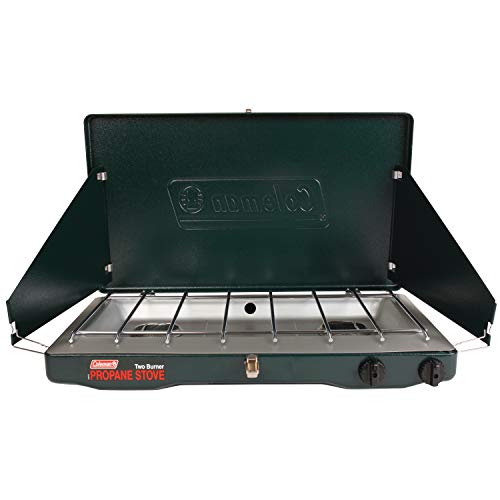
Coleman Classic 2-Burner Propane Camping Stove
Best budget RV camp stove that actually works
Coleman Classic 2-Burner Propane Camping Stove
Best budget RV camp stove that actually works
What we like
- 20,000 total BTUs is enough for two-burner RV cooking at a price point well under everything else on this list.
- Wind-blocking panels are built-in and work well enough for typical campsite conditions.
- Coleman's pressure regulator keeps heat consistent even in cold temps and at altitude.
- Fits a 10-inch and 12-inch pan simultaneously — same cooking surface width as the upgraded Triton+ at a fraction of the cost.
What we don't
- No matchless ignition — you need a lighter or matches every single time, which gets old fast on cold mornings.
- Older styling with less refined build quality than the Triton+ at slightly higher price.
- Drip tray is not removable, making deep cleaning harder than it should be.
This stove has been around so long because it works: 20,000 BTUs, two burners, wind protection, and a pressure regulator that keeps the flame steady when conditions are less than ideal. You give up matchless ignition and a removable drip tray, and you get everything else at roughly half the price of the upgraded models.
Buy this if you are equipping a first RV setup on a tight budget or want a reliable spare stove for the rig. Skip it if you cook outside daily and the missing push-button ignition is going to irritate you every single morning.
What to Look For
BTU output determines how fast you cook. Two-burner stoves rated at 20,000 total BTUs handle most RV meals, but if you are cooking for four or more people, look for 28,000-40,000 BTUs total — otherwise your bacon finishes while your eggs are still raw.
Wind protection is the single most overlooked spec. RV campsites are often exposed.
A stove without wind guards drops effective BTUs by 30 percent and doubles your cook time on a breezy afternoon. Compatibility with your RV propane tank matters if you plan to camp long-term.
Most modern stoves work with a standard bulk adapter hose, but confirm before you buy — running out of 1-lb canisters on day three is a genuinely miserable experience.
Who Should Skip This
Skip this entire category if you do full hookup RV camping with an electric range inside the rig — you already have what you need. These stoves are for people cooking outside their RV who want a real cooking surface, not a sad single burner or a grill that takes 20 minutes to heat up.
What the Community Actually Uses
On r/GoRVing and r/vandwellers, the most consistent advice is to skip single-burner options entirely for anything beyond solo trips. Members repeatedly flag wind resistance and bulk-tank compatibility as the two things they wish they had checked before buying.
The Blackstone flat-top in particular gets mentioned constantly in r/camping as a game-changer for campsite breakfasts once people make the switch from traditional two-burner stoves.
Quick Picks — In Case You've Already Decided
Frequently Asked Questions
Can I connect a camp stove to my RV's built-in propane tank?
Yes, with a bulk adapter hose — usually a standard QCC1 fitting. Most stoves on this list support it. Pick up a 5-foot hose adapter and you will never need a 1-lb canister again at the campsite.
How many BTUs do I actually need for RV cooking?
At least 20,000 total for two-burner cooking. If you are feeding more than two people or cooking anything that requires simultaneous high heat on both burners, look for 28,000 or higher. Single-burner backpacking stoves top out around 10,000 and will frustrate you.
Is a flat-top griddle better than a traditional camp stove for RV use?
For breakfast foods — bacon, eggs, pancakes, hash browns — a flat-top wins every time. For boiling water or simmering sauces in a pot, a traditional burner is more versatile. Many RV campers end up bringing both.
How do I keep my camp stove from blowing out in wind?
Look for built-in wind guards, which are the folding metal panels on either side of the burners. If your stove does not have them, park your stove on the leeward side of your RV and use the rig itself as a windbreak.
Are camp stoves safe to use next to an RV?
Yes, with standard precautions: keep at least three feet of clearance from the RV body, never use inside the vehicle, and check hose connections for leaks with soapy water before each trip. Never leave a running stove unattended.
Buying Guide
For RV cooking, BTU output and wind resistance matter more than weight. You want at least 20,000 total BTUs for real meals — not just boiling water.
Check whether you can run a hose to your rig's 20-lb tank or if you need 1-lb canisters. A removable drip tray saves you 20 minutes of cleanup every single trip.