Dirty solar panels can silently steal 25% or more of your system's output, and a standard garden hose won't cut through the baked-on pollen and dust that builds up over a season. The right low-PSI electric pressure washer with a 40-degree nozzle clears a rooftop array in under 20 minutes without leaving a single scratch on the glass.
| Photo |
Top Pick

|
Versatile

|
Budget

|
Best Value
|
Best for Reliability

|
|---|---|---|---|---|---|
| Product | Sun Joe SPX3000 Electric Pressure Washer | Karcher K1700 Electric Pressure Washer | RYOBI RY40PW01DG9 40V Cordless Pressure Washer | Sun Joe SPX3000-XT Electric Pressure Washer | Greenworks GPW1703 1700 PSI Vertical Pressure Washer |
| Gpm | 1.76 GPM | 1.2 GPM | 1.2 GPM | 1.1 GPM | 1.2 GPM |
| Psi | 2030 PSI max | 1700 PSI | 1500 PSI | 2200 PSI max | 1700 PSI |
| Cord length | 35 ft | 35 ft | Cordless | 35 ft | 35 ft |
| Nozzles included | ✓ | ✓ | ✓ | ✓ | ✓ |
| Buy Now | Check Price → | Check Price → | Check Price → | Check Price → | Check Price → |
Quick Tips
Always use the 40-degree or soap nozzle on panels -- never the 0-degree or turbo tip, which can crack seals.
Clean panels in the early morning or evening when the glass is cool to prevent thermal shock from cold water on hot surfaces.
Use deionized or distilled water for the final rinse to avoid mineral spotting that reduces light transmission.
Keep the wand at least 12 inches from the panel surface and work in smooth horizontal passes to avoid streaking.
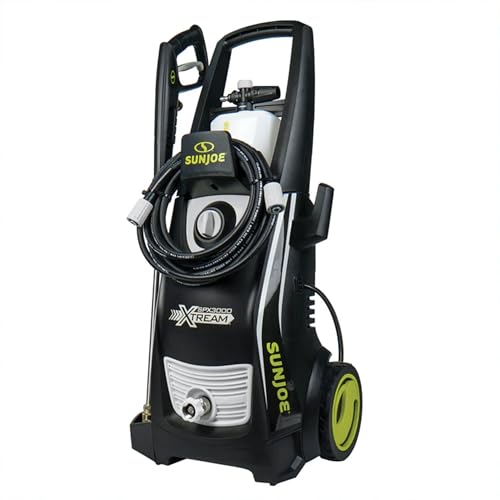
Sun Joe SPX3000 Electric Pressure Washer
Best for whole-array cleaning with dual soap tanks
Sun Joe SPX3000 Electric Pressure Washer
Best for whole-array cleaning with dual soap tanks
What we like
- Dual 0.9L onboard soap tanks let you pre-soak with panel cleaner and rinse in one pass without stopping.
- 34-inch extension wand gives you extra reach toward roof edge panels without moving the unit.
- 1800W motor delivers consistent pressure over a long cleaning session without overheating on a full array.
- GFCI-protected power cord is built into the machine, not just the outlet -- correct for wet outdoor work.
What we don't
- 2030 PSI max is higher than needed for panels -- you must consciously use the 40-degree nozzle and stay at distance.
- Plastic construction on the hose connectors has a known weak point that can crack if you over-torque them.
- At 31 lbs it is heavier than compact competitors, which matters if you are hauling it up a slope to reach panels.
The SPX3000 earns its spot at the top because the dual soap tank system is genuinely useful for panel cleaning -- you load one tank with pH-neutral panel solution and leave the other empty for the rinse cycle, which means you are not stopping mid-array to swap chemicals. This is the right choice if you have 10 or more panels and want to do a proper two-stage clean in one session.
If you have a four-panel starter setup and want the simplest possible option, it is more machine than you need.
Karcher K1700 Electric Pressure Washer
Best for precision cleaning on sensitive panel glass
Karcher K1700 Electric Pressure Washer
Best for precision cleaning on sensitive panel glass
What we like
- True 1700 PSI rated output -- not a peak figure -- puts you in the ideal safe range for panel glass without nozzle management anxiety.
- Foot-activated on/off switch means you can stop water flow instantly when repositioning without setting down the wand.
- 0.5-gallon onboard detergent tank is correctly sized for a panel-specific cleaning solution without over-applying.
- 20-foot kink-resistant hose handles repeated coiling and uncoiling without the cracking common on budget models.
What we don't
- 1.2 GPM flow rate means cleaning a large array takes longer than higher-flow competitors.
- Universal motor is louder than brushless alternatives, which matters if you are cleaning early morning in a neighborhood.
- Hose is 20 ft rather than 25 ft, which limits reach from a single ground position on wider roof spans.
The K1700's biggest advantage for panel cleaning is that 1700 PSI is a glass-safe output level you do not have to manage with nozzle tricks -- point it, pull the trigger, and you are not gambling on the glass. That predictability is worth more than raw PSI numbers on a spec sheet.
Pick this if you have a ground-level or low-roof array and want a European-engineered machine built around consistent rated pressure rather than inflated max figures. Choose the Sun Joe if you need the dual soap tank system for large arrays.
RYOBI RY40PW01DG9 40V Cordless Pressure Washer
Best for off-grid or remote solar array cleaning
RYOBI RY40PW01DG9 40V Cordless Pressure Washer
Best for off-grid or remote solar array cleaning
What we like
- Fully cordless 40V design means you can clean panels at a cabin, barn, or remote property with no outlet within reach.
- Dual battery ports accept two 5.0Ah batteries simultaneously for extended run time across a full array.
- Onboard 5-gallon water tank lets you operate completely independent of a hose connection.
- 1000 PSI standard mode conserves battery for large arrays, with boost mode for stubborn grime spots.
What we don't
- At $280-340 it is the most expensive unit in this roundup, and that is before factoring in replacement battery costs.
- Run time on two 5.0Ah batteries is adequate for a small array but tight for 15 or more panels.
- 1500 PSI max is enough for panel cleaning but leaves no margin for driveway or siding work afterward.
If your panels are on a property without a reliable outdoor outlet -- a rural cabin, agricultural building, or off-grid homestead -- this is the only unit in this roundup that actually solves your problem. The cordless plus onboard water tank combination means zero infrastructure requirements to do a proper clean.
This is not the right tool if you have grid power at the panel location and are simply trying to avoid running an extension cord -- the price premium does not make sense for that use case. Get the SPX3000 or K1700 instead.
Sun Joe SPX3000-XT Electric Pressure Washer
Best for combining panel cleaning with heavy-duty yard work
Sun Joe SPX3000-XT Electric Pressure Washer
Best for combining panel cleaning with heavy-duty yard work
What we like
- 2200 PSI with four quick-connect nozzles makes it genuinely versatile beyond panel cleaning -- driveway, siding, and deck work are all in range.
- 14.9A motor is one of the most powerful in the corded electric class without crossing into gas-territory bulk.
- Four nozzle set including 40-degree tip covers the full range from panel-safe to heavy-duty surface cleaning.
- 35-foot power cord with GFCI plug reaches most residential solar installations from a single standard outlet.
What we don't
- 2200 PSI requires disciplined nozzle selection for panel work -- the 0-degree and 15-degree tips are genuinely unsafe on glass at this pressure.
- No onboard soap tank, which means stopping to add cleaner manually between wash and rinse passes.
- Slightly heavier than the base SPX3000 due to the larger motor, making repositioning around the house more effort.
The SPX3000-XT makes sense if you are buying one machine to do panel cleaning plus the rest of your outdoor maintenance -- driveway, deck, siding, and vehicles -- rather than a dedicated panel-only tool. The value comes from not needing two washers.
If panels are your only use case, the extra PSI is a liability you have to manage rather than a feature. Stick with the K1700 or base SPX3000 for dedicated panel work.
Greenworks GPW1703 1700 PSI Vertical Pressure Washer
Best budget pick for small residential solar setups
Greenworks GPW1703 1700 PSI Vertical Pressure Washer
Best budget pick for small residential solar setups
What we like
- Sub-$110 price makes it the most accessible entry point for homeowners who only clean panels once or twice a year.
- 1700 PSI output is inherently in the panel-safe range without requiring careful nozzle management.
- Vertical upright design takes up minimal storage space in a garage already full of solar equipment and tools.
- 35-foot power cord reaches most single-story residential panel locations from a standard outdoor outlet.
What we don't
- No onboard soap tank -- you need a separate container and soap nozzle attachment for a two-stage clean.
- Lighter-duty build quality than Karcher or Sun Joe -- not the right choice if you plan heavy-duty driveway or siding work.
- 5-inch rear wheels work fine on flat ground but struggle on gravel or uneven terrain around rural properties.
If you have four to eight panels on a single-story roof and clean them twice a year, this is the honest answer -- you do not need $150 of pressure washer for that job. The GPW1703 delivers a panel-safe 1700 PSI, a GFCI cord, and basic nozzle set for around $90.
Step up to the K1700 if you want German build quality and the foot-switch convenience, or to the SPX3000 if you need onboard soap tanks. For the occasional clean on a small system, this covers it.
What to Look For
PSI range matters more than peak power for panel cleaning. Stay between 1200 and 1900 PSI -- enough to move biofilm and dust without stressing frame seals or edge bonding.
Cord length and hose reach determine whether you can actually get to the panels. A 35-foot cord plus a 25-foot hose covers most single-story roof setups without an extension cord.
A GFCI-protected plug is non-negotiable when combining water and outdoor electricity. Look for it on the machine itself, not just your outlet -- it keeps you safe if the wand contacts a wet panel edge.
Who Should Skip This
If your panels are on a two-story or steep-pitch roof you cannot safely access from a ladder, a ground-based water-fed pole brush is a safer tool than any pressure washer. Pressure washers also require a water source -- if your array is off-grid in a remote location without hose access, a cordless unit with a water tank is the only viable option in this category.
What the Community Actually Uses
On r/solar, the recurring advice is to skip gas-powered units entirely -- members consistently flag vibration from gas engines as a microvibration risk to panel mounts over time. The most-upvoted threads recommend corded electric models in the 1500-1800 PSI range paired with a 40-degree nozzle, with several users reporting a measurable bump in system output after a proper seasonal clean.
Quick Picks — In Case You've Already Decided
Frequently Asked Questions
What PSI is safe for cleaning solar panels?
Most manufacturers recommend staying under 2000 PSI, with 1200-1800 PSI being the practical sweet spot. Always pair it with a 40-degree nozzle and keep the wand moving -- static high-pressure streams are what crack seals.
Can I use a pressure washer on solar panels without voiding the warranty?
Most panel warranties do not prohibit pressure washing, but some require water pressure to stay below a specified limit. Check your panel manufacturer's maintenance guide before cleaning -- LG, Panasonic, and SunPower all publish cleaning guidelines online.
How often should I pressure wash solar panels?
Twice a year is the standard recommendation -- spring to clear winter grime and fall to remove summer pollen and dust. In high-dust environments like the Southwest or near agricultural land, quarterly cleaning can meaningfully improve output.
Do I need to turn off my solar system before pressure washing?
Yes -- shut down the inverter and isolate the system before washing. Water intrusion into junction boxes or inverter vents during active operation is a fire risk. Most system manuals include a pre-cleaning shutdown procedure.
What is the best nozzle tip for solar panel cleaning?
The 40-degree tip is the standard recommendation -- it fans the water wide enough to reduce point pressure on the glass while still clearing biofilm. The soap nozzle works well for the initial pass with a gentle pH-neutral cleaner.
Buying Guide
You need enough pressure to lift grime but not enough to crack tempered glass -- that window is 1200 to 1900 PSI with the 40-degree nozzle. Look for a long cord or cordless design so you can reach the array, a soap tank for deionized-water rinse cycles, and a GFCI plug for outdoor safety near water.