There are exactly five portable power stations under $1,000 worth owning in 2024 — and the rest will leave you stranded on night two. The gap between a $400 unit and a real LFP station starts at around 3,000 charge cycles versus 500, and you feel it the first time the cheap one dies mid-trip.
| Photo |
Top Pick

|
Versatile

|
Budget

|
Best Value

|
Best for Reliability
|
|---|---|---|---|---|---|
| Product | Anker SOLIX C1000 Portable Power Station | Jackery Explorer 1000 v2 Portable Power Station | EF EcoFlow DELTA 2 Portable Power Station | BLUETTI AC180 Portable Power Station | Goal Zero Yeti 1000 Core Portable Power Station |
| Battery | LiFePO4 (3,000 cycles) | LiFePO4 (4,000 cycles) | LiFePO4 (3,000+ cycles) | LiFePO4 | Lithium-ion NMC |
| Capacity | 1,056Wh | 1,070Wh | 1,024Wh | 1,152Wh | 983Wh |
| Ac output | 1,800W (2,400W surge) | 1,500W | 1,800W | 1,800W (2,700W Power Lifting) | 1,200W (2,400W surge) |
| Solar input | 600W max | 400W max | 500W max | 500W max | 300W max |
| Buy Now | Check Price → | Check Price → | Check Price → | Check Price → | Check Price → |
Quick Tips
Check watt-hours, not watts — capacity (Wh) tells you how long it runs, output (W) tells you what it can run. Most people confuse the two and undersize their unit.
LiFePO4 chemistry is non-negotiable for overlanding. Standard lithium cells degrade fast in heat and deep-discharge cycles — LFP handles both without flinching.
Solar input wattage is as important as battery capacity. A 1,000Wh unit with only 200W solar input takes 5+ hours to charge in ideal conditions — look for 500W or more.
Run your fridge load before you buy. A 12V compressor fridge draws 40-60W average — a 1,000Wh station gives you roughly 15-20 hours, less if you're also charging devices.
Anker SOLIX C1000 Portable Power Station
Best for overlanding base camps and multi-device setups
Anker SOLIX C1000 Portable Power Station
Best for overlanding base camps and multi-device setups
What we like
- Charges from 0-80% in under 58 minutes via wall outlet — fastest in this class.
- SurgePad technology pushes peak output to 2,400W, covering almost any appliance you'd run at camp.
- 15% smaller than comparable 1kWh units, which makes a real difference in a packed vehicle.
- App control lets you monitor draw and adjust charging modes without opening the box.
What we don't
- Heavier than some competitors at around 27 lbs — noticeable on longer carries.
- App is required to access some charging modes, which adds a step if your phone dies.
- No built-in LED light, which is a minor miss for camp use.
The C1000 is the unit to grab when your setup needs to run hard — fridge on, devices charging, tools at the ready — without babysitting battery percentage all trip. If you're running a 3-4 day overland camp with real power demands, this is the most capable station at this price point.
It's not the move if you want something light enough to carry a mile — there are better options for that. For basecamp power where the vehicle does the hauling, nothing in this price range beats it.
Jackery Explorer 1000 v2 Portable Power Station
Best for van lifers and frequent travelers who charge daily
Jackery Explorer 1000 v2 Portable Power Station
Best for van lifers and frequent travelers who charge daily
What we like
- 4,000 charge cycles — the highest cycle rating in this roundup — means it outlasts most of the competition by years.
- 1-hour full charge via emergency mode in the Jackery App, with a 1.7-hour default for battery health.
- App control includes quiet overnight mode at 30 dB, which matters when you're sleeping five feet away.
- Three AC outlets, two USB-C ports, and 100W USB-C PD output covers every device you're likely running.
What we don't
- 1,500W AC output is lower than the Anker and Bluetti picks — won't run high-draw appliances like some air compressors.
- Emergency 1-hour charging must be enabled manually in the app each time, which gets old on long trips.
- At 23 lbs it's manageable but not exactly light.
The v2 earns its reputation on longevity — 4,000 cycles means daily use for over a decade before you hit 80% capacity, which no other unit here matches. If you're charging from solar every day and need a station that keeps up without degrading, this is the right call.
Van lifers and people who use their station constantly will get more total lifetime value here than from any other pick. If you only camp a few times a year, the extra cycle life is overkill — look at the Bluetti or EcoFlow instead.
EF EcoFlow DELTA 2 Portable Power Station
Best for home backup combined with camping use
EF EcoFlow DELTA 2 Portable Power Station
Best for home backup combined with camping use
What we like
- X-Stream fast charging gets from 0-80% in 50 minutes, full charge in 80 minutes — some of the fastest AC charging in this class.
- 500W solar input means you can realistically recharge in 2-3 hours on a clear day without combining sources.
- Expandable with a DELTA 2 Smart Extra Battery to double capacity to 2,048Wh without buying a new unit.
- 5-year customer service warranty is the longest coverage in this roundup.
What we don't
- Fan noise during heavy charging is noticeable — not ideal for dead-quiet camp nights.
- The app can be slow to sync in remote areas with spotty connectivity.
- Expansion battery is a separate purchase that adds significant cost.
The DELTA 2 is the dual-purpose pick — genuinely good as both a camping unit and a home backup that actually covers real appliances during an outage. The expandable capacity is the killer feature: buy the base unit now, add the extra battery later if your needs grow.
If you camp a few times a year and want the same unit pulling double duty at home during storms, this is the one. Pure overlanders running full-time will likely want the Anker's higher surge output instead.
BLUETTI AC180 Portable Power Station
Best for solo campers who want the most capacity per dollar
BLUETTI AC180 Portable Power Station
Best for solo campers who want the most capacity per dollar
What we like
- 1,152Wh is the highest base capacity in this roundup at this price tier — more runtime per dollar than anything else here.
- Power Lifting mode via app boosts output to 2,700W, allowing high-draw devices that would otherwise trip the breaker.
- UPS function switches to battery power within 20ms of an outage — fast enough for sensitive electronics.
- 11 output ports covers every device type including regulated 12V for direct fridge connection.
What we don't
- Power Lifting mode requires app activation every time, which adds friction when you're tired and just want power.
- Heavier than some competitors in this price range at around 27.5 lbs.
- Cycle life specs are less clearly published than competitors — flag for comparison if longevity is your top priority.
The AC180 wins on raw capacity per dollar — 1,152Wh for under $650 is the best storage-to-price ratio in this entire roundup, period. You're running a solo camp or a couple with one fridge and a few devices, this powers everything for days without stress.
If you need the most Wh for the least money and aren't obsessed with exact cycle-life numbers, this is your unit. People who run heavy multi-device setups should still consider the Anker for its confirmed cycle ratings and app depth.
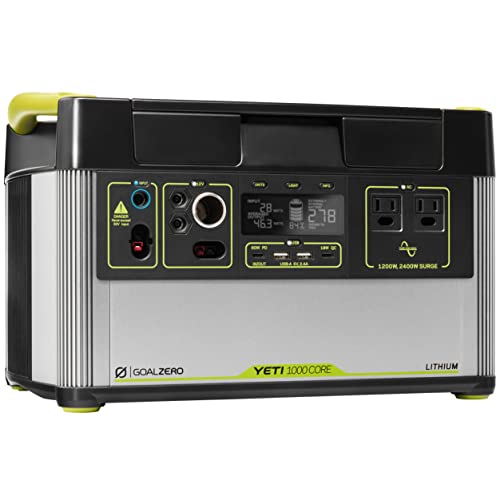
Goal Zero Yeti 1000 Core Portable Power Station
Best for weekend warriors who want bombproof build quality
Goal Zero Yeti 1000 Core Portable Power Station
Best for weekend warriors who want bombproof build quality
What we like
- Goal Zero's build quality is best-in-class at this price — the Yeti Core feels like it was built to take a beating, not a shelf.
- 2,400W surge capacity runs demanding appliances and tools that trip lesser units.
- Amazon-exclusive model cuts out retail markup, making it the most straightforward value purchase in the lineup.
- Simple no-app operation — plug in, check the display, run your gear — no setup required.
What we don't
- NMC lithium-ion chemistry, not LFP — shorter cycle life than the other picks here, plan for eventual replacement sooner.
- 300W solar input max is the lowest in this roundup — recharging from panels takes significantly longer.
- No app connectivity if you want to monitor or adjust remotely.
The Yeti 1000 Core is for people who want something that works without thinking about it — no app, no modes, no fuss, just power. The build is noticeably more rugged than the competition, and Goal Zero's support track record is longer than anyone else in this category.
If you camp a handful of times a year and want a station that outlasts trends and doesn't require a firmware update, the Yeti Core is exactly that. Heavy daily users or solar-dependent setups should pick one of the LFP units above for better cycle life and faster solar input.
What to Look For
Battery chemistry is the single most important spec in this category. LFP (LiFePO4) cells last 3,000-plus charge cycles versus 300-500 for standard lithium-ion, and they handle heat, deep discharge, and long storage without the degradation curve.
Output wattage determines what you can actually run. Most fridge compressors, CPAP machines, and power tools need at least 1,000W sustained — units with surge protection above 2,000W cover almost anything you'd plug in at a base camp.
Solar input speed separates weekend units from trip-capable stations. If you're spending multiple nights off-grid, you need a station that can accept 500W or more from solar panels — otherwise you're always chasing sun and never fully charged by morning.
Who Should Skip This
If you're only powering phones and a camp light for one or two nights, a 500Wh unit at half the price handles that fine — you don't need the weight or cost of a 1,000Wh station. These picks are built for people running a fridge, CPAP, power tools, or multiple devices for three or more days.
Van lifers needing whole-home backup should also look at expandable options above the $1,000 ceiling.
What the Community Actually Uses
On r/overlanding, the power station conversation comes up constantly — and the consensus is predictable: anyone who bought a no-name unit on sale has a story about it dying on the second trip. The thread consensus usually lands on Jackery, EcoFlow, and Anker as the field-tested brands, with Goal Zero getting nods from the long-timers who've used them since before LFP was standard.
Quick Picks — In Case You've Already Decided
Frequently Asked Questions
What size portable power station do I need for camping?
For a compressor fridge plus device charging, plan for at least 1,000Wh. A 12V fridge draws 40-60W average, which eats through a smaller unit in under 12 hours. If you're adding a CPAP or power tools, 1,000Wh is your floor.
Is LiFePO4 really better than lithium-ion for portable power stations?
For outdoor use, yes. LFP batteries last 3,000-plus cycles versus 300-500 for standard lithium-ion, handle heat better, and are inherently more stable. The trade-off is slightly lower energy density, which is why some LFP units weigh more.
Can I run a CPAP machine from a portable power station?
Yes. Most CPAP machines draw 30-60W — a 1,000Wh station gives you 15-25 hours of run time before hitting reserve. Disable the humidifier to cut power draw roughly in half.
How long does it take to charge a portable power station from solar panels?
Depends on panel wattage and the station's solar input limit. A 500W solar input with 400W of panels charges a 1,000Wh unit in around 2-3 hours in full sun. Most budget units cap at 200W solar, which stretches that to 5-6 hours.
Can I use a portable power station while it's charging?
Yes — all five picks here support pass-through charging. You can draw from the station while it charges from solar or wall power. Some units limit combined input and output to protect the cells, so check the manual for any restrictions.
Buying Guide
You need capacity, output, and battery chemistry — in that order. Anything under 1,000Wh won't run a fridge overnight.
Look for LiFePO4 (LFP) cells, which last 3,000-plus cycles versus 300-500 for standard lithium. Fast recharge matters when you're working off solar.
Ports matter when you're running multiple devices. Get the right tool.