A power station without a native 30 amp TT-30 outlet isn't really built for your rig — it's built for someone else's. Every station on this list has a verified TT-30 or 30A RV port and enough wattage to actually run your AC, fridge, and lights without tripping a breaker.
| Photo |
Top Pick

|
Versatile
|
Budget

|
Best Value
|
Best for Reliability

|
|---|---|---|---|---|---|
| Product | EF EcoFlow DELTA Pro 3 Portable Power Station | BLUETTI Elite 300 Portable Power Station | BLUETTI AC200L Portable Power Station | EF ECOFLOW Portable Power Station DELTA Pro 3600Wh | Nature's Generator Elite with Cart |
| Rv port | TT-30R 30A | TT-30 + 12V/30A DC | 30A RV output | 30A Anderson port | 120V 30A pure sine wave |
| Capacity | 4,096Wh | 3,014Wh | 2,048Wh | 3,600Wh | 720Wh |
| Ac output | 4,000W (8,000W surge) | 2,400W (4,800W surge) | 2,400W (3,600W power lifting) | 3,600W (4,500W X-Boost) | 3,600W continuous |
| Solar input | 2,600W max | 1,200W max | 1,200W max | 1,600W max | Solar + wind compatible |
| Buy Now | Check Price → | Check Price → | Check Price → | Check Price → | Check Price → |
Quick Tips
Measure your RV's peak draw before buying — a rooftop AC alone can pull 1,800W on startup surge, and your fridge adds another 400W on top of that.
LiFePO4 batteries tolerate being left at partial charge far better than older NMC cells — you can leave them at 80% without degrading cycle life.
Run your power station in pass-through mode at a campsite with hookups to top off slowly via solar and only tap the battery when you lose shore power.
Check whether the 30A output and the standard AC outlets share the same inverter pool — on some units running the TT-30 at full draw disables the other AC ports.
EcoFlow DELTA Pro 3 Portable Power Station
Best for full RV hookup with 30A TT-30R and 240V on one unit
EcoFlow DELTA Pro 3 Portable Power Station
Best for full RV hookup with 30A TT-30R and 240V on one unit
What we like
- Native TT-30R RV outlet runs your rig's shore power cord plug-and-play with zero adapters.
- 4,000W continuous output and 8,000W surge handles rooftop AC startup without power-lifting tricks.
- Charges from 0 to 80% in under 50 minutes via dual AC input — faster than any competitor at this capacity.
- Expandable to 48kWh with extra battery packs, making it viable for week-long off-grid basecamp setups.
What we don't
- Weighs 113.5 lbs — you need the built-in wheels and two people for serious portability.
- Premium price puts it out of reach for occasional weekend campers who don't need this much power.
- At 4kWh base capacity you may be paying for more battery than a solo van build actually needs.
When your RV's shore power cord plugs straight into the station without an adapter and the lights come on instantly, that's what this unit delivers — the TT-30R port is native, the 4,000W output covers your AC, and the 8,000W surge means you won't trip anything on startup. This is the station for people running a serious rig: dual-axle fifth wheels, truck campers with residential AC, or basecamp setups powering multiple rigs at once.
If your RV is a teardrop trailer and you mainly need to charge devices, start one tier down.
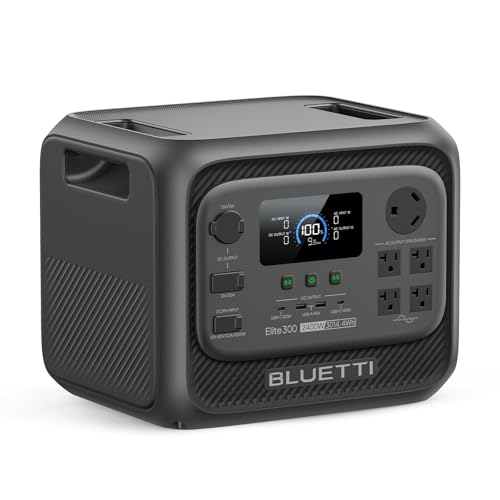
BLUETTI Elite 300 Portable Power Station
Best compact 3kWh station with native TT-30 RV port
BLUETTI Elite 300 Portable Power Station
Best compact 3kWh station with native TT-30 RV port
What we like
- Smallest verified 3kWh power station on the market — 59% more compact than traditional large units for the same capacity.
- TT-30 RV port plus a dedicated 12V/30A DC port covers both shore power hookup and DC-direct appliance running.
- Charges from 0 to 100% in 78 minutes via AC — one of the fastest full-charge times at this capacity.
- User-serviceable rear fan cover lets you clean dust from the cooling system, unusually practical for off-grid use.
What we don't
- 2,400W continuous output may not handle the startup surge of larger rooftop AC units without power-lifting mode.
- 1,200W solar input is limiting if you're trying to sustain heavy loads across multiple days without shore power access.
- No wheels or telescoping handle — at this size you carry it by hand, which gets awkward on longer hikes to a site.
The Elite 300 solves the single biggest complaint about large-capacity power stations: they're enormous. At 3kWh it gives you enough capacity to run an RV fridge overnight plus a rooftop AC for a few hours, and it still fits in the back of a mid-size SUV without reorganizing your gear.
Pick this if you have a van, Class B, or pop-up camper where space is the limiting factor and you're willing to recharge via solar during the day to offset evening draw. If you're running a larger trailer with a residential-size AC, step up to a higher continuous wattage option.
BLUETTI AC200L Portable Power Station
Best for expandable basecamp power with 30A RV output
BLUETTI AC200L Portable Power Station
Best for expandable basecamp power with 30A RV output
What we like
- Expandable to 8,192Wh with additional BLUETTI battery packs — the most scalable unit in this price range.
- Power-lifting mode temporarily boosts output to 3,600W to start resistive loads that exceed the rated 2,400W ceiling.
- 11 output ports including the 30A RV port, 48V DC port, and USB-C 100W PD for simultaneous device charging.
- Compatible with BLUETTI D40 voltage regulator to charge an RV's 12V house battery directly from the station.
What we don't
- The 30A RV port is not a standard TT-30R connector on all variants — verify the connector type matches your RV's shore cord before ordering.
- At 2,048Wh base capacity, heavy AC use will drain it in under 2 hours without supplemental solar input.
- Heavier than the Elite 300 despite lower base capacity, due to the larger chassis needed for expansion port hardware.
The AC200L earns its place by being the most expandable option in the sub-$1,100 tier — you can start with 2kWh and stack up to 8kWh as your setup grows, which is exactly how most people build out a van or overlanding rig over time rather than buying everything at once. This is the right pick if you're actively building out a system and want room to scale, or if you run two vehicles at camp and want one station that can expand to cover both.
If your rig is finalized and you just want maximum capacity out of the box, the Elite 300 or DELTA Pro 3 is a cleaner buy.
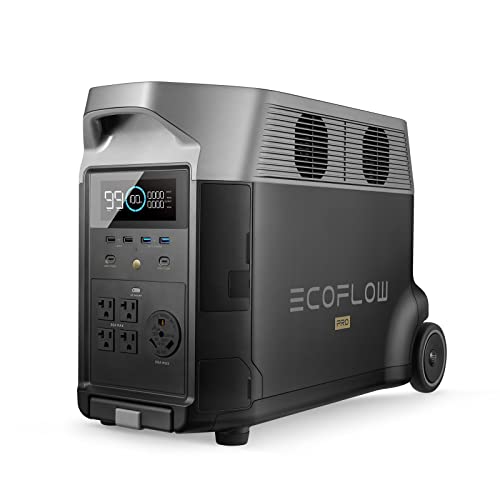
EcoFlow DELTA Pro Portable Power Station
Best for heavy-load basecamp with 3,600Wh and 5 AC outlets
EcoFlow DELTA Pro Portable Power Station
Best for heavy-load basecamp with 3,600Wh and 5 AC outlets
What we like
- 3,600Wh base capacity is the highest in this price range — runs a residential fridge for 26+ hours on a single charge.
- X-Boost technology temporarily extends output to 4,500W to start heavy appliances rated above the 3,600W inverter ceiling.
- Charges to full in 1.8 hours via 240V input or 2.7 hours via standard wall outlet — significantly faster than most competitors.
- Pairs with a second DELTA Pro unit to deliver 7,200W split-phase 240V output for whole-campsite power sharing.
What we don't
- The 30A RV output uses an Anderson port rather than a standard TT-30R — you need an adapter cable for direct RV hookup.
- Weighs around 99 lbs, which requires the built-in trolley wheel kit or a second person to move across uneven terrain.
- Solar input ceiling of 1,600W is lower than the DELTA Pro 3, limiting recharge speed on overcast multi-day trips.
The original DELTA Pro still delivers the best raw capacity-per-dollar in the EcoFlow lineup, and the 3,600W inverter handles nearly every basecamp load without engaging boost mode. The catch for RV owners is real: the 30A output runs through an Anderson port, meaning you need an adapter cable to hook up your RV's standard shore power cord.
This is the right buy if you're using it primarily as a home backup or basecamp generator and occasionally connecting to the RV — the adapter is a one-time $25 cable purchase that solves the issue permanently. If plug-and-play TT-30R is non-negotiable on every setup, go with the Elite 300 or DELTA Pro 3 instead.
Nature's Generator Elite with Cart
Best solar-wind hybrid station with native 30A AC outlet
Nature's Generator Elite with Cart
Best solar-wind hybrid station with native 30A AC outlet
What we like
- Native 120V 30A pure sine wave AC outlet on the back delivers clean power compatible with RV shore power requirements.
- Accepts both solar panel and wind turbine input simultaneously — useful for off-grid winter trips where sun hours are short.
- Ships with a rolling cart included, making it significantly more mobile than comparably priced units that charge extra for mobility kits.
- 3,600W continuous output punches well above its battery capacity tier — handles most RV loads at any given moment.
What we don't
- 720Wh battery capacity is the lowest on this list — heavy loads will drain it in under 30 minutes without active solar or wind input.
- Depends on solar or wind recharging for extended use since the small battery means you must recharge between significant draw events.
- Fewer output ports than BLUETTI or EcoFlow competitors at this price point — only 3 AC outlets plus 2 USB.
The Nature's Generator Elite makes a specific trade: it prioritizes output power over stored capacity, giving you a 3,600W inverter in a unit that costs under $900. The 30A AC outlet on the back is a true native port — your RV's shore cord plugs right in — and the continuous output is genuinely high for the price tier.
This is the right pick for weekend RVers who can position it near a solar panel and don't need it to run independently for hours without recharging. If you need multi-hour autonomous run time for a rooftop AC with no solar input, the 720Wh base battery won't get you there — step up in capacity.
What to Look For
The 30A port type matters more than people realize. A TT-30R outlet is the standard RV shore power connector — if your station has one, you plug in with zero adapters.
Some stations advertise '30A output' but deliver it through an Anderson port or proprietary connector, which requires a cable you may not have on the road. Wattage ceiling defines what you can actually run.
Most RV air conditioners need 1,200W to 1,800W continuous and 2,200W or more on startup surge — a 1,000W station with a TT-30 port is still useless for that. Look for at least 2,400W continuous or a power-lifting mode that temporarily exceeds the rated ceiling to start resistive loads.
Battery size determines how long you can camp off-grid. A 2,000Wh station running a 12V fridge (45W) and LED lighting (30W) gives you roughly 26 hours — add an air conditioner and that drops to under 3 hours.
Solar input capacity is what separates a one-night station from a multi-day system: look for at least 800W of solar acceptance to keep up with daily demand.
Who Should Skip This
If your RV is already parked at a full-hookup campsite 90% of the time, a portable power station with a 30 amp port is overkill — a simple surge protector is all you need. These stations also won't make sense if your rig runs a 50 amp service and you need both legs of 240V for a residential-size AC; in that case, look at dual-unit setups or whole-home battery backup systems instead.
What the Community Actually Uses
On r/vandwellers and r/overlanding, the 30 amp power station conversation almost always splits into two camps: people who want a true TT-30 plug for seamless hookup at campgrounds, and people who just want raw wattage and are fine using an adapter. The consensus leans hard toward native TT-30 for anyone who moves camps frequently — digging through a cable bag at midnight when you've just pulled into a site gets old fast.
Quick Picks — In Case You've Already Decided
Frequently Asked Questions
What is a 30 amp TT-30 outlet and why does it matter for RVs?
TT-30R is the standard 30 amp RV shore power receptacle used at most campgrounds across North America. A power station with a native TT-30 port lets you plug in your RV's existing shore power cord directly — no adapters, no dongles, no improvising at midnight.
Can a portable power station actually run an RV air conditioner?
Yes, if the station outputs at least 2,400W continuous and has surge headroom above 3,500W for startup. Most 13,500 BTU rooftop ACs pull around 1,200W-1,500W running and spike to 3,000W+ on startup. Check your AC's spec plate before buying.
How long will a 2,000Wh power station last in an RV?
Running a 12V fridge, LED lights, and phone charging only, you'll get 18-24 hours. Add a rooftop air conditioner and that drops to roughly 1-2 hours. Pair any of these stations with 400W+ of solar panels to extend run time indefinitely in sunny conditions.
Is LiFePO4 worth the premium over standard lithium for a power station?
For RV use, yes. LiFePO4 chemistry delivers 3,000 to 4,000 charge cycles versus 300-500 for older NMC lithium cells, which means 8-10 years of daily use before significant capacity loss. It also handles heat better and is considerably safer under heavy load.
Do these power stations work with solar panels?
All five options on this list accept solar panel input via MC4 or XT60 connectors. Solar input capacity ranges from 1,200W to 2,600W depending on the unit — higher solar acceptance means faster recharging and better viability for multi-day off-grid camping.
Buying Guide
You need a native TT-30 or 30A RV port — not a 15 amp adapter pretending to be one. Look for continuous output above 2400W or power-lifting headroom that covers your AC unit's surge.
Battery chemistry matters too: LiFePO4 lasts 3,000 to 4,000 cycles versus 500 for older lithium.