The right portable power station turns your van from a gas-station dependent road tripper into a genuinely self-sufficient home — no hookups, no noise, no fumes. Five current picks range from a 288Wh grab-and-go unit at under $250 up to a 2048Wh expandable rig that will outlast your roof solar on cloudy weeks.
| Photo |
Top Pick

|
Versatile
|
Budget

|
Best Value

|
Best for Reliability

|
|---|---|---|---|---|---|
| Product | EF EcoFlow DELTA 2 Portable Power Station | BLUETTI AC200MAX Portable Power Station 2048Wh | Anker SOLIX C1000 Portable Power Station | Jackery Explorer 1000 Pro Portable Power Station | Jackery Explorer 300 Plus Portable Power Station |
| Capacity | 1024Wh | 2048Wh | 1056Wh | 1002Wh | 288Wh |
| Ac output | 1800W (2700W surge) | 2200W (4800W surge) | 1800W (2400W surge) | 1000W (2000W surge) | 300W (600W surge) |
| Solar input | 500W max | 900W max | 600W max | 200W max | 100W max |
| Battery cycles | 3000+ | 3500+ | 3000+ | 1000+ | 3000+ |
| Buy Now | Check Price → | Check Price → | Check Price → | Check Price → | Check Price → |
Quick Tips
Calculate your real daily watt-hour draw before buying — fridge, laptop, lights, and phone add up to more than most people expect.
LFP (LiFePO4) chemistry is worth paying for: 3000-plus cycles means years of daily use before capacity noticeably drops.
Solar input wattage limits how fast you can top off on cloudy travel days — check the spec, not just capacity.
A built-in TT-30 RV port lets you plug in at campgrounds without any adapters — useful if you mix hookup nights into your route.
EF EcoFlow DELTA 2 Portable Power Station
Best for full-time van builds that need fast solar recovery
EF EcoFlow DELTA 2 Portable Power Station
Best for full-time van builds that need fast solar recovery
What we like
- 500W solar input refills the unit in about 3 hours on a good sun day — faster than most competing 1kWh units.
- LFP battery chemistry rated for 3000-plus cycles, meaning years of daily van use before any noticeable capacity drop.
- EcoFlow app lets you monitor state of charge and adjust charging speed remotely via Bluetooth when you are off-grid.
- Expandable to 3kWh with an add-on battery if your power needs grow — no new unit required.
What we don't
- Heavier than comparably sized units at around 27 lbs, which matters if you are frequently moving it in and out of the van.
- The app is useful but required for some advanced settings — not fully functional without a phone pairing step.
- Price sits at the higher end of the 1kWh category; budget builds may find better value per Wh elsewhere.
The Delta 2 earns its spot at the top of van life power lists because of one spec most people gloss over: 500W solar input. When you are two days into a cloudy stretch with no hookups, a unit that fills in 3 hours versus 6 hours is the difference between working and rationing.
This is the right pick for anyone building a serious full-time or long-term van setup who wants one unit to do everything. If you are a weekend warrior who mostly camp-hops with hookups available, you are paying for capacity you will rarely need.
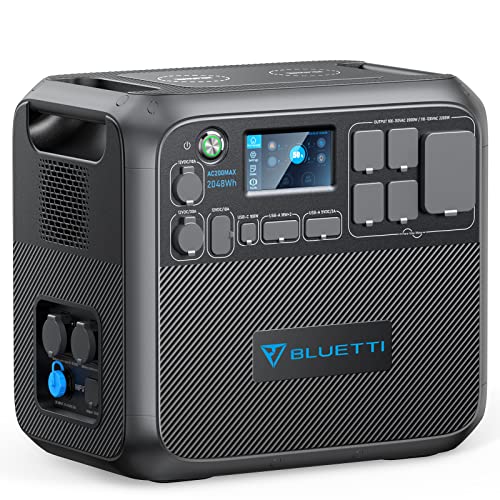
BLUETTI AC200MAX Portable Power Station
Best for couples or anyone running multiple appliances simultaneously
BLUETTI AC200MAX Portable Power Station
Best for couples or anyone running multiple appliances simultaneously
What we like
- Expandable to 8192Wh with external battery packs, making this the most future-proof option on the list for growing builds.
- Built-in TT-30 RV outlet means you can plug directly into campground power pedestals without any adapter.
- 900W solar input — the highest on this list — means full recharge in roughly 2.5 hours with the right panel setup.
- Bluetooth app control lets you monitor and adjust charging remotely, useful when panels are on the roof and unit is inside.
What we don't
- Weighs around 61 lbs — this is basecamp power, not something you reposition frequently.
- Higher price than most van lifers need unless you are running a full dual-occupancy or work-from-van setup.
- Expansion batteries are a significant additional cost; capacity advertised at full expansion requires a substantial investment.
The AC200MAX is the only pick on this list designed to grow with your build. Start at 2048Wh and add expansion batteries later without replacing the core unit — that modularity makes it the smart buy for anyone who expects their power needs to increase as their van setup matures.
This is built for two-person rigs, remote-work setups, or anyone running a full-size compressor fridge plus a coffee maker plus a laptop simultaneously. Solo minimalists or weekend dippers should step down to the Delta 2 and save the money.
Anker SOLIX C1000 Portable Power Station
Best for van lifers who also need fast wall charging at home base
Anker SOLIX C1000 Portable Power Station
Best for van lifers who also need fast wall charging at home base
What we like
- Charges from 0 to 100% via wall outlet in 58 minutes — fastest AC charging speed in this capacity class.
- 15% smaller than comparable 1kWh units, which genuinely matters when floor space in a van build is tight.
- SurgePad technology pushes output to 2400W peak, covering more appliances than the rated 1800W suggests.
- LFP battery rated for 3000 cycles and a 10-year lifespan under normal van-life usage patterns.
What we don't
- 600W solar input is solid but falls short of the EcoFlow Delta 2's 500W and BLUETTI's 900W for pure solar-speed comparisons.
- App customization is useful but requires setup before you can unlock the fastest charging mode.
- Slightly higher price than the EcoFlow Delta 2 for comparable 1kWh capacity.
The SOLIX C1000 wins one specific race: if you are pulling into a friend's driveway or a co-working space between van stints, a 58-minute full charge from wall power is genuinely useful in a way that 1.8-hour competitors are not. It also takes up less shelf space than anything else at this capacity tier, which van builders notice immediately.
Pick this if you split time between van life and buildings with outlets — the fast AC charging is its real differentiator. If you are purely off-grid on solar with no wall access for days at a time, the EcoFlow Delta 2's solar input advantage is worth more.
Jackery Explorer 1000 Pro Portable Power Station
Best for first-time van builders who want a proven, no-fuss setup
Jackery Explorer 1000 Pro Portable Power Station
Best for first-time van builders who want a proven, no-fuss setup
What we like
- One of the most reliable names in portable power — firmware updates are consistent and customer support response times are well-regarded.
- Dual 100W PD ports let you charge two laptops or camera rigs simultaneously at full speed.
- 1.8-hour full charge from wall outlet is among the fastest charge times in the 1kWh class.
- Ultra-low self-discharge keeps the unit at 80% charge after a full year on the shelf — useful for van builds that sit between trips.
What we don't
- 1000-cycle LFP rating is lower than EcoFlow and Anker competitors in this price range — meaningful for daily van-life use.
- 200W max solar input is the limiting spec here — on a full solar day you are looking at 5-plus hours to fill from panels.
- AC output capped at 1000W rated, which won't run a full-size power tool or larger induction burner.
Jackery built its reputation on making power stations that just work, and the Explorer 1000 Pro delivers exactly that. The setup is genuinely simple, the app is optional rather than required, and the unit handles everyday van-life loads — fridge cycling, laptop charging, lighting — without any configuration headaches.
This is the right first power station for someone converting a van for the first time who wants reliability over maximum specs. Daily van lifers and anyone running high-draw appliances should step up to the Delta 2 for its superior solar input and cycle count.
Jackery Explorer 300 Plus Portable Power Station
Best for weekend van trips and supplemental device charging
Jackery Explorer 300 Plus Portable Power Station
Best for weekend van trips and supplemental device charging
What we like
- Weighs 8.3 lbs — light enough to grab from the van for a beach day or trail picnic without thinking twice.
- LFP battery rated for 3000-plus cycles, which is exceptional chemistry for a sub-$300 unit.
- Charges 0-80% in under 2 hours via wall outlet — quick enough to top off during a restaurant stop.
- App control via Wi-Fi or Bluetooth gives you real-time state-of-charge monitoring from inside the van.
What we don't
- 288Wh capacity will not run a compressor fridge overnight — this is supplemental power, not a standalone van build solution.
- 100W max solar input means a full recharge from panels takes 4-plus hours on a clear day.
- 300W AC output rules out any appliance draws above a travel blender or small laptop charger.
The Explorer 300 Plus is not the power center of your van build — it is the unit that lives on the passenger seat for day use while your main station handles the fridge. Phone, laptop, camera, small fan: it covers the daily carry items without pulling from your main battery reserve.
Buy this as a secondary unit or as your first van power station if your trips are two nights or under and you have zero fridge needs. Anyone committing to full-time van life or running cold storage should start at the 1000Wh tier instead.
What to Look For
Capacity is the starting point, but it only tells half the story. For a solo van build with a small compressor fridge, 1000Wh is a comfortable daily buffer — enough to run the fridge overnight, charge a laptop, and keep your phone topped off without stressing the battery.
Solar input rating controls how fast you recover on sun days. A unit capped at 200W solar input takes twice as long to refill from panels as one that accepts 500W — on cloudy days that difference decides whether you wake up with power or not.
Battery chemistry is a long-term investment, not a spec to skip. LFP (LiFePO4) packs hold 3000-plus charge cycles before dropping to 80% capacity; standard lithium-ion units often hit that wall at 500 cycles — about 18 months of daily use in a full-time van build.
Who Should Skip This
If your van is permanently wired with a dedicated AGM or lithium house battery bank and a DC-DC charger running off the alternator, a standalone power station is redundant weight. These picks are built for people who want a portable, no-install power solution — not a replacement for a proper 200Ah house battery system already bolted to the floor.
What the Community Actually Uses
On r/vandwellers, the recurring advice for first-time builds is to go bigger than you think you need on capacity and smaller than you expect on solar panel count — most members report that 400W of roof solar paired with a 1000Wh station covers 90% of real-world van life days comfortably, with the expandable units like the BLUETTI AC200MAX getting called out specifically for future-proofing a build without rewiring anything.
Quick Picks — In Case You've Already Decided
Frequently Asked Questions
How much capacity do I actually need for van life?
Most solo builds with a compressor fridge, laptop, and basic lighting draw 300-500Wh per day. A 1000Wh unit gives you two days of buffer without solar — enough for cloudy stretches or urban parking without hookups.
Can I charge a portable power station while driving?
Yes — every unit on this list includes a 12V car charging cable. Charge rate via car port is typically 100-200W, so figure 5-10 hours of driving to fill a 1000Wh unit from a vehicle outlet.
Is LFP battery chemistry worth the extra cost?
For van life, yes. LFP packs last 3000-plus cycles before dropping to 80% capacity — roughly 8-10 years of daily use. Standard lithium-ion units can degrade significantly within 18 months of heavy daily cycling.
Can a portable power station run a 12V compressor fridge?
Yes. A typical 12V compressor fridge draws 40-60W and cycles on and off, consuming roughly 30-50Ah (360-600Wh) per day. A 1000Wh station will run one overnight; a 2000Wh unit gives you two-plus days of buffer.
Do I still need solar panels with a power station?
Not technically — you can charge via wall outlet, car port, or both. But without solar you are dependent on campground hookups or driving to recharge, which defeats the off-grid purpose for most van lifers.
Buying Guide
You need to match capacity to your actual daily draw before buying anything. Add up your fridge wattage, laptop hours, and lighting — most solo van builds run 300-600Wh per day.
For couples or anyone running a compressor fridge full-time, go 1000Wh minimum. Battery chemistry matters: LFP lasts 3000-plus cycles versus 500 for standard lithium.