Your sump pump will run during the exact storm that kills your power, which means a battery backup that can't handle the surge is just expensive decoration. The five stations below all deliver pure sine wave AC output above 1500W continuous — enough for any residential sump pump with headroom for the startup spike.
| Photo |
Top Pick

|
Versatile
|
Budget

|
Best Value

|
Best for Reliability

|
|---|---|---|---|---|---|
| Product | EcoFlow Delta 2 Max Portable Power Station | Jackery Explorer 2000 Pro Portable Power Station | BLUETTI AC200P Portable Power Station | Anker SOLIX C1000 Portable Power Station | Jackery Explorer 1000 v2 Portable Power Station |
| Capacity | 2048Wh | 2160Wh | 2000Wh | 1056Wh | 1070Wh |
| Ups mode | ✓ | ✗ | ✗ | ✓ | ✗ |
| Ac output | 2400W (3400W X-Boost) | 2200W (4400W surge) | 2000W (4800W surge) | 1800W (2400W surge) | 1500W (3000W surge) |
| Recharge time | 1 hour (AC) | 2 hours (AC) | 2.5 hours (AC+Solar) | 58 minutes (AC) | 1.7 hours (AC) |
| Buy Now | Check Price → | Check Price → | Check Price → | Check Price → | Check Price → |
Quick Tips
Check your pump's nameplate for running watts and multiply by 3 to find the minimum surge rating you need from the power station.
Store the station plugged in to a standard outlet in pass-through mode so it's always fully charged before a storm hits.
Run a dedicated extension cord directly to the pump rather than daisy-chaining through a power strip — surge current needs a clean path.
Test the full setup before storm season: plug pump into station, run a test cycle, confirm the inverter doesn't hiccup on the startup draw.
EcoFlow Delta 2 Max Portable Power Station
Best for whole-storm coverage with fast recharge
EcoFlow Delta 2 Max Portable Power Station
Best for whole-storm coverage with fast recharge
What we like
- Built-in UPS mode switches to battery power in under 30ms when grid drops — your pump never skips a cycle.
- 2400W continuous AC output handles the startup surge of virtually any residential sump pump without tripping.
- LiFePO4 battery rated for 3000 cycles, meaning 10-plus years of storm season use without meaningful capacity loss.
- Recharges fully in one hour from a wall outlet, so you can top it off between squall lines if grid power returns.
What we don't
- At roughly 50 lbs it's not something you casually move around the basement.
- UPS mode must be enabled manually in the app, which is easy to forget until the storm is already here.
- Price puts it toward the top of this category, though sales frequently bring it well under $1000.
The Delta 2 Max is the only station on this list with a certified UPS switchover — under 30ms means your sump pump motor never even feels the gap between grid power and battery. Pair that with a 2400W continuous output and 3400W surge headroom and there is no standard residential pump it can't handle.
This is the right buy if you have a finished basement, a high water table, or live somewhere that loses power for 6-plus hours at a stretch. If you only need to cover a 1-hour outage and want to spend less, the Anker SOLIX C1000 below gets you there for several hundred dollars less.
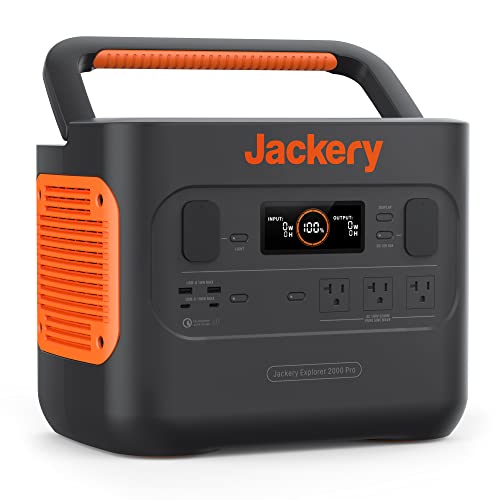
Jackery Explorer 2000 Pro Portable Power Station
Best for multi-day outage coverage
Jackery Explorer 2000 Pro Portable Power Station
Best for multi-day outage coverage
What we like
- The largest capacity on this list at 2160Wh, giving you the most runtime before you need to recharge.
- 4400W surge rating provides a massive safety margin for pump startup draw even on larger 3/4 HP motors.
- Solar charging compatible with up to 1400W of panel input, so you can recharge during an extended grid-down event.
- Proven field reliability with a very large user base and widely available support documentation.
What we don't
- No dedicated UPS mode means there is a brief delay when switching from grid to battery if the power drops suddenly.
- Recharges in 2 hours versus 1 hour for the EcoFlow, which matters if the grid flickers back on mid-storm.
- Heavier and bulkier than the 1kWh options at approximately 43 lbs.
The Explorer 2000 Pro wins on raw capacity — 2160Wh means a typical 400W sump pump gets roughly 4.5 hours of continuous runtime, and most pumps cycle on and off, so real-world coverage extends well beyond that. The 4400W surge rating is the highest on this list and handles even larger commercial-grade pumps without hesitation.
Choose this one if your outages routinely stretch past 6 hours or if you plan to power other things alongside the pump during a storm event. If instant switchover is your top concern, the EcoFlow Delta 2 Max is the better fit.
BLUETTI AC200P Portable Power Station
Best value for high-output whole-home backup
BLUETTI AC200P Portable Power Station
Best value for high-output whole-home backup
What we like
- Six AC outlets let you run the sump pump plus other essentials like a refrigerator or phone chargers simultaneously.
- 4800W surge rating is the highest peak on this list, making it the most forgiving for motor startup spikes.
- 2000Wh capacity at this price point represents the best watt-hour-per-dollar value among all five picks.
- Dual input charging from AC and solar simultaneously cuts full recharge to about 2.5 hours when both are available.
What we don't
- Older LiFePO4 cell chemistry with a lower cycle count (3500) compared to newer units, though still excellent longevity.
- No app-based UPS mode or automatic switchover — requires manual awareness of power status.
- Bulkier at 60 lbs than the newer generation units, which matters if basement access is tight.
The AC200P delivers 2000Wh and a 4800W surge for consistently less money than comparable units — and six AC outlets means you're not choosing between the sump pump and the refrigerator during an outage. For the price, the watt-hour capacity is nearly unmatched.
This is the right call if you want serious backup coverage on a tighter budget and don't need the instant UPS switchover the EcoFlow provides. If weight and portability matter, look at the Anker SOLIX C1000 instead.
Anker SOLIX C1000 Portable Power Station
Best for fast-charge short outage coverage
Anker SOLIX C1000 Portable Power Station
Best for fast-charge short outage coverage
What we like
- UPS mode with under 10ms switchover keeps the pump running through the exact moment the grid drops.
- Recharges fully in under an hour, making it the fastest to recover between outage events on this list.
- At around 27 lbs it's the most portable full-output option here — easy to relocate around the basement.
- SurgePad technology handles the 2400W startup spike cleanly on most 1/3 and 1/2 HP residential pumps.
What we don't
- 1056Wh capacity limits continuous pump runtime to roughly 2–2.5 hours, which may not be enough for long storms.
- 1800W continuous output leaves less headroom than the 2000W-plus options if you're running other devices alongside the pump.
- Not expandable, so you can't add battery capacity if your coverage needs grow.
The SOLIX C1000 is the fastest-charging station on this list and the most portable with UPS capability — 58 minutes from dead to full means if grid power returns briefly mid-storm, you can top off and be ready for the next outage window. The under-10ms UPS switchover is identical in quality to the EcoFlow at roughly $300 less.
This is your pick if your outages are typically 2–3 hours and you value portability over raw runtime. For all-night coverage or multi-device use, step up to the EcoFlow Delta 2 Max.
Jackery Explorer 1000 v2 Portable Power Station
Best budget entry for light-duty sump coverage
Jackery Explorer 1000 v2 Portable Power Station
Best budget entry for light-duty sump coverage
What we like
- 1500W continuous output handles most standard 1/3 HP residential sump pumps with the 3000W surge covering startup spikes.
- At 23.2 lbs it is the lightest option on this list and genuinely easy to carry between floors or storage locations.
- LiFePO4 battery with 4000 cycle rating matches or exceeds pricier units for long-term durability.
- 1.7-hour AC recharge is nearly as fast as the Anker for a significantly lower price point.
What we don't
- 1500W continuous output is the tightest margin on this list — a 3/4 HP pump drawing 800W running watts leaves little headroom.
- No UPS mode means a brief delay when switching to battery, which could cause the pump to miss a startup cycle.
- 1070Wh gives you roughly 2 hours of continuous runtime on a typical pump — adequate for short outages, borderline for longer ones.
The Explorer 1000 v2 is the only station under $500 on this list that can reliably run a standard residential sump pump — 1500W continuous with a 3000W surge and a real LiFePO4 battery that won't degrade after 50 cycles. For a typical 1/3 HP pump in a low-water-table basement, this covers you through most storm events.
Choose this if you have a smaller pump, live somewhere storms are brief, and want real protection without a four-figure price tag. Anyone with a 1/2 HP or larger pump, a finished basement, or storm outages that stretch past 3 hours should step up to the Anker SOLIX C1000.
What to Look For
Look for continuous AC output of at least 1500W and a surge rating of 3000W or higher. Most residential sump pumps run on 300–800W continuously but spike hard on startup, and an undersized inverter will trip or shut down at the worst moment.
Pure sine wave output is non-negotiable for sump pumps with capacitor-start motors. Modified sine wave stations exist at lower prices but can overheat pump motors or cause erratic cycling — avoid them entirely for this use case.
Capacity in watt-hours determines how long you can ride out an outage. A 1000Wh station running a 400W pump continuously lasts about 2 hours; a 2000Wh station doubles that, and most storms don't need more than 4–6 hours of coverage.
Who Should Skip This
If your basement floods heavily and continuously — not just during storm events — a portable power station is the wrong solution; you need a dedicated battery backup sump system with auto-transfer and a larger battery bank. These stations are also overkill if you only need to cover a 30-minute pump cycle — a basic UPS unit handles that for far less money.
And if you're in a region with outages measured in days rather than hours, look at expandable stations with add-on battery packs.
What the Community Actually Uses
On r/Plumbing and r/homeowners, the sump pump backup question comes up every spring. The consistent advice from experienced members: don't cheap out on output wattage, always verify your pump motor type before buying, and keep the station charged year-round rather than scrambling before a storm.
The solar charging angle is popular with r/preppers members who treat this as part of a broader grid-independence setup.
Quick Picks — In Case You've Already Decided
Frequently Asked Questions
Will a portable power station actually run my sump pump?
Yes, as long as the station outputs pure sine wave AC at or above your pump's wattage rating. Check your pump's label for running watts, then confirm the station's continuous AC output exceeds that. All five stations on this list meet that standard for typical residential pumps.
How long will a power station run my sump pump?
Divide the station's watt-hour capacity by your pump's running wattage and multiply by 0.85 to account for inverter efficiency. A 2000Wh station running a 400W pump gives you roughly 4 hours of continuous runtime — though most pumps cycle on and off, which extends that significantly.
Do I need pure sine wave output for a sump pump?
Yes. Sump pumps use induction motors that require clean AC power. Modified sine wave output can cause the motor to run hot, trip thermal overload protectors, or fail to start under load. Every station on this list uses pure sine wave inverters.
Can I keep the power station plugged in all the time?
Most modern LiFePO4 stations support pass-through charging and are designed to stay plugged in. The EcoFlow Delta 2 Max and Anker SOLIX C1000 both have UPS modes specifically built for this. Check your specific station's manual — some older lithium-ion units recommend cycling the battery periodically.
What size power station do I need for a sump pump?
For most residential 1/3 to 1/2 HP sump pumps drawing 300–800W, a 1000Wh station with 1500W continuous output covers a typical 4–6 hour storm outage. If your area sees extended outages or you have a larger pump, step up to a 2000Wh unit with 2400W output.
Buying Guide
Your sump pump draws between 300 and 800 watts continuously but spikes two to three times that on startup. You need a station with pure sine wave output, at least 1500W continuous, and enough capacity to run several cycles through a long outage.
LiFePO4 chemistry charges faster and holds up better in a damp basement than lithium-ion.