The RV power station market has finally caught up — you don't have to choose between enough capacity and enough outlets. Five picks here range from 1024Wh to 2048Wh and $500 to $1,800, covering weekend rigs to full-time setups with dedicated 30A RV ports.
| Photo |
Top Pick

|
Versatile
|
Budget
|
Best Value

|
Best for Reliability

|
|---|---|---|---|---|---|
| Product | BLUETTI AC200L Portable Power Station | Jackery Explorer 2000 Pro Portable Power Station | Goal Zero Yeti 1500 Portable Power Station (6th Gen) | EF EcoFlow DELTA 2 Portable Power Station | Anker SOLIX C1000 Portable Power Station |
| Rv port | ✓ | ✗ | ✗ | ✗ | ✗ |
| Capacity | 2048Wh | 2160Wh | 1505Wh | 1024Wh | 1056Wh |
| Ac output | 2400W (3600W surge) | 2200W (peak 4400W) | 2000W (peak 3500W) | 1800W (2700W surge) | 1800W (2400W surge) |
| Expandable | ✓ | ✗ | ✗ | ✓ | ✗ |
| Buy Now | Check Price → | Check Price → | Check Price → | Check Price → | Check Price → |
Quick Tips
Run your fridge wattage for 24 hours to calculate your true baseline draw before buying — most RV fridges pull 30-60W continuously.
Look for 30A TT-30 RV ports on higher-capacity units — they charge your RV house battery directly without an adapter.
LiFePO4 chemistry handles the heat inside an RV far better than older lithium-ion — check battery type before you buy.
Solar input wattage caps matter: a 2kWh station with only 200W solar input will take all day to recover on the road.
BLUETTI AC200L Portable Power Station
Best for full-time RV setups with a dedicated 30A shore power port
BLUETTI AC200L Portable Power Station
Best for full-time RV setups with a dedicated 30A shore power port
What we like
- Built-in 30A TT-30 RV port feeds your rig's shore power inlet directly without adapters.
- Expandable to 8192Wh with add-on batteries — the only pick here that scales to full-time living demands.
- 2400W continuous output with 3600W power-lifting handles compressor fridges and microwaves simultaneously.
- LiFePO4 chemistry rated to 3500+ cycles with stable thermal performance in hot RV compartments.
What we don't
- Heaviest unit in this roundup at around 61 lbs — not a one-handed carry.
- Premium pricing puts it above the budget of weekend-only RV users.
- App connectivity has drawn mixed reviews for reliability versus the hardware itself.
The AC200L is the only unit here built with RV infrastructure in mind — the 30A TT-30 port means you plug directly into your rig's shore power inlet and power everything through your existing breaker panel, exactly the way a campsite hookup would. This is the pick for Class B vans and truck campers doing extended trips where capacity and scalability matter more than portability.
If you're weekend-only and just need to charge devices and run a small fridge, this is overkill.
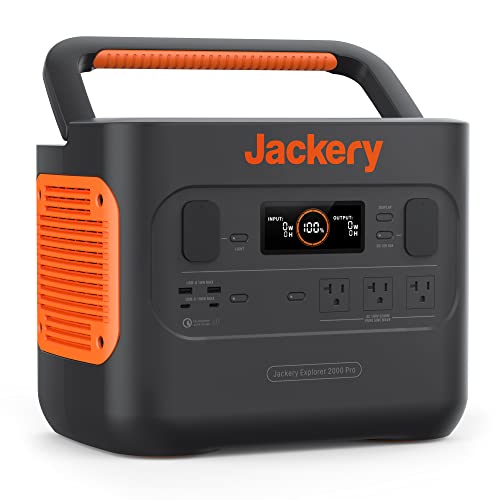
Jackery Explorer 2000 Pro Portable Power Station
Best for solar-charging RVers who want fast recovery time
Jackery Explorer 2000 Pro Portable Power Station
Best for solar-charging RVers who want fast recovery time
What we like
- Charges fully in 2 hours via AC wall outlet — fastest wall-charge recovery in this roundup.
- Compatible with up to 6 SolarSaga 200W panels, reaching a full solar recharge in 2.5 hours.
- 2160Wh capacity handles two full nights of typical RV device and fridge loads before needing recharge.
- Under 53dB fan noise means it runs quietly in a small camper van without disrupting sleep.
What we don't
- No dedicated 30A RV port — requires adapter for shore power inlet use.
- Cylindrical cell chemistry runs warmer than LFP alternatives in confined, hot spaces.
- At 43 lbs it's manageable but not light for frequent in-and-out of a vehicle.
The Explorer 2000 Pro earns its place through sheer recharge speed — 2 hours wall-to-full means you can top it off at a campsite laundry or visitor center and head back to boondocking the same afternoon. No other unit here recovers that fast.
This is the right pick for solar-forward RVers who have panels on the roof and want a station that keeps pace with them. Skip it if you need a native 30A RV port — the BLUETTI AC200L has that covered.
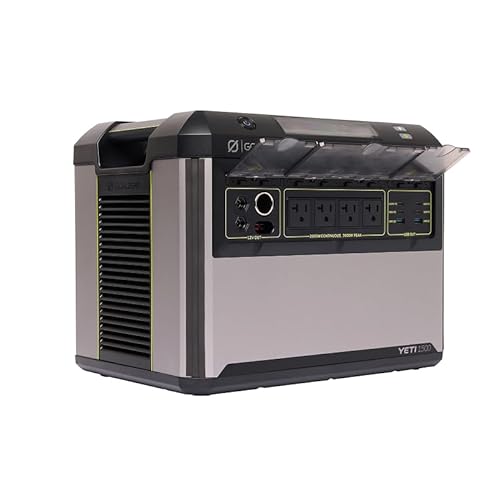
Goal Zero Yeti 1500 Portable Power Station (6th Gen)
Best for overlanders and off-road RVers who need weatherproof durability
Goal Zero Yeti 1500 Portable Power Station (6th Gen)
Best for overlanders and off-road RVers who need weatherproof durability
What we like
- IPX4 weather-resistant rating with aluminum construction handles rain, dust, and trail vibration that plastic-bodied units can't.
- 10x faster recharging than previous Goal Zero models — 0-80% from AC in under an hour.
- Port shields protect inputs from mud and moisture during rough-road transport.
- 4000-cycle LiFePO4 battery rated for 10+ years of regular use.
What we don't
- 1505Wh capacity falls short for multi-night trips running a compressor fridge continuously.
- No 30A RV shore power port — better suited to powering individual devices than the whole rig.
- Higher price-per-watt than the EcoFlow or Anker alternatives.
The Yeti 1500 is built differently than every other unit here — aluminum housing, rubber bumpers, IPX4 waterproofing, and vibration testing that actually accounts for bumpy roads. If your RV goes off-pavement, that matters.
This is the pick for overlanding rigs and 4WD campers where build quality outranks raw capacity. If your campsite is always flat and paved, the BLUETTI gives you more watt-hours per dollar.
EF EcoFlow DELTA 2 Portable Power Station
Best for weekend RVers who want fast charging without the bulk
EF EcoFlow DELTA 2 Portable Power Station
Best for weekend RVers who want fast charging without the bulk
What we like
- 0-80% from AC in 50 minutes via X-Stream technology — the fastest charge in the sub-$700 range.
- Expandable to 2048Wh or 3040Wh with EcoFlow extra batteries — room to grow without replacing the unit.
- LiFePO4 battery rated to 3000+ cycles for long-term value at its price point.
- X-Boost technology lets it run devices up to 2200W despite a 1800W inverter output.
What we don't
- 1024Wh base capacity is tight for anything beyond one night running a fridge and charging devices.
- No dedicated RV port — generic AC outlets only.
- Expansion batteries add significant cost, reducing the value advantage quickly.
The DELTA 2 wins on charge speed at its price — 50 minutes to 80% means it's usable again before you've finished dinner. For weekend RV trips where you're plugging in every other day, that cadence works perfectly.
This is the entry point for RVers who want to test portable power before committing to a larger system. If you find yourself consistently draining it overnight, the expandable battery path keeps you from starting over.
Anker SOLIX C1000 Portable Power Station
Best compact option for van life and smaller RV footprints
Anker SOLIX C1000 Portable Power Station
Best compact option for van life and smaller RV footprints
What we like
- 15% smaller than comparable 1kWh units — fits in van and Class B storage compartments where larger stations don't.
- Full charge in 58 minutes via AC — among the fastest wall recharge times at this capacity.
- SurgePad technology handles up to 2400W surge, covering compressor fridges and power tool startups.
- 600W solar input supports a meaningful roof panel array for boondocking recovery.
What we don't
- No expansion battery option — capacity is fixed at 1056Wh.
- 1056Wh is borderline for full-night fridge plus device charging without a solar top-up.
- No 30A RV port — relies on standard AC outlets only.
The SOLIX C1000 makes a case on size and speed — it's physically smaller than units with similar capacity, charges in under an hour, and handles surge loads that most compact stations choke on. For a cargo van or small Class B with tight storage, that physical footprint is the deciding factor.
Skip it if you need more than one night of power without recharging or if your rig runs a lot of high-draw appliances. The BLUETTI AC200L handles both of those scenarios better.
What to Look For
Capacity is the starting point, but it misleads people. A 2000Wh rating only translates to real power if the inverter can sustain your peak load — a 12V compressor fridge, CPAP, and phone charging simultaneously can spike past 400W.
RV-specific outputs separate purpose-built units from repurposed camping gear. A 30A TT-30 port or DC charging output lets you feed your RV's house batteries directly — something a generic USB-heavy station can't do.
Solar recharge speed is what keeps you off shore power. A unit that accepts 500W+ of solar input can recover overnight from a panel array on your roof, while a 200W-max station will always be chasing its own deficit.
Who Should Skip This
If you're running a full Class A with a residential fridge, roof AC, and a microwave, no portable power station is the right tool — you need a fixed lithium house battery bank at 200Ah or more. These units are built for Class B and C rigs, camper vans, and truck campers where a portable solution that can be moved, charged at home, and swapped between trips makes actual sense.
What the Community Actually Uses
On r/vandwellers and r/fulltiming, the power station conversation comes up every week — and the consensus is consistent: capacity gets oversold and solar input gets ignored. Members regularly post full discharge logs and real-world amp-hour draws from their actual setups.
If you're unsure what size you need, post your fridge model and sleeping situation there before buying.
Quick Picks — In Case You've Already Decided
Frequently Asked Questions
Can a portable power station run an RV air conditioner?
Most rooftop RV ACs require 1400-1800W to start and 900-1300W to run continuously. A 2000Wh station can run a small soft-start AC unit for 1-2 hours, but it's not a practical all-night solution without solar recharging simultaneously.
What does a 30A RV port actually do on a power station?
It outputs a TT-30 connection — the standard 30-amp shore power plug — allowing you to plug directly into your RV's shore power inlet. This powers everything through your RV's breaker panel exactly like a campsite hookup would.
How long will a 2000Wh power station run a 12V RV fridge?
A typical 12V compressor fridge draws 30-60W on average. At 45W average, a 2000Wh unit provides roughly 35-37 hours of run time — about 1.5 days before needing a recharge.
Is LiFePO4 worth the premium over standard lithium in an RV?
Yes, for RV use specifically. LiFePO4 handles heat better, is safer in enclosed spaces, and offers 2000-4000 cycles versus 500 cycles on older lithium-ion. The long-term cost per cycle is significantly lower.
Can I charge a portable power station while driving?
Yes — most units accept 12V car charging via a cigarette lighter or DC cable. Output is usually slow at 100-200W, but pairing with a high-amp alternator charger accessory can push that to 400-600W for meaningful in-transit charging.
Buying Guide
You need to match capacity to your actual load — not the marketing number. Add up your fridge, CPAP, lighting, and device charging in watts, then multiply by hours.
If that number clears 1000Wh nightly, skip the compact options. RV-specific ports and solar input matter more than raw output wattage.