A quality portable power station runs a 12V compressor fridge for 24 to 48 hours without touching a solar panel or engine. The five picks below are all verified on Amazon, all use LiFePO4 chemistry for 3,000-plus cycles, and the top one holds 1,024Wh for under $600.
| Photo |
Top Pick

|
Versatile

|
Budget

|
Best Value
|
Best for Reliability

|
|---|---|---|---|---|---|
| Product | EF EcoFlow DELTA 2 Portable Power Station | Jackery Explorer 1000 Pro Portable Power Station | Anker SOLIX C1000 Portable Power Station | BLUETTI AC180 Portable Power Station | EF EcoFlow DELTA Max 2000 Portable Power Station |
| Capacity | 1,024Wh | 1,002Wh | 1,056Wh | 1,152Wh | 2,016Wh |
| Ac output | 1,800W (2,700W surge) | 1,000W (2,000W surge) | 1,800W (2,400W surge) | 1,800W (2,700W surge) | 2,400W (5,000W surge) |
| Charge time | 0-80% in 50 min | Full in 1.8 hrs from AC | 0-80% in 43 min | 0-80% in 45 min | Full in 1.8 hrs from AC |
| Battery type | LiFePO4 | NMC Lithium | LiFePO4 | LiFePO4 | NMC Lithium |
| Buy Now | Check Price → | Check Price → | Check Price → | Check Price → | Check Price → |
Quick Tips
Check your fridge's startup surge wattage, not just running watts — compressor fridges can spike 3x at startup, so a 45W fridge may need 150W peak output minimum.
Pre-cool your fridge on shore power before switching to the power station — a cold fridge uses 30-50% less energy than one cooling from ambient temp.
Enable eco or low-power mode on your power station when the fridge is the only load — most units cut fan noise and parasitic draw significantly in this mode.
A 12V DC output port runs compressor fridges more efficiently than the AC inverter — if your fridge supports it, use the DC connection and gain roughly 10-15% more runtime.
EF EcoFlow DELTA 2 Portable Power Station
Best for all-around fridge duty on overnight and weekend trips
EF EcoFlow DELTA 2 Portable Power Station
Best for all-around fridge duty on overnight and weekend trips
What we like
- LiFePO4 battery rated for 3,000-plus cycles means years of daily fridge use before noticeable capacity drop.
- X-Stream fast charging hits 80% in 50 minutes from a wall outlet — fastest recharge in its class at this price.
- X-Boost technology powers appliances up to 2,200W even though the inverter is rated 1,800W, handling surge-heavy compressor starts.
- 500W solar input lets you top it off during the day while the fridge runs simultaneously.
What we don't
- At around 27 lbs, it is heavier than some 1kWh competitors.
- App is required to unlock some advanced charging features.
- Fan runs audibly at higher load levels, which can be noticeable in a quiet cabin.
The DELTA 2 is the rare power station where the fast-charging spec actually matters in the field — if you run your fridge overnight and kill it to 20%, a 50-minute wall charge before leaving camp gets you back to full before the drive home. This is the right pick if you're running a 40-50L compressor fridge for one to two nights and want the fastest recharge turnaround available under $600.
If you need 48-plus hours of runtime without any solar or recharge, step up to the Delta Max.
Jackery Explorer 1000 Pro Portable Power Station
Best for solar-charged overlanding setups
Jackery Explorer 1000 Pro Portable Power Station
Best for solar-charged overlanding setups
What we like
- 1.8-hour full AC charge is impressively fast for a 1kWh unit and reliable across temperature ranges.
- 800W combined input accepts both AC and solar simultaneously for the fastest possible recharge in camp.
- Quiet operation under light load makes it usable inside a tent or vehicle without noise issues.
- Established ecosystem of Jackery solar panels with plug-and-play compatibility and no adapter headaches.
What we don't
- NMC battery chemistry offers fewer cycles (roughly 1,000) than LFP alternatives at this price point.
- 1,000W AC output is lower than competitors and may struggle with high-surge appliances beyond a fridge.
- Heavier than the newer Jackery v2 lineup at over 25 lbs with a bulkier form factor.
The Explorer 1000 Pro earns its place in solar setups because the dual-input charging — pull from AC and solar at the same time — genuinely cuts recharge time in half versus single-source charging, which matters when you're camped somewhere with partial sun and a hookup. Choose this over the EcoFlow if you're already in the Jackery solar panel ecosystem or if you prioritize charging speed from mixed sources over raw battery cycle life.
Skip it if your main priority is longevity — the NMC chemistry just doesn't last as long under daily use.
Anker SOLIX C1000 Portable Power Station
Best for fast recharge off a wall outlet between trips
Anker SOLIX C1000 Portable Power Station
Best for fast recharge off a wall outlet between trips
What we like
- 43-minute 0-to-80% charge via UltraFast mode is the fastest recharge available in the 1kWh class.
- LiFePO4 chemistry with 3,000-plus cycle rating matches EcoFlow's longevity at a comparable price.
- SurgePad technology handles appliances up to 2,400W peak, covering virtually any compressor fridge startup draw.
- 15% smaller footprint than comparable 1kWh units makes it easier to fit in an overland rig or truck bed.
What we don't
- UltraFast charging requires the Anker app active on a smartphone to enable — annoying if you don't keep Bluetooth on.
- 600W solar input is solid but requires the app to configure properly for combined charging modes.
- Premium pricing puts it $100-200 above the EcoFlow DELTA 2 for roughly equivalent capacity.
The SOLIX C1000's 43-minute recharge is the headline spec, and it holds up — this is the unit you buy when you're running a fridge across a trip with intermittent access to a 120V outlet and you need to top off in under an hour before the next leg. It makes the most sense for people who camp near hookups every other night and need a unit that can fully recover fast.
If you're spending three or more nights fully off-grid, the extra charge speed matters less than solar input or raw capacity.
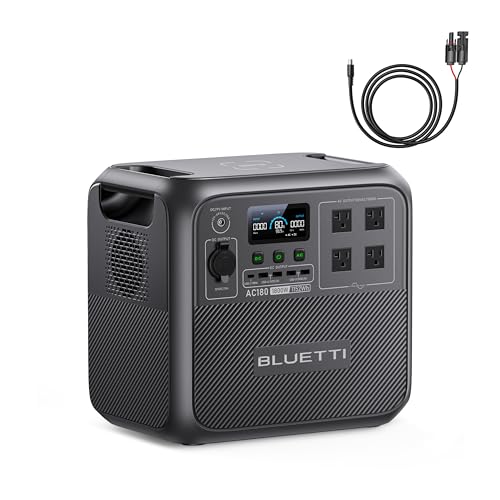
BLUETTI AC180 Portable Power Station
Best value for high-capacity fridge backup under $500
BLUETTI AC180 Portable Power Station
Best value for high-capacity fridge backup under $500
What we like
- 1,152Wh capacity is the largest in this price range, giving measurably longer fridge runtime per charge than 1kWh competitors.
- LiFePO4 battery rated for 3,500 cycles beats most competitors at this price point for long-term durability.
- Power Lifting mode boosts output to 2,700W for high-draw appliances without needing a more expensive unit.
- 1,440W flash charging via a single cable — no bulky adapter — charges fully in about one hour.
What we don't
- Heavier than the EcoFlow DELTA 2 at around 30 lbs, which matters for people loading and unloading frequently.
- The BLUETTI app interface is functional but less polished than EcoFlow's or Anker's equivalents.
- 500W solar input is solid but AC and solar cannot be combined as flexibly as on competing units.
The AC180 wins on straight math — more watt-hours per dollar than anything else in this lineup, with LFP battery chemistry that outlasts the standard lithium options at even higher price points. If you're running a 40L fridge and want the lowest cost-per-use over five years, this is the pick.
Choose the AC180 if budget is the primary filter and you're willing to carry an extra few pounds. Go with the EcoFlow DELTA 2 instead if fast recharging speed matters more than raw capacity.
EF EcoFlow DELTA Max 2000 Portable Power Station
Best for powering a full-size fridge or running multiple days off-grid
EF EcoFlow DELTA Max 2000 Portable Power Station
Best for powering a full-size fridge or running multiple days off-grid
What we like
- 2,016Wh capacity runs a 40L compressor fridge for 48-plus hours without any solar input or recharge.
- Expandable up to 6kWh with additional batteries, making it a genuine long-term off-grid power solution.
- 2,400W continuous AC output handles a full-size home refrigerator's running draw with headroom to spare.
- 800W solar input accepts up to four panels simultaneously for rapid daytime recharging in high-sun environments.
What we don't
- NMC battery chemistry means roughly 1,000 charge cycles before capacity noticeably degrades — less than LFP alternatives.
- At 48 lbs, it requires two people or a hand truck to move any real distance, limiting portability.
- Premium price is significant — only justified if you genuinely need 2kWh-plus of capacity on a regular basis.
The Delta Max 2000 exists for situations where the math on a 1kWh unit just doesn't work — running a full-size fridge, powering multiple appliances simultaneously, or going three or more nights fully off-grid without reliable solar. This is a basecamp unit, not a day-tripper.
Buy it if you're outfitting a truck camper or trailer with a dedicated power system and want headroom to run a fridge, lighting, and a CPAP without rationing. If you only need to keep drinks cold for the weekend, it's overkill.
What to Look For
Capacity is the first number that matters, but it's not the only one. A 1,000Wh station doesn't deliver 1,000Wh to your fridge — expect 85-90% efficiency through the inverter, which means real-world runtime is always shorter than the math suggests.
Battery chemistry separates weekend units from long-term investments. LiFePO4 (LFP) batteries deliver 3,000-plus cycles versus 500 for standard lithium-ion — if you're running a fridge on every trip, LFP pays for itself in years, not decades.
Output wattage protects your fridge motor. A pure sine wave inverter is non-negotiable for compressor refrigerators — modified sine wave output causes motors to run hot, shortens compressor life, and can void the fridge warranty.
Who Should Skip This
If your only use case is a weekend cooler trip once a year, a quality 12V cooler and a bag of ice is still the cheaper math. These power stations earn their cost when you're running a true compressor fridge across multiple nights, overlanding in heat, or eliminating the ice-and-drain routine for good.
What the Community Actually Uses
On r/overlanding and r/vandwellers, the fridge-and-power-station combo is the single most-discussed electrical topic. The consensus leans hard toward LFP chemistry and at least 1,000Wh for anything beyond a single overnight — members regularly post runtime logs showing 24-36 hours on a 40L compressor fridge from a 1kWh station under shade with light solar.
Quick Picks — In Case You've Already Decided
Frequently Asked Questions
How many watt-hours do I need to run a refrigerator overnight?
A compact 12V compressor fridge (35-50L) typically draws 30-60 watts while running and cycles on for 30-50% of the time. Budget 400-600Wh for a single overnight run, or 800-1,200Wh if you want to run through a full 24-hour period without recharging.
Can I run a full-size home refrigerator on a portable power station?
Yes, but you'll need a high-capacity unit — 2,000Wh or more. Full-size fridges draw 100-400 watts running and have large startup surges. A standard 1kWh portable station will run a full-size fridge for roughly 4-6 hours before depleting.
What is LiFePO4 and why does it matter for running a fridge?
LiFePO4 (lithium iron phosphate) is a battery chemistry that offers 3,000+ charge cycles versus 300-500 for standard lithium-ion. For fridge duty — where you're charging and discharging frequently — LFP batteries last significantly longer and maintain capacity more reliably over time.
Is it better to use the AC outlet or the 12V DC port to run a compressor fridge?
The 12V DC port is more efficient — it bypasses the inverter conversion loss and delivers 10-15% more runtime from the same battery. If your fridge has a 12V input and your power station has a regulated DC output, use that connection.
How do I recharge a portable power station while camping?
The fastest options are AC wall charging (if you have hookups), a DC-DC alternator charger from your vehicle, or solar panels. Most 1kWh stations accept 400-600W of solar input and can fully recharge from a 200W panel in 3-5 hours of good sun.
Buying Guide
You need at least 500Wh of usable capacity to run a compact compressor fridge overnight. Look for LiFePO4 chemistry — it lasts three times longer than standard lithium.
Match the output wattage to your fridge's startup surge, not its running draw. Pure sine wave AC output protects compressor motors from damage.