Any pellet grill running under 500W of continuous draw is fair game for a quality portable power station — the problem is most people buy underpowered units that fold during the ignition spike. The five options below all handle the 300-600W startup surge that kills cheap stations, with capacities from 1,024Wh to 2,048Wh to keep you smoking through a full brisket session.
| Photo |
Top Pick

|
Versatile

|
Budget

|
Best Value
|
Best for Reliability

|
|---|---|---|---|---|---|
| Product | EF EcoFlow DELTA 2 Portable Power Station | Jackery Explorer 1000 v2 Portable Power Station | Anker SOLIX C1000 Portable Power Station | Goal Zero Yeti 1500 Portable Power Station (6th Gen) | BLUETTI AC200L Portable Power Station |
| Battery | LiFePO4 / 3,000 cycles | LiFePO4 / 4,000 cycles | LiFePO4 / 3,000 cycles | LiFePO4 / 4,000 cycles | LiFePO4 / 3,500 cycles |
| Capacity | 1,024Wh | 1,070Wh | 1,056Wh | 1,505Wh | 2,048Wh |
| Recharge | 0-80% in 50 min (AC) | 0-100% in 1.7 hr (AC) | 0-80% in 43 min (AC) | 0-80% under 1 hr (AC) | 0-80% in 45 min (AC) |
| Ac output | 1,800W (2,700W surge) | 1,500W (3,000W surge) | 1,800W (2,400W surge) | 2,000W (3,600W surge) | 2,400W (3,600W surge) |
| Buy Now | Check Price → | Check Price → | Check Price → | Check Price → | Check Price → |
Quick Tips
Check your grill's ignition surge wattage in the manual — most pellet grills spike to 400-600W at startup before settling to 200-350W steady state.
Use your power station's eco mode only after the grill is fully up to temp — eco mode can cut power mid-ignition and trip a fault on some controllers.
Pair a 200W solar panel with any station on this list to extend a 6-hour cook indefinitely in direct sun, offsetting the grill's steady draw almost watt-for-watt.
Let the power station sit in shade during the cook — heat degrades lithium discharge efficiency, and a station baking at 95°F loses measurable runtime.
EcoFlow DELTA 2 Portable Power Station
Best for all-day pellet grill cooks with fast recharge
EcoFlow DELTA 2 Portable Power Station
Best for all-day pellet grill cooks with fast recharge
What we like
- 1,800W continuous output handles pellet grill ignition spikes without fault codes.
- Pure sine wave inverter protects digital PID controllers on all major grill brands.
- 50-minute 0-80% AC recharge means you can top it off between cook sessions the same day.
- App control lets you monitor state of charge while the grill is running unattended.
What we don't
- 1,024Wh limits you to roughly 4-5 hours on a 200W steady draw — not enough for an overnight brisket without solar.
- Fan noise is audible at high load, which matters if you are nearby in a quiet campsite.
- Price fluctuates significantly — buy during sales to hit the lower end of the range.
The DELTA 2 is the most common power station people end up with after trying something underpowered first — the 1,800W continuous output clears the ignition surge of every mainstream pellet grill on the market without breaking a sweat, and the LFP battery means you are not babying it through 3,000 cooks. This is the right pick if you run cooks under 6 hours and want a station that also pulls double duty charging cameras, lights, and a fridge at the same campsite.
If you are planning 10+ hour overnight smokes, you will want to pair it with a 200W solar panel or step up in capacity.
Jackery Explorer 1000 v2 Portable Power Station
Best lightweight option for tailgate and truck camp cooks
Jackery Explorer 1000 v2 Portable Power Station
Best lightweight option for tailgate and truck camp cooks
What we like
- 23.8 lbs is meaningfully lighter than competing 1,000Wh stations — easier to move in and out of a truck bed.
- 3,000W surge handles the ignition spike of any pellet grill currently on the consumer market.
- 4,000-cycle LFP battery means a decade of weekend use before meaningful capacity loss.
- Verified by Jackery and users to run pellet smokers — confirmed compatible use case from real reviews.
What we don't
- 1,500W continuous is lower than the EcoFlow DELTA 2 — fine for most grills but check your specific model's steady draw.
- Solar charging is Jackery-panel-only, which limits flexibility if you already own third-party panels.
- App requires enabling emergency charge mode manually each time for the 1-hour fast charge.
The Explorer 1000 v2 is what you bring when the power station has to ride in a packed truck bed and still run a pellet smoker for an afternoon tailgate or hunting camp cook. It is lighter and more packable than anything else at this capacity, and the 3,000W surge clears the ignition spike on every mid-size grill we found specs for.
Pick this over the EcoFlow if portability is your primary constraint and your cooks stay under 5-6 hours. Choose something else if you run a large-format grill over 500W steady or want to do overnight smokes without solar backup.
Anker SOLIX C1000 Portable Power Station
Best for fast recharge between back-to-back cook days
Anker SOLIX C1000 Portable Power Station
Best for fast recharge between back-to-back cook days
What we like
- 43-minute 0-80% recharge is the fastest in this capacity class — fully recoverable between a morning and afternoon cook.
- 15% smaller than comparable 1kWh stations, making camp packing meaningfully less annoying.
- 1,800W continuous output and pure sine wave inverter handle every pellet grill in this guide.
- Up to 600W solar input means a 200W panel gets you to 100% in under 2 hours at the campsite.
What we don't
- UltraFast charging requires the Anker app and a smartphone on-site to enable — not fully standalone.
- Expansion battery adds significant cost if you decide you need more capacity later.
- Premium pricing puts it above the EcoFlow DELTA 2 at similar real-world capacity.
The SOLIX C1000 earns its spot here because of one spec: 43-minute 0-80% recharge. If you are cooking two sessions in a day — morning brisket wrap, afternoon spare ribs — you can fully recover this station on a 30-amp shore hookup or fast charger between cooks while everything resets.
This is the pick for camp cooks who treat the power station as infrastructure, not just a battery. If you only need one cook per outing and recharge speed is irrelevant, the EcoFlow DELTA 2 hits the same output numbers for less money.
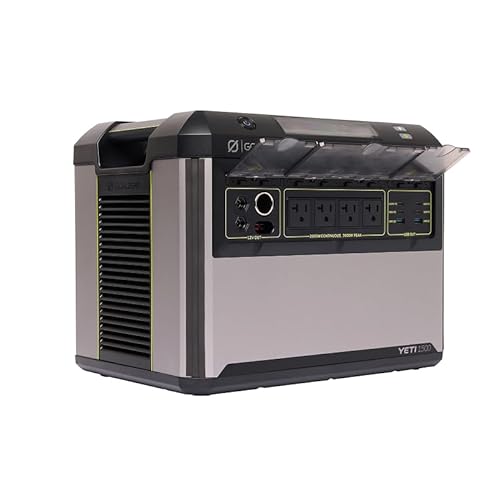
Goal Zero Yeti 1500 Portable Power Station (6th Gen)
Best for rugged outdoor use and all-night smokes
Goal Zero Yeti 1500 Portable Power Station (6th Gen)
Best for rugged outdoor use and all-night smokes
What we like
- 1,505Wh gives you 6-8 hours of cook time on a 200W steady draw — enough for most full brisket cooks.
- 2,000W continuous and 3,600W surge handles even large-format pellet grills that spike higher at ignition.
- IPX4 weather-resistant aluminum housing with port shields — built to sit outside in camp conditions.
- 4,000-cycle battery at 10+ year daily use lifespan from a brand with deep overlanding community trust.
What we don't
- Heavier and bulkier than 1,000Wh stations — not the choice if you are weight-constrained.
- Higher price than EcoFlow and Jackery options at similar or lower capacity.
- Solar recharge requires Goal Zero panels for best results, adding to total system cost.
The Yeti 1500 is the station you buy when you want to stop thinking about it — 1,505Wh covers an 8-hour cook with margin left over, the aluminum housing does not care about rain or grease splash, and the 3,600W surge handles any pellet grill currently sold at retail. Choose this if you run long smokes at established base camps and want a station that also connects to Goal Zero ecosystem gear.
If you are weight-sensitive or cooking sessions stay under 5 hours, the EcoFlow DELTA 2 delivers similar power at less cost and weight.
BLUETTI AC200L Portable Power Station
Best high-capacity option for overnight brisket cooks
BLUETTI AC200L Portable Power Station
Best high-capacity option for overnight brisket cooks
What we like
- 2,048Wh of capacity runs a 200W pellet grill for 9-10 hours before hitting 20% reserve — full brisket capable.
- 2,400W continuous output is the highest on this list and handles large-format grills with ease.
- Expandable to 8,192Wh with external batteries — the only station here that can grow with your setup.
- 30A RV port and 48V DC output make this a full camp power hub beyond just the grill.
What we don't
- Heaviest and largest unit on this list — meaningful for anyone loading it in and out of a vehicle solo.
- Overkill for cooks under 6 hours — you are paying for capacity you will not use on most sessions.
- At max expansion cost, this becomes a serious financial commitment for a camp cook setup.
The AC200L is the only station on this list you buy specifically because you refuse to babysit a battery percentage during a 12-hour brisket cook. At 2,048Wh you have real margin — enough to run the grill all night and still have charge left for a camp fridge in the morning.
This is not the right pick for weekend tailgaters or truck campers who run 4-5 hour cooks. It is built for people who do serious long-cook BBQ away from outlets and want one station that handles everything without compromise.
What to Look For
Inverter wattage is the first number to check — your station needs at least 1,500W continuous output, not peak. Most pellet grills run 300-500W steady but hit 600W at ignition, and a station with a low continuous rating will fault out right when the fire rod kicks on.
Capacity in watt-hours tells you how long you can cook. A 1,024Wh station gives you roughly 4-5 hours on a 200W steady draw with conversion losses factored in — enough for ribs, not enough for a full brisket.
Step up to 1,500-2,000Wh if you're planning cooks over 8 hours. Pure sine wave output is non-negotiable for any pellet grill with a digital controller.
Modified sine wave stations can corrupt the signal to the controller board and throw error codes — or cause permanent damage over repeated use.
Who Should Skip This
If you're running a full-size pellet grill like a Traeger Pro 780 or Pit Boss 1150, verify the peak draw is under 1,500W before buying any station on this list — some larger grills spike higher. Budget power stations under 700Wh are not listed here for a reason: they will not reliably complete a long cook.
If your cook sessions run 12+ hours regularly, consider a propane generator instead — battery capacity at that duration becomes expensive.
What the Community Actually Uses
On r/pelletgrills, the power station question comes up every few months and the consensus is clear: 1,000Wh minimum, pure sine wave, and name-brand lithium cells. The thread on running a Traeger from a Jackery has over 300 comments and most people report no issues on cooks under 6 hours.
Quick Picks — In Case You've Already Decided
Frequently Asked Questions
Can a 1,000Wh power station run a pellet grill for a full cook?
For most mid-size pellet grills drawing 200-300W at steady temp, 1,000Wh gets you 4-5 hours of cook time after conversion losses. That covers ribs or a pork shoulder but falls short for a full 12-hour brisket — step up to 1,500-2,000Wh for overnight cooks.
Does my pellet grill need a pure sine wave power station?
Yes. Every pellet grill with a digital PID controller requires clean sine wave AC power. Modified sine wave stations can interfere with the controller signal, trigger fault codes, or in worst cases damage the board over repeated use.
What wattage do pellet grills actually use?
Most mid-size pellet grills (Traeger 575, Camp Chef Woodwind, Pit Boss 700) draw 300-400W at startup and settle to 150-300W during steady cooking. Larger grills can spike higher — always check your manual's rated wattage before buying.
Can I recharge the power station while running the grill?
With a solar panel, yes — a 200W panel in full sun offsets most of a pellet grill's steady draw, extending your cook time significantly. Charging from your truck while cooking is also an option on stations with car input.
Is it safe to run a power station near a pellet grill?
Keep at least 6-10 feet between the station and the grill, and never place it in direct line of smoke or grease splatter. Heat degrades lithium battery performance and can void warranties — shade the station whenever possible.
Buying Guide
Your pellet grill draws roughly 300-500W at steady temp and up to 600W at ignition. You need a station with at least 1,000Wh of capacity for a 4-6 hour cook and an inverter rated for 1,500W continuous minimum.
Pure sine wave output is non-negotiable — modified sine risks your grill's controller board.