The right portable power station makes a blackout a minor inconvenience instead of a crisis. These five units cover everything from a 768Wh overnight backup to a 2048Wh system that runs your fridge, router, and CPAP for two days straight.
| Photo |
Top Pick

|
Versatile
|
Budget
|
Best Value

|
Best for Reliability

|
|---|---|---|---|---|---|
| Product | EcoFlow Delta 2 Max Portable Power Station | BLUETTI AC180 Portable Power Station | Goal Zero Yeti 1500 Portable Power Station (6th Gen) | Jackery Explorer 1000 Pro Portable Power Station | Anker SOLIX C800 Portable Power Station |
| Capacity | 2048Wh | 1152Wh | 1505Wh | 1002Wh | 768Wh |
| Ac output | 2400W (3400W X-Boost) | 1800W (2700W peak) | 2000W (surge capable) | 1000W (2000W peak) | 1200W (1600W peak) |
| Charge time | 0-80% in 43 min | 0-80% in 45 min | 0-80% in under 1 hr | Full charge in 1.8 hrs | Full charge in 58 min |
| Battery type | LiFePO4 | LiFePO4 | LiFePO4 | Lithium NMC | LiFePO4 |
| Buy Now | Check Price → | Check Price → | Check Price → | Check Price → | Check Price → |
Quick Tips
Calculate your minimum load first: fridge (~150W), router (~20W), phone charger (~20W), and CPAP (~30W) total roughly 220W continuous — size accordingly.
Charge your power station to 80% after every use; LiFePO4 cells last significantly longer when not stored at 100% for extended periods.
If you lose power regularly, look for a unit with UPS mode — 20ms switchover time keeps sensitive electronics like desktop computers from restarting.
Solar input matters most if outages last more than 24 hours — prioritize units with 500W+ solar input so you can recharge fully in an afternoon with two panels.
EF EcoFlow Portable Power Station DELTA 2 Max
Best for whole-home essential backup during extended outages
EF EcoFlow Portable Power Station DELTA 2 Max
Best for whole-home essential backup during extended outages
What we like
- X-Boost mode pushes output to 3400W, handling high-draw appliances that would trip a standard 2400W inverter.
- LFP battery is rated for 3000 cycles to 80% capacity — 6x more than the industry average at this price point.
- Expandable to 6kWh by adding up to two extra batteries, so you can scale it as your needs grow.
- 20ms UPS switchover keeps computers and sensitive equipment from ever noticing the power went out.
What we don't
- At 50+ lbs it isn't truly portable — once you set it down in your house, it mostly stays there.
- The companion app is required to access some charging modes, which adds a dependency on your phone.
- Premium pricing puts it out of reach for buyers who only need basic overnight backup.
If your mental checklist during a blackout includes the fridge, the router, a CPAP, and anything else that actually runs the household — this is the unit built around that exact scenario. The 2048Wh capacity paired with X-Boost mode means you're not doing math on what you can and can't plug in.
This is the pick for homeowners who lose power at least a couple of times a year and want a unit that handles it without compromise. If you only need to charge phones and keep the lights on, the capacity here is overkill and you'll pay for it.
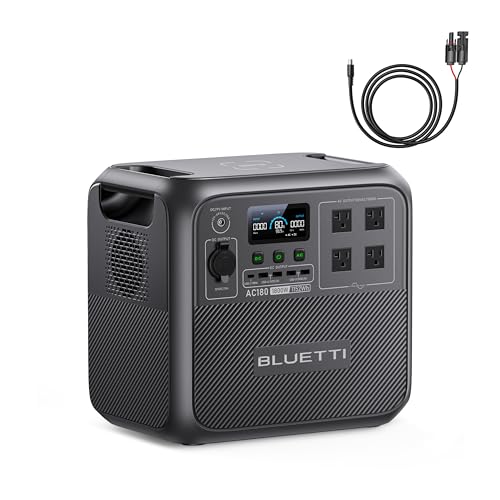
BLUETTI AC180 Portable Power Station
Best for renters and apartment dwellers who need flexible backup
BLUETTI AC180 Portable Power Station
Best for renters and apartment dwellers who need flexible backup
What we like
- Power Lifting mode pushes output to 2700W, letting it handle a coffee maker or microwave that exceeds the base wattage.
- At roughly 35 lbs it moves easily between rooms or out to a tailgate, unlike heavier 2000Wh-class units.
- 500W solar input means a pair of 200W panels can top it off in an afternoon with decent sun.
- Five-year warranty from a brand with a strong US customer service track record.
What we don't
- 1152Wh capacity means you're making real choices about what to run simultaneously during a long outage.
- The display is smaller and harder to read at a glance compared to EcoFlow's interface.
- Expansion battery compatibility adds cost quickly if you decide you need more capacity later.
The AC180 hits a sweet spot that most power stations miss: enough capacity to handle a real outage, a form factor you'll actually move around, and a price that doesn't require a long internal debate. The 1800W output covers your fridge and router simultaneously without breaking a sweat.
This is the right unit if you're in an apartment or smaller home, want something that doubles as a camping or tailgate power source, or just don't want to spend $1000+ for backup power you hope to never need. Step up to EcoFlow if multi-day outages are a real concern.
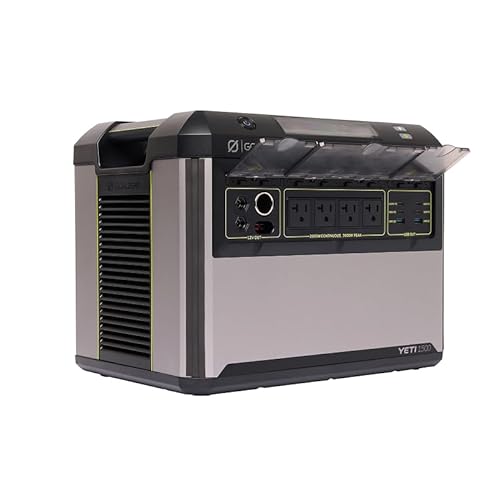
Goal Zero Yeti 1500 Portable Power Station (6th Gen)
Best for outdoor-to-home crossover use with rugged build quality
Goal Zero Yeti 1500 Portable Power Station (6th Gen)
Best for outdoor-to-home crossover use with rugged build quality
What we like
- Aluminum casing with IPX4 weatherproof rating and rubber bumpers — it's built to take actual outdoor abuse, not just sit in a closet.
- 4000 cycle rating translates to over 10 years of daily use, the longest lifespan spec in this category.
- 140W USB-C port is the fastest in class — charges a laptop at full speed without an adapter.
- Goal Zero's ecosystem of Yeti-Ready accessories (coolers, lights) integrates cleanly with this unit.
What we don't
- The premium construction comes with a premium price — it's the most expensive unit in this lineup per watt-hour.
- No X-Boost or power-lifting equivalent, so the 2000W hard limit means some high-draw appliances won't run.
- Heavier than the Bluetti AC180 despite similar capacity, which limits how often you'll want to move it.
This is the unit built for the person who wants one power station that lives in the garage, goes to the campsite, and steps up during a blackout — without treating any of those uses as a compromise. The IPX4 rating and aluminum shell mean it doesn't need to be babied.
If you'll only use this inside and primarily for home backup, the premium build quality costs more than it delivers. But if you genuinely split time between outdoors and home use, this is the only unit here that handles both without feeling like a bad fit for one of them.
Jackery Explorer 1000 Pro Portable Power Station
Best for first-time buyers who want proven reliability
Jackery Explorer 1000 Pro Portable Power Station
Best for first-time buyers who want proven reliability
What we like
- Dual 100W PD USB-C ports charge two laptops at full speed simultaneously — more useful for home office setups than any other unit here.
- Low self-discharge rate holds an 80% charge for up to 365 days in storage, so it's actually ready when you need it.
- 1.8-hour full charge time via AC is among the fastest in its capacity class.
- Jackery's name recognition and customer support infrastructure make warranty claims and troubleshooting straightforward.
What we don't
- 1000W continuous output means you cannot run a standard refrigerator (which can surge to 400-600W at startup) on this unit reliably.
- NMC battery chemistry has a shorter cycle life than LiFePO4 alternatives at this price point.
- No UPS mode, so it won't automatically switch over during a power cut — you have to plug in manually.
The Explorer 1000 Pro is the Jackery that most people end up with when they buy their first power station — easy to understand, well-documented, and reliable enough that you'll trust it when the lights go out. The dual 100W PD ports are genuinely useful in a home office or multi-device household.
The 1000W output ceiling is a real limitation for home backup — this unit is best for charging devices, running small appliances, and keeping lights on, not for powering a refrigerator through the night. Step up to the Bluetti or EcoFlow if the fridge is a priority.
Anker SOLIX C800 Portable Power Station
Best for budget buyers who refuse to compromise on recharge speed
Anker SOLIX C800 Portable Power Station
Best for budget buyers who refuse to compromise on recharge speed
What we like
- 58-minute full recharge via AC wall outlet is the fastest in this entire lineup regardless of price.
- LiFePO4 chemistry with 3000 cycle rating on a sub-$500 unit is genuinely uncommon at this price tier.
- 10 output ports covers phones, laptops, a lamp, and a small appliance simultaneously.
- 20ms UPS switchover mode protects computers and routers during a power cut — rare at this price point.
What we don't
- 768Wh capacity means you're planning carefully — it won't power a fridge through a full night without running out.
- 1200W continuous output rules out any appliance with a heating element like a coffee maker or electric kettle.
- The built-in light is a nice addition but the housing feels noticeably less premium than Jackery or EcoFlow at a similar price.
The C800 exists to answer one specific question: what's the best power station under $500 that doesn't cut corners on battery chemistry or recharge speed? The answer is this unit. LiFePO4 at this price usually means a tradeoff somewhere — here the tradeoff is capacity, not build quality or cycle life.
This is the right pick if you want backup power for phones, internet, and lights during a short outage, or a starter unit you plan to upgrade in a few years. If you need the fridge to run all night, the 768Wh won't get you there and you should step up to the Bluetti.
What to Look For
Capacity is your first filter — measured in watt-hours (Wh), it tells you how much total energy the unit holds. A 1000Wh unit running a 100W fridge will last about 8 hours; double the capacity and you double the runtime.
Output wattage determines what you can actually run. A 1800W inverter handles a fridge, router, and several lights simultaneously — units under 1000W struggle with anything that has a motor or heating element.
Battery chemistry separates the long-term value picks from the short-term ones. LiFePO4 (LFP) cells handle 3000+ charge cycles versus 500 for older NMC chemistries, which matters if you plan to use the unit regularly rather than just for emergencies.
Who Should Skip This
If you need to run central air conditioning, a well pump, or a full electric stove during an outage, a portable power station won't cut it — you need a whole-home generator rated at 5000W or higher. These units are also a poor fit if your outages regularly last more than 48 hours and you have no solar panel access, since recharging depends on grid power returning or sunlight.
What the Community Actually Uses
On r/preppers and r/homeautomation, the most common question isn't which brand to buy — it's how much capacity is actually enough. The consensus leans toward 1500Wh as the practical minimum for overnight home backup covering essentials, with LiFePO4 chemistry treated as non-negotiable for anyone planning to use the unit more than a handful of times per year.
Quick Picks — In Case You've Already Decided
Frequently Asked Questions
How long will a portable power station run my refrigerator?
A standard refrigerator draws 100-150W average (not continuously). A 1000Wh unit will run it for roughly 6-8 hours; a 2000Wh unit can stretch that to 12-16 hours depending on how often the compressor cycles.
Can I use a portable power station as a full-time UPS?
Yes, if it has a UPS mode with a fast enough switchover time — look for 20ms or less. Units like the EcoFlow Delta 2 Max and Bluetti AC180 support this. Running in UPS mode continuously does accelerate battery wear slightly.
What's the difference between LiFePO4 and standard lithium batteries?
LiFePO4 (LFP) cells are safer, more thermally stable, and rated for 2000-4000 charge cycles versus 300-500 for older NMC lithium. They're heavier per watt-hour but worth it for home backup use where longevity matters more than weight.
Can I charge a portable power station with solar panels?
Yes — most units in this range accept 200-500W of solar input via MC4 connectors. A 400W solar panel array can recharge a 1500Wh unit in about 4-5 hours of direct sun, making extended outages much more manageable.
Are portable power stations safe to use indoors?
Yes — unlike gas generators, they produce zero emissions and are completely safe indoors. LiFePO4 chemistry is also more thermally stable than older lithium, though you should still keep them in a well-ventilated space away from direct heat sources.
Buying Guide
You need to know your wattage before you buy. Add up the devices you can't live without during an outage — fridge, router, phone, CPAP, lights — then pick a unit with at least 20% more capacity than that number.
Battery chemistry matters too: LiFePO4 lasts 3,000-plus cycles versus 500 for standard lithium.