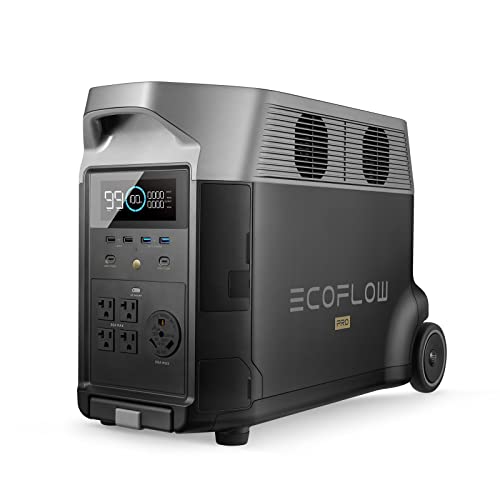
There is a portable power station that can run a circular saw, charge your drill batteries, and power site lighting without a drop of gas or a decibel of noise. The EcoFlow DELTA Pro delivers 3600W of continuous AC output and recharges in under 2.7 hours from a wall — enough to run a full trade day off a single overnight charge.
| Photo |
Top Pick
|
Versatile

|
Budget

|
Best Value

|
Best for Reliability

|
|---|---|---|---|---|---|
| Product | EF ECOFLOW Portable Power Station DELTA Pro 3600Wh | BLUETTI AC200MAX Portable Power Station | Goal Zero Yeti 1500X Portable Power Station | Jackery Explorer 1000 Pro Portable Power Station | Anker SOLIX C1000 Portable Power Station |
| Capacity | 3600Wh | 2048Wh | 1516Wh | 1002Wh | 1056Wh |
| Ac output | 3600W continuous | 2200W continuous | 2000W continuous | 1000W continuous | 1800W continuous |
| Battery type | LiFePO4 | LiFePO4 | Lithium NMC | Lithium NMC | LiFePO4 |
| Recharge time | 2.7 hrs (wall) | 3-4 hrs (wall + solar combined) | 14 hrs (wall) / 3 hrs (600W supply) | 1.8 hrs (wall) | 58 min (wall, UltraFast mode) |
| Buy Now | Check Price → | Check Price → | Check Price → | Check Price → | Check Price → |
Quick Tips
Check continuous AC wattage — not surge — against your most power-hungry tool before buying
LiFePO4 battery chemistry lasts 2-3x longer than NMC under daily discharge cycles typical on job sites
Recharge during lunch breaks using a site outlet to extend your effective runtime across a full shift
Run power tools on AC only — never through a USB or DC port, which are low-current outputs
EF EcoFlow DELTA Pro Portable Power Station
Best for running power tools all day on a remote site
EF EcoFlow DELTA Pro Portable Power Station
Best for running power tools all day on a remote site
What we like
- 3600W continuous AC output handles a circular saw, drill chargers, and site lighting simultaneously
- Recharges from a standard wall outlet in 2.7 hours — full battery before the next shift starts
- LiFePO4 cells rated for 3,500 cycles, equivalent to nearly 10 years of daily job site use
- Five AC outlets lets you run multiple tools or chargers without a power strip
What we don't
- At roughly 99 lbs it requires two people or a cart to move around a site
- Premium price sits well above mid-range alternatives
- App control requires Wi-Fi or Bluetooth — not useful on remote sites without signal
When your site has no power hookup and you need to run a saw, charge four batteries, and keep a work light on all at once, the DELTA Pro is the only unit that handles it without throttling — 3600W continuous means you are not watching output numbers nervously every time you pull a trigger. This is the pick for general contractors running a full crew on a remote lot or open-air build.
If you only need to charge drill batteries and power a radio, a smaller unit will save you real money and 60 lbs of carry weight.
BLUETTI AC200MAX Portable Power Station
Best for tradespeople who need expandable capacity over time
BLUETTI AC200MAX Portable Power Station
Best for tradespeople who need expandable capacity over time
What we like
- Expandable to 8192Wh with B230 or B300 battery modules — capacity grows as your site demands grow
- 2200W continuous output handles most corded saws and compressors without issue
- 900W max solar input means you can recharge on-site without access to a wall outlet
- Wireless charging pad and 30A RV port make it versatile beyond the job site
What we don't
- At 62 lbs it is manageable solo but awkward to carry long distances across a site
- Base AC input is only 500W — wall charging alone is slower than competitors
- Expansion batteries cost extra and are a separate purchase
The AC200MAX starts as a capable 2048Wh station and can scale to over 8000Wh as your work demands grow — you buy what you need now and add capacity later without buying a new unit. That modular approach makes it the smartest long-term investment for a tradesperson whose site power needs change job to job.
Best for solo contractors or small crews who want flexibility and solar recharging on remote sites. If you need above 2200W output for heavy corded tools, step up to the DELTA Pro.
Goal Zero Yeti 1500X Portable Power Station
Best for outdoor sites that demand rugged, weather-resistant power
Goal Zero Yeti 1500X Portable Power Station
Best for outdoor sites that demand rugged, weather-resistant power
What we like
- Aluminum housing and rubber bumpers make it one of the most physically durable units in this class
- 2000W continuous output with 3500W surge handles most corded tool startups cleanly
- Yeti App 3.0 provides real-time consumption monitoring and remote charging control
- Compatible with the Goal Zero solar panel ecosystem for off-grid recharging
What we don't
- Default 120W charger is extremely slow — the 600W power supply is a must-buy add-on
- NMC battery chemistry offers fewer total cycles than LiFePO4 units on this list
- Higher price per watt-hour compared to BLUETTI and EcoFlow equivalents
The Yeti 1500X is built like it is meant to be thrown in a truck bed and used in the rain — the aluminum casing and rubber corner protection are noticeably more serious than the plastic-shell competition. If your site is exposed, muddy, or sees real weather, that durability matters more than spec-sheet watt-hours.
Choose this if physical toughness is your first requirement and you can pair it with the 600W power supply to solve the recharge speed issue. If you need more capacity or faster standard charging, the DELTA Pro is the better value despite the similar price.
Jackery Explorer 1000 Pro Portable Power Station
Best value for light-duty tool charging and site lighting
Jackery Explorer 1000 Pro Portable Power Station
Best value for light-duty tool charging and site lighting
What we like
- Recharges from a wall outlet in 1.8 hours — fastest full recharge of any unit at this price point
- At 25.1 lbs it is genuinely one-person portable across a job site without a cart
- Three AC outlets plus USB-C and USB-A cover tools, device charging, and lighting from one unit
- Quiet, zero-emission operation makes it practical inside framed buildings before drywall
What we don't
- 1000W continuous output rules out corded circular saws and larger power tools
- NMC chemistry means fewer lifetime cycles than LiFePO4 units in this roundup
- 1002Wh capacity limits you to 4-5 hours of moderate tool use before a recharge
If your site tool load is cordless drill charging, a work light, a phone and tablet, and maybe a small corded jigsaw, the Explorer 1000 Pro covers all of it and recharges over lunch in under two hours. The weight is the real differentiator — 25 lbs means one person moves it anywhere on site without thinking about it.
This is the right pick for finish carpenters, painters, or solo tradespeople who work primarily with cordless tools and need a portable station for charging and lighting. Not a fit if you are running corded saws or any tool above 800W.
Anker SOLIX C1000 Portable Power Station
Best budget pick for contractors who need fast daily recharge
Anker SOLIX C1000 Portable Power Station
Best budget pick for contractors who need fast daily recharge
What we like
- Full recharge in under 60 minutes via AC wall outlet — fastest in this price class by a significant margin
- 1800W continuous output handles a circular saw (most models) running alone without issue
- LiFePO4 chemistry rated for 3,000 cycles — better longevity than NMC units costing more
- SurgePad technology pushes peak output to 2400W for high-draw tool motor startups
What we don't
- 1056Wh capacity is on the smaller side — expect 3-4 hours of mixed tool use before recharge
- UltraFast charging requires the Anker app and a smartphone — adds friction in daily use
- Not expandable — capacity is fixed at 1056Wh without buying a separate unit
The SOLIX C1000 charges faster than every other unit on this list and costs less than all of them — that combination is hard to ignore for a contractor who can plug in at lunchtime and have a full battery by 1pm. The 1800W output is also a genuine step up from the Jackery 1000 Pro, handling most corded saw loads without breaking a sweat.
Best for budget-conscious contractors who want LiFePO4 durability, enough wattage for real tools, and a recharge speed that fits a working lunch. Step up to the BLUETTI AC200MAX if you need more than 1056Wh of capacity per shift.
What to Look For
Continuous AC output is the number that matters on a construction site. A circular saw pulls 1,200-1,400W — you need a station rated above that just to spin the blade, let alone run anything else simultaneously.
Capacity in watt-hours tells you how long you can run before a recharge. A 2000Wh station running a 1200W saw gives you roughly 90 minutes of cutting time — plan your workflow around that math.
Recharge speed matters as much as capacity if you are working multi-shift. Units that charge in under 2 hours from a wall outlet give you a full battery by the time lunch is over.
Who Should Skip This
If your site has reliable 120V power access at every station, a portable power station is overkill — an extension cord costs $40. These units are built for remote sites, open lots, rural builds, or any job where running a gas generator is not permitted or not practical.
If your primary tool load exceeds 4000W continuous — think large table saws or compressors — even the biggest units here will struggle.
What the Community Actually Uses
On r/Construction and r/Tools, the conversation around battery stations on job sites has shifted hard in the last two years. Contractors who switched off gas generators consistently report lower noise complaints, no fuel costs, and no carbon monoxide risk in enclosed spaces.
The recurring advice: size up one tier on wattage — what looks like enough on paper rarely accounts for motor startup draws.
Quick Picks — In Case You've Already Decided
EF ECOFLOW Portable Power Station DELTA Pro 3600Wh
Check Price on AmazonFrequently Asked Questions
Can a portable power station run a circular saw?
Yes — most corded circular saws pull 1,200-1,400W, which is within range of any station rated 1800W or above. Make sure you are checking continuous output, not surge rating, which only lasts a fraction of a second.
How long will a 2000Wh station last on a job site?
Running a 1200W circular saw continuously, a 2000Wh station gives you roughly 90 minutes of active tool use. In real use — intermittent cuts, drill charging, lighting — you will typically get 4-6 hours across a standard shift.
Are portable power stations allowed on indoor construction sites?
Yes, and they are often preferred over gas generators indoors because they produce zero carbon monoxide. Check your site safety plan — battery stations are generally OSHA-compliant where gas units are not.
What battery chemistry is best for daily job site use?
LiFePO4 (lithium iron phosphate) is the right choice — it handles 2,000-3,500 charge cycles versus 300-500 for older NMC cells. Every unit on this list uses LiFePO4.
Can I charge a portable power station from my truck?
Yes, via the 12V car port, but it is slow — expect 8-12 hours for a full charge that way. A site outlet or solar panel is far faster and the better option for daily recharging.
Buying Guide
You need continuous wattage that matches your heaviest tool, enough capacity to last a shift, and a recharge method that fits your site. Check AC output first — not peak, but continuous.
Then check capacity in watt-hours. Bigger tools drain faster.
Pick a unit that handles your worst-case tool load with 20% headroom.