A dead starter battery 4 miles from the ramp is not a power problem — it's a planning problem, and the fix is a dedicated portable station running your accessories. The picks below range from 1,024Wh to 2,000Wh, cover fish finders, live wells, trolling motor chargers, and nav lights, and start under $600.
| Photo |
Top Pick

|
Versatile

|
Budget
|
Best Value

|
Best for Reliability

|
|---|---|---|---|---|---|
| Product | EF EcoFlow Portable Power Station DELTA 2 | Jackery Explorer 1000 v2 Portable Power Station | Goal Zero Yeti 1500 Portable Power Station (6th Gen) | BLUETTI AC200P Portable Power Station | Anker SOLIX C1000 Portable Power Station |
| Capacity | 1,024Wh | 1,070Wh | 1,505Wh | 2,000Wh | 1,056Wh |
| Ac output | 1,800W (2,700W surge) | 1,500W (3,000W surge) | 2,000W (3,600W surge) | 2,000W (4,800W surge) | 1,800W (2,400W surge) |
| Waterproof | ✗ | ✗ | IPX4 | ✗ | ✗ |
| Recharge time | 80 min (AC) | 60 min (AC) | Under 60 min (0-80% AC) | 2.5 hrs (dual AC) | 58 min (AC) |
| Buy Now | Check Price → | Check Price → | Check Price → | Check Price → | Check Price → |
Quick Tips
Wire your fish finder and live well pump to the portable station, never the starter battery — one bad trip will teach you why
Recharge via your truck's 12V outlet on the drive home so the unit is topped off before the next launch
Lay the power station flat in the bow storage compartment and secure it with a bungee or cargo net to prevent sliding in chop
Check watt-hour capacity before buying — a 500Wh unit may not last a full 8-hour day running a live well and fish finder simultaneously
EF EcoFlow DELTA 2 Portable Power Station
Best for anglers who want fast recharge and app control
EF EcoFlow DELTA 2 Portable Power Station
Best for anglers who want fast recharge and app control
What we like
- X-Stream fast charging hits 80% in under 50 minutes from a wall outlet or shore power
- App control via Wi-Fi or Bluetooth lets you monitor draw and toggle ports without touching the unit
- LiFePO4 battery chemistry rated for 3,000+ cycles — handles daily use for years without degradation
- 1,800W pure sine wave inverter safely powers fish finders, chartplotters, and live well pumps without voltage spikes
What we don't
- No IP water resistance rating — keep it in bow storage, not on the open deck
- At 27 lbs it is manageable but not lightweight for smaller boats
- USB-C is 100W, not the 140W+ found on newer EcoFlow models
The DELTA 2 earns its spot because of one thing: you can run accessories all day, plug it into shore power at the ramp, and have it fully charged before you've finished loading the boat. No other unit in this price range recharges this fast.
Ideal for anglers with shore power access at the dock or a 120V outlet in the garage — the fast recharge loop makes daily use frictionless. If you never have access to shore power and rely entirely on solar or a car charger, the Goal Zero Yeti 1500 below is built more with that use case in mind.
Jackery Explorer 1000 v2 Portable Power Station
Best for solo day trips on smaller boats
Jackery Explorer 1000 v2 Portable Power Station
Best for solo day trips on smaller boats
What we like
- 1-hour full charge with emergency fast charging mode via the Jackery app
- LiFePO4 battery rated for 4,000 cycles — one of the highest cycle counts in this price tier
- Multiple output ports including 100W USB-C, 12V DC car port, and three AC outlets for flexibility
- Slightly lighter than comparable 1,000Wh units, easier to move in and out of smaller boats
What we don't
- 1,500W continuous output is lower than EcoFlow and Bluetti options — not ideal if running high-draw gear simultaneously
- Emergency 1-hour charge mode must be manually activated in the app each session, which is easy to forget
- No native Bluetooth or Wi-Fi monitoring without activating the app
The Explorer 1000 v2 is the right size for a solo angler running a fish finder, phone charger, and small live well on a half-day or full-day trip — 1,070Wh is enough capacity with room to spare. The 1-hour charge means you can top it off between morning and afternoon sessions if you have an outlet nearby.
Pick this over the EcoFlow if you want maximum battery longevity (4,000 vs 3,000 cycles) and slightly lower weight. Skip it if you need to run multiple high-draw accessories at the same time — the 1,500W ceiling gets tight when a live well pump surges at startup.
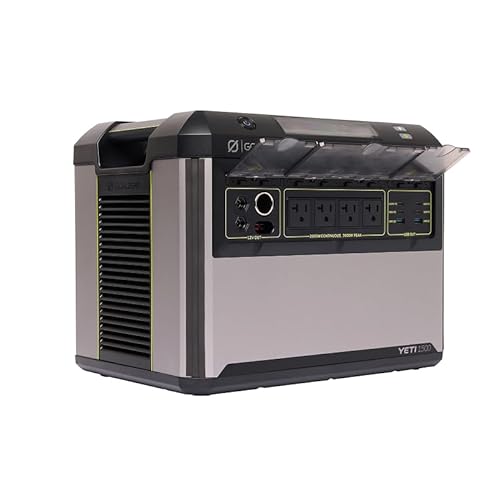
Goal Zero Yeti 1500 Portable Power Station (6th Gen)
Best for all-day runs with spray exposure
Goal Zero Yeti 1500 Portable Power Station (6th Gen)
Best for all-day runs with spray exposure
What we like
- IPX4 splash rating — the only unit in this roundup rated to handle spray and light rain without babysitting placement
- 1,505Wh capacity runs a fish finder and live well all day with power left over for lights and phone charging
- 2,000W inverter with 3,600W surge handles high-draw startup loads from live well pumps and aerators without tripping
- LiFePO4 battery rated for 4,000+ cycles with a 10+ year lifespan backed by a Goal Zero warranty
What we don't
- Most expensive unit in this roundup — premium is real and not for casual weekend anglers
- Heavier at around 35 lbs — harder to move in and out of tight bow storage solo
- Charging via solar is slower than EcoFlow or EcoFlow if you lack shore access
The Yeti 1500 is the only unit here with a tested water resistance rating, which matters on a boat in a way it simply does not matter in a truck or campsite. Spray hits, rain happens, and a splashed power station on a $500 fishing day is a bad day.
This is the pick for guides, tournament anglers, or anyone running a full day of electronics in open water conditions where deck spray is guaranteed. If your boat stays dry and your budget is tighter, the EcoFlow DELTA 2 gets you 80% of this performance at 60% of the price.
BLUETTI AC200P Portable Power Station
Best for multi-day trips and high-draw setups
BLUETTI AC200P Portable Power Station
Best for multi-day trips and high-draw setups
What we like
- 2,000Wh capacity is enough to run a full electronics and live well setup across two or three consecutive days without recharging
- 4,800W surge rating handles virtually any marine accessory startup load without voltage dips
- 17 output ports including a 12V/25A DC port for direct accessory wiring and dual wireless charging pads
- Supports up to 700W of solar input — ideal for remote fishing without shore power access
What we don't
- Heaviest unit in this roundup at around 60 lbs — not a one-hand lift and requires two people for bigger moves
- No water resistance rating — needs careful placement on any boat that takes spray
- Slower recharge without dual AC adapters, which are sold separately
The AC200P is for anglers who spend multiple consecutive days on the water — think houseboat trips, remote lake camping, or week-long outfitter runs where you cannot recharge every night. At 2,000Wh, it comfortably handles a full day of high-draw gear and still has capacity left for the next morning.
If you only fish single-day trips, the extra capacity is wasted weight — 60 lbs is serious on a small boat. This unit earns its place on larger platforms like pontoons, bass boats with extended storage, or trailered boats where the station stays in a compartment and never gets manually lifted.
Anker SOLIX C1000 Portable Power Station
Best value compact station for light marine use
Anker SOLIX C1000 Portable Power Station
Best value compact station for light marine use
What we like
- 58-minute full AC recharge makes it one of the fastest-charging units under $700
- SurgePad delivers 2,400W peak output, enough headroom for live well pump startup surges
- 15% smaller footprint than comparable 1kWh units — fits into tighter bow storage compartments
- LiFePO4 battery with 3,000 cycle lifespan and 10-year rated durability at a lower entry price
What we don't
- No water resistance rating — needs to stay in dry storage on any boat that gets deck spray
- App required to activate UltraFast charging mode, which adds a step every session
- Fewer output ports than BLUETTI and Goal Zero — may feel limiting if you run multiple accessories
The SOLIX C1000 is the compact pick for anglers who want a name-brand station with fast recharge and proven battery chemistry without paying flagship prices. The 1,056Wh capacity and small footprint make it a natural fit for center consoles or bass boats where storage is tight.
Choose this over the Jackery if fast recharge matters more than maximum cycle count, or if port layout is a better fit for your setup. Skip it if you need water resistance or plan multi-day trips — the Goal Zero Yeti 1500 or BLUETTI AC200P are the better call for those scenarios.
What to Look For
Capacity is the first thing to nail down. A fish finder pulls 15-30W, a live well pump runs 50-150W, and a trolling motor charger can hit 200W — add your actual loads and buy at least 30% more than your daily draw.
Output type matters on a boat. You want a pure sine wave inverter for electronics and a native 12V DC port for direct wiring — modified sine wave can damage fish finders and chartplotters over time.
Weight and water resistance are real concerns. Boats get spray and condensation, and you may be lifting the unit in and out solo.
Under 30 lbs and at least IPX4 splash resistance is the practical floor for most setups.
Who Should Skip This
If your boat already has a dedicated house battery bank wired to a DC-DC charger from the outboard, a portable station is redundant. Anglers running small kayaks or canoes with a single handheld fish finder will also find even the smallest units here oversized — a 20,000mAh power bank handles that load at a fraction of the weight and cost.
What the Community Actually Uses
On r/boatbuilding and r/fishfinder, the recurring recommendation is to keep accessories completely off the starter circuit — dedicated portable stations come up constantly for trailered boats where running a full house battery install is overkill. The consensus: 1,000Wh is the minimum for a full day with a live well running.
Quick Picks — In Case You've Already Decided
Frequently Asked Questions
Can I run a trolling motor directly from a portable power station?
Most portable stations cannot sustain a trolling motor draw — even a small motor pulls 20-40A at 12V, far exceeding what most stations can handle for hours. Use the station for accessories and chargers, and keep your trolling motor on a dedicated deep-cycle battery.
How many watt-hours do I need for a full day on the water?
A fish finder at 25W and a live well at 100W running 8 hours equals roughly 1,000Wh of draw. Add a 30% buffer for efficiency losses and you need at least 1,300Wh of usable capacity for a true all-day session.
Will salt air or spray damage a portable power station?
Salt air alone is low risk if you wipe the unit down after use. Spray is the real concern — look for IPX4 or better and store the unit under a seat or in bow storage rather than in open air on the gunwale.
Can I recharge the station while running electronics off it simultaneously?
Yes — all units here support pass-through charging, meaning you can plug into a shore outlet or solar panel while powering accessories at the same time. Just confirm your unit supports it before leaving the dock.
Is a portable power station safer than wiring a second battery into the boat?
For trailered recreational boats, a portable station is often simpler and safer — no permanent wiring, no risk of a bad installation, and you can bring it inside to charge. A permanent install makes more sense for boats that stay in the water or have high daily power demands.
Buying Guide
You need enough watt-hours to run your fish finder and live well for a full day without touching your starter battery. Calculate your draw, add 30%, and size up from there.
Prioritize a pure sine wave inverter, at least one 12V DC output, and a unit you can recharge from your tow vehicle on the drive home.