High altitude breaks canister stoves that lack a pressure regulator — thin air and cold temperatures tank the output before your water even thinks about boiling. The five stoves here all use pressure regulation or liquid fuel, weigh between 2.3 and 11.5 oz, and are proven performers above 10,000 feet.
| Photo |
Top Pick

|
Versatile
|
Budget

|
Best Value

|
Best for Reliability

|
|---|---|---|---|---|---|
| Product | MSR WindBurner Personal Stove System | SOTO WindMaster Backpacking Stove with 4Flex | MSR PocketRocket Deluxe Stove | Jetboil Flash Camping Stove Cooking System | MSR WhisperLite Universal Compact Hybrid Fuel Camping and Backpacking Stove |
| Fuel | Isobutane-propane canister | Isobutane-propane canister | Isobutane-propane canister | Isobutane-propane canister | Canister or liquid (white gas, kerosene, unleaded) |
| Weight | 14.9 oz (system) | 2.3 oz (67g) | 2.9 oz (83g) | 13.1 oz (system) | 11.5 oz (with pump) |
| Seasons | 3-4 season | 3-4 season | 3-4 season | 3-4 season | 4 season |
| Boil time | 4.5 min/L | 2.5 min per 2 cups | 3.5 min/L | 100 seconds/L | 3.5 min/L (white gas) |
| Buy Now | Check Price → | Check Price → | Check Price → | Check Price → | Check Price → |
Quick Tips
Warm your fuel canister in a jacket pocket for 10-15 minutes before lighting — cold canisters lose pressure fast above 10,000 feet and a regulated stove cannot fix a canister that is barely pressurized.
Use a windscreen even with a stove that claims wind resistance — above treeline, gusts are unpredictable and a simple foil screen can cut boil time by 30 percent.
Switch to a 4-season isobutane-propane blend canister rather than pure butane — the propane component stays gaseous at lower temperatures and performs better in the cold thin air.
At extreme altitude, liquid fuel (white gas) maintains pressure independently of temperature, making it the most reliable fuel type above 14,000 feet where canister performance degrades fastest.
MSR WindBurner Personal Windproof Stove System
Best for fast solo boils in exposed alpine conditions
MSR WindBurner Personal Windproof Stove System
Best for fast solo boils in exposed alpine conditions
What we like
- Radiant burner with 100% primary air combustion creates a fully windproof flame that performs on exposed ridgelines without a separate windscreen.
- Integrated pressure regulator maintains consistent output from the first light to the last drop of fuel, eliminating the fade that kills unregulated stoves at altitude.
- All-in-one enclosed system with 1.0L pot nests the stove, canister, and accessories for a no-fumble alpine setup.
- Anti-topple remote canister design keeps the system stable on uneven rocky terrain where a top-mount canister stove would tip.
What we don't
- The 1.0L pot is too small for cooking anything beyond boiling water for two people, limiting meal options on longer trips.
- Heavier than a bare canister stove at 14.9 oz for the system — you are paying weight for the windproof enclosure.
- Poor simmering control compared to open burner stoves — it is optimized for boiling, not cooking.
When you are at 12,000 feet with wind across the ridge and a depleting canister, the WindBurner is the stove that keeps working while others fade — the radiant burner is fully enclosed and the pressure regulator compensates for the cold canister automatically. This is the right call for solo and duo alpine trips where you need boiling water reliably and want zero setup complexity.
If you are cooking actual meals rather than rehydrating or making coffee, the limited simmering and 1.0L pot will frustrate you.
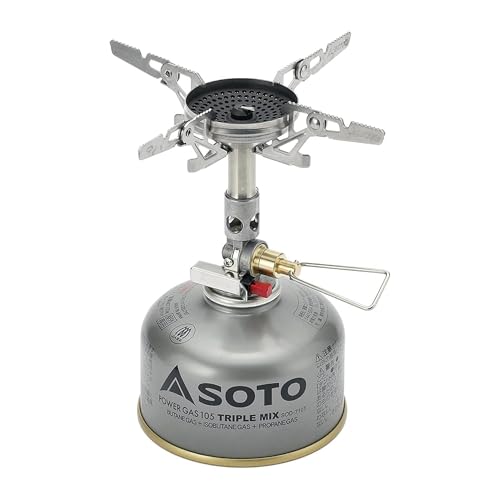
SOTO WindMaster Canister Stove with 4Flex
Best for ultralight alpine backpackers who cook real meals
SOTO WindMaster Canister Stove with 4Flex
Best for ultralight alpine backpackers who cook real meals
What we like
- At 2.3 oz with the 4Flex support, it is among the lightest regulated canister stoves available — negligible pack weight for serious gram counters.
- Micro-regulator valve system maintains consistent output across a wide temperature range, which directly addresses the core altitude performance problem.
- Concave burner design with raised edge acts as a built-in windshield, reducing heat loss without requiring a separate screen.
- 4Flex pot supports accommodate both small mugs and larger group pots, making it versatile across different cook setups.
What we don't
- The stealth igniter, while durable, is harder to access with cold gloves on compared to a push-button system.
- No integrated pot means you carry more separate pieces than an all-in-one system like the WindBurner.
- 100% propane fuel is explicitly prohibited — you must use a standard isobutane blend canister.
The WindMaster solves the two core altitude problems — wind and canister pressure drop — at 2.3 oz, which is less than half the weight of most regulated systems. That combination of engineering and weight is why it sits in almost every serious alpine backpacker's kit.
Pick this if you want simmer control for real cooking and need to save every gram. Skip it if you want an all-in-one system that eliminates loose parts at camp.
MSR PocketRocket Deluxe Ultralight Backpacking Stove
Best for day hikers who want reliable altitude performance without the system cost
MSR PocketRocket Deluxe Ultralight Backpacking Stove
Best for day hikers who want reliable altitude performance without the system cost
What we like
- Pressure regulator delivers consistently fast boil times even with a cold or nearly empty canister — solves the primary altitude performance problem at an accessible price.
- Broad burner head provides better wind resistance than narrow-jet canister stoves and allows genuine simmering for cooking.
- Protected piezo push-start igniter is inside the burner head so it resists breakage on a packed and jostled stove.
- At 2.9 oz, it folds small enough to fit in a coat pocket and pairs with virtually any pot you already own.
What we don't
- No integrated windscreen means you will want a foil screen above treeline — the broad burner helps but does not replace a dedicated wind barrier in strong gusts.
- Not as wind-resistant as the WindMaster or WindBurner in true alpine exposure conditions.
- Stove only — no pot included, so you are building your own cook system around it.
The PocketRocket Deluxe is the pressure-regulated step up from the basic PocketRocket 2, and that regulator is what makes it worth the extra cost for altitude use — it holds output steady as your canister cools and depletes at elevation. For most three-season hikers going to 10,000-13,000 feet, it does everything the WindBurner does at half the system weight and cost.
This is the pick if you already have a pot you like and want a lightweight regulated stove that does not lock you into a system. If you are heading to genuinely exposed alpine ridgelines with consistent wind, step up to the WindMaster or WindBurner.
Jetboil Flash Camping and Backpacking Stove Cooking System
Best for speed-focused campers who want the fastest boil at camp
Jetboil Flash Camping and Backpacking Stove Cooking System
Best for speed-focused campers who want the fastest boil at camp
What we like
- FluxRing technology captures heat from the burner and channels it directly into the pot, making it the fastest boiling system in its class at 100 seconds per liter.
- Integrated 1.0L insulated cooking cup with thermochromatic indicator tells you when water is ready without lifting the lid.
- Push-button auto ignition is reliable even in cold conditions and requires no separate lighter.
- All-in-one nesting system packs the stove, cup, and a small canister into a single unit with no loose components.
What we don't
- No pressure regulator on the standard Flash — output fades more noticeably as the canister cools and depletes compared to regulated stoves at altitude.
- Simmering is poor — the FluxRing design optimizes for boiling speed, not controlled cooking.
- Proprietary canister-to-stove connection limits you to Jetboil-compatible canisters in the field.
The Flash is not the most technically optimized stove for sustained high-altitude use without a regulator, but its FluxRing efficiency compensates significantly — it boils water fast enough that canister fade matters less when trips are short and you are primarily rehydrating meals. For most backpackers hitting altitude on weekend trips, the speed and convenience justify it.
Choose the Flash if getting hot food fast with zero setup is the priority and you are not going above 13,000 feet regularly. Choose the WindBurner or WindMaster if you need sustained regulated performance in genuine alpine conditions.
MSR WhisperLite Universal Compact Hybrid Fuel Camping and Backpacking Stove
Best for extreme altitude and expedition use where canister performance is not reliable
MSR WhisperLite Universal Compact Hybrid Fuel Camping and Backpacking Stove
Best for extreme altitude and expedition use where canister performance is not reliable
What we like
- AirControl technology delivers full-pressure liquid fuel performance that does not degrade with altitude or cold — unlike canister stoves, the WhisperLite Universal self-pressurizes regardless of temperature.
- Switches between canister and liquid fuel modes, giving you flexibility to use canisters at moderate altitude and white gas on extreme or cold expeditions.
- Proven expedition-grade durability with field-serviceable design — you can clean and repair it with a basic kit in the backcountry without special tools.
- Extra-stable stainless steel legs and wide pot support handle large pots for group cooking, unlike the compact canister stoves above.
What we don't
- Liquid fuel mode requires priming and preheating before lighting — a learned skill that adds complexity compared to push-button canister stoves.
- Heavier than any canister stove here at 11.5 oz plus fuel bottle weight, which matters on long approaches.
- No simmer control on liquid fuel mode — it burns hot and consistent, but fine cooking requires technique.
Above 14,000 feet or in serious winter conditions, canister stoves hit a wall that no regulator fully fixes — the WhisperLite Universal bypasses that entirely by letting you run white gas, which maintains pressure independent of temperature and altitude. It is the stove that expedition mountaineers reach for when reliability is non-negotiable.
This is the pick for high-altitude expeditions, winter mountaineering, or international travel where fuel canister availability is uncertain. If you are doing summer backpacking under 13,000 feet, it is more stove than you need and heavier than justified.
What to Look For
A pressure regulator is the single most important feature for high altitude cooking. Without one, your stove output drops as the canister cools and empties, leaving you with a struggling flame right when you need it most.
Wind resistance matters as much as raw BTU output on exposed ridgelines. Look for radiant burner designs, integrated windscreens, or remote canister configurations that keep the flame sheltered.
Fuel type determines your ceiling. Canister stoves with regulators perform well to around 14,000 feet, but liquid fuel stoves like the WhisperLite Universal maintain full pressure at any altitude because they self-pressurize independently of temperature.
Who Should Skip This
If you are car camping below 6,000 feet with no wind exposure, any basic canister stove will do the job at half the price. The stoves on this list are optimized for thin air and exposure — paying for pressure regulation and wind resistance you will never need is a waste.
A Coleman or cheap single-burner canister stove is the right call for casual low-elevation camping.
What the Community Actually Uses
On r/ultralight and r/alpinism, the high-altitude stove debate comes down to two camps: regulated canister stoves for trips under 14,000 feet where weight is king, and liquid fuel for anything higher or in extreme cold. The SOTO WindMaster and MSR WindBurner dominate three-season alpine discussions, while the WhisperLite Universal shows up consistently in expedition threads where reliability trumps everything else.
Quick Picks — In Case You've Already Decided
Frequently Asked Questions
Why does my canister stove perform worse at high altitude?
Two factors combine: lower atmospheric pressure reduces the pressure differential that pushes fuel out of the canister, and cold temperatures cause the fuel mix to partially liquefy inside the canister. A pressure regulator compensates by maintaining consistent output as canister pressure drops.
What is the best fuel type for high altitude camping?
Isobutane-propane blends outperform pure butane at altitude and in cold because propane stays gaseous at lower temperatures. For extreme altitude above 14,000 feet, liquid white gas is the most reliable option since it self-pressurizes independent of canister temperature.
Do I need a pressure-regulated stove for camping above 10,000 feet?
It makes a significant difference. Non-regulated stoves can lose 30-50 percent of their output as the canister cools and depletes. At altitude where water boils at a lower temperature, you still need a consistent flame — a regulated stove delivers that when an unregulated one is struggling.
Can I use a windscreen with a canister stove at altitude?
Yes, but never fully enclose a canister stove with a windscreen — trapped heat can cause the canister to over-pressurize and fail. Leave the canister end open and shield only the burner side. Stoves with built-in wind protection like the WindBurner or WindMaster make this a non-issue.
How much does altitude actually slow down boil time?
Water boils at about 194 degrees Fahrenheit at 10,000 feet versus 212 at sea level, so it actually boils slightly faster once you get there. The challenge is maintaining enough consistent heat output from a cold, low-pressure canister to reach that boiling point without the stove fading mid-boil.
Buying Guide
At altitude, two things kill your stove: cold canisters losing pressure and wind stripping heat before it reaches your pot. You need a pressure regulator to maintain consistent output as the canister depletes, a windshield or radiant burner design, and enough BTUs to compensate for lower boiling points.
Weight matters too — every ounce counts when you're already hauling layers.