Finding a stove that fits your kit without dead weight or fuel drama is a solved problem — you just need to know which five options cut through the noise. The top pick here boils a liter in 100 seconds, weighs 13 oz with the cup, and packs into a space smaller than a Nalgene.
| Photo |
Top Pick

|
Versatile

|
Budget
|
Best Value

|
Best for Reliability

|
|---|---|---|---|---|---|
| Product | Jetboil Flash Camping Stove Cooking System | MSR PocketRocket 2 Ultralight Camping and Backpacking Stove | SOTO WindMaster Backpacking Stove with 4Flex | Fire-Maple Fixed Star 1 Stove System | BRS-3000T Ultralight Titanium Backpacking Stove |
| Fuel | Isobutane-propane | Isobutane-propane | Isobutane-propane | Isobutane-propane | Isobutane-propane |
| Weight | 13.1 oz (system) | 2.6 oz (stove only) | 2.3 oz (stove only) | 18 oz (system) | 0.88 oz (25g) |
| Seasons | 3-season | 3-season | 3-4 season | 3-season | 3-season |
| Boil time | 100 seconds / 1L | 3.5 min / 1L | 2.5 min / 1L | ~3 min / 1L | ~3 min / 1L |
| Buy Now | Check Price → | Check Price → | Check Price → | Check Price → | Check Price → |
Quick Tips
Always carry isobutane-propane canisters rather than pure butane — they perform better in cold mornings and at elevation without a warmup ritual.
Nest your stove inside your pot and pack the fuel canister separately in a saddle bag to distribute weight and avoid pressure buildup from heat.
A small windscreen adds under 1 oz but can cut your boil time in half on open roads — worth carrying even if your stove has a built-in shield.
Check canister availability before your route: isobutane canisters are harder to find than white gas in remote areas, so liquid-fuel stoves have a real advantage on long international tours.
Jetboil Flash Camping and Backpacking Stove Cooking System
Best for riders who want one piece of kit, zero fuss
Jetboil Flash Camping and Backpacking Stove Cooking System
Best for riders who want one piece of kit, zero fuss
What we like
- Boils 1 liter in 100 seconds — fastest in this category by a significant margin.
- Everything nests into the 1L FluxRing cup, so you pack one object instead of three loose parts.
- Push-button igniter means no lighter to lose, even cold-fingered after a long ride.
- Color-change heat indicator shows when water is ready without watching the pot.
What we don't
- Limited simmer control makes it poor for actual cooking beyond boiling water and rehydrating meals.
- System size is slightly larger than bare-burner options like the PocketRocket, taking more saddlebag space.
- Fuel canisters are not included and add to overall kit cost.
When you pull into camp at dusk and want coffee or a hot meal inside five minutes without thinking, the Flash does the job better than anything else in this category. The self-contained system means nothing rattles loose in your bags, and the 100-second boil time means you are eating before the tent is up.
This is the right stove for riders doing three to five nights out and prioritizing speed and simplicity over culinary range. If you are doing multi-week tours and want to actually cook rather than just rehydrate, pair this with a second pot or look at the SOTO WindMaster instead.
MSR PocketRocket 2 Ultralight Camping and Backpacking Stove
Best for ultralight minimalists counting every gram
MSR PocketRocket 2 Ultralight Camping and Backpacking Stove
Best for ultralight minimalists counting every gram
What we like
- At 2.6 oz, it is one of the lightest full-function canister stoves you can buy from a proven brand.
- Collapses to 2x2x3 inches — fits in a jersey pocket, let alone a saddlebag.
- Serrated pot supports accommodate a wide range of pot sizes for actual cooking, not just boiling.
- MSR's 3-year warranty and parts availability give it real long-tour durability credentials.
What we don't
- No igniter — you must carry a lighter or matches as a separate item.
- Wind performance is mediocre without a separate windscreen in exposed campsites.
- Pot not included, so total system cost rises if you are starting from scratch.
This is the stove you grab when you have already committed to minimal kit and you want a trusted name on the burner without paying for an integrated system. At under 3 oz, it genuinely disappears into your load, and it scales up to cooking actual food — not just ramen water — when you use a proper pot.
Choose this over the Jetboil if weight is your primary constraint and you are already carrying a separate pot for meal prep. If you run cold camps frequently or camp in wind-exposed sites, add a $6 windscreen and you have a more capable setup than the Flash at half the price.
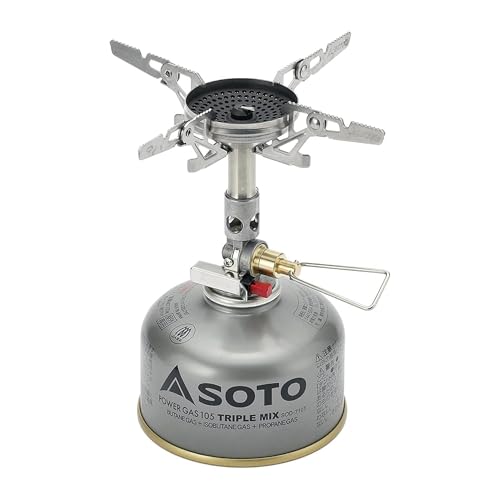
SOTO WindMaster Backpacking Stove with 4Flex
Best for exposed campsites and shoulder-season riding
SOTO WindMaster Backpacking Stove with 4Flex
Best for exposed campsites and shoulder-season riding
What we like
- Micro-regulator maintains consistent output in cold temps and gusty conditions where standard canister stoves falter.
- Boils water in under 2.5 minutes in real wind — outperforms the PocketRocket significantly in crosswind tests.
- At 2.3 oz, it is lighter than the PocketRocket 2 despite having a more sophisticated burner design.
- 4Flex pot support handles larger pots, making it genuinely versatile for multi-day cooking.
What we don't
- Stealth igniter is fragile — experienced users carry a backup lighter for extended trips.
- Premium price for a stove-only product; you will need a separate pot and lighter.
- Regulator valve requires keeping the base clean of sand and debris, which matters in dusty roadside camps.
If your routes regularly hit exposed ridgelines, coastal camps, or early spring temperatures, the WindMaster earns its price premium over every other canister stove here. The regulator is the differentiator: where other stoves lose output as the canister cools or the wind picks up, this one holds steady.
This is the pick for riders doing shoulder-season touring in unpredictable conditions who cook more than they just boil water. If you camp exclusively in sheltered forest sites in summer, the PocketRocket 2 does the same job at $25 less.
Fire-Maple Fixed Star 1 Backpacking and Camping Stove System
Best all-in-one value system for new touring riders
Fire-Maple Fixed Star 1 Backpacking and Camping Stove System
Best all-in-one value system for new touring riders
What we like
- Heat exchanger base boils up to 30% faster than conventional canister stoves in the same wind conditions.
- Stove, 1L pot, bowl, and fuel canister all nest into one compact unit — one bag item, nothing loose.
- Built-in piezo igniter handles cold-morning starts without fumbling for a lighter.
- Hard-anodized aluminum pot with locking handle is genuinely durable for regular touring use.
What we don't
- At 18 oz, it is the heaviest system in this roundup — noticeable on ultralight builds.
- Not compatible with Coleman-threaded canisters, which limits fuel options in some rural areas.
- Heat exchanger pot is proprietary; you cannot swap in a lighter pot without losing the efficiency advantage.
The Fixed Star 1 is what you buy when you want a complete system at Jetboil performance levels without the Jetboil price tag, and you are okay carrying an extra 5 oz for the convenience. The all-in-one nested design is particularly good for newer tourers who want everything in one object and zero assembly stress at camp.
Pick this over the Jetboil Flash if you want to save $50 and the extra weight is not a constraint on your build. If you are already running a lean sub-30 lb setup and every ounce is contested, the PocketRocket 2 serves the same rider at a third of the weight.
BRS BRS-3000T Ultra-Light Titanium Alloy Camping Gas Stove
Best for gram-obsessed minimalists on a tight budget
BRS BRS-3000T Ultra-Light Titanium Alloy Camping Gas Stove
Best for gram-obsessed minimalists on a tight budget
What we like
- At 25 grams, it is the lightest stove in this roundup by a factor of four — borderline disappears in a kit bag.
- Titanium construction is genuinely durable despite the featherweight price point.
- Compact folded size nests inside a 750ml pot with a 110g canister for a truly minimal system.
- Price leaves room in the budget to invest in a better pot, windscreen, or fuel supply.
What we don't
- No igniter — a backup lighter is non-negotiable with this stove.
- Wind performance is the weakest of any stove here; a separate windscreen is not optional, it is required.
- Tripod-style pot supports can be unstable with larger pots, limiting cooking versatility.
The BRS-3000T exists in its own category: a titanium stove that weighs less than a set of keys and costs less than dinner, and it genuinely works if you pair it with a windscreen and a good pot. For a rider already at a meticulous weight limit who just needs a backup burner or a dedicated coffee setup, nothing in this roundup touches it on price-to-weight ratio.
Buy this if you have already built out your touring kit and you are filling the last 1 oz gap where a stove should go. If this is your only stove and you camp in any wind at all, budget $6 for a windscreen the same day or you will regret it by the first exposed campsite.
What to Look For
Weight is the first filter for motorcycle touring stoves. You are already managing a full kit across limited panniers, so anything over 16 oz starts eating into gear that earns its place.
Fuel compatibility matters more on a bike than it does in a parking-lot campsite. A stove that only runs on specialty canisters becomes a logistics problem the moment your route goes rural or crosses a border.
Boil time under wind is the real-world test — not the sea-level spec. If a stove cannot maintain a consistent flame in a 15 mph crosswind without a dedicated screen, it will frustrate you at the worst possible moments on exposed campsites.
Who Should Skip This
Motorcycle touring stoves are the wrong buy if you regularly camp with a group of three or more and want to cook actual meals — a larger two-burner setup strapped to a rack will serve you better. Riders on purely urban overnighters who always camp near amenities can skip the research and grab whatever is cheapest.
And if your route is exclusively international and remote, a multi-fuel liquid stove is the only honest answer regardless of what this guide recommends.
What the Community Actually Uses
On r/motorcycletouring the stove conversation comes up every season, and the recurring verdict is that integrated systems like the Jetboil consistently beat loose canister stoves for one reason: fewer parts to lose at camp after a 400-mile day. The secondary debate is always canister vs liquid fuel, with most North American riders landing on canister for convenience and adventure tourers heading international defaulting to the WhisperLite.
Quick Picks — In Case You've Already Decided
MSR PocketRocket 2 Ultralight Camping and Backpacking Stove
Check Price on AmazonFrequently Asked Questions
What fuel type is easiest to find on a long motorcycle tour?
Isobutane-propane canisters (EN417 threading) are widely available at outdoor retailers, REI, and many gas stations near camping destinations in the US. White gas is less common but available at most outdoor specialty shops. Pure butane canisters — common in Asia and Europe — usually will not thread onto US-spec stoves without an adapter.
How small does a motorcycle touring stove need to be?
Most riders target a packed size that fits inside a 750ml–1L pot, since you can then nest the whole system into a single corner of a saddlebag. Stoves like the BRS-3000T and MSR PocketRocket 2 achieve this easily. An integrated system like the Jetboil Flash is slightly larger but eliminates loose parts entirely.
Is wind performance really that important for a touring stove?
Yes — campsite wind conditions are usually worse on touring routes than in designated campgrounds because you are often stopping in exposed areas. A stove that struggles above 10 mph will double your fuel consumption and boil time. The SOTO WindMaster and MSR WhisperLite are the two best performers in real crosswind conditions.
Can I take an isobutane canister on a ferry or as air freight?
No. Pressurized fuel canisters are prohibited on most ferries and all commercial flights. If your route involves significant water crossings or any air legs, plan to purchase fuel at the destination or switch to a stove compatible with locally available fuel sources.
Do I need a separate windscreen for motorcycle camping?
For most canister stoves, yes. A folding titanium or aluminum windscreen weighs under 1.5 oz and prevents the single most common cause of cold meals on tour. Integrated systems like the Jetboil have a built-in heat exchanger that reduces — but does not eliminate — wind sensitivity.
Buying Guide
You need a stove that fits in a saddlebag without stealing space from gear that matters more. Prioritize weight under 14 oz, a self-contained or nested design, and canister compatibility you can actually find at gas stations and outdoor shops on route.
Wind resistance is the spec most riders overlook until they're shielding a flame with their body at mile 600.