A camping stove that sputters out the moment wind picks up is not a camping stove — it is dead weight you carried to the lake. The five options below boil water in under two minutes, pack down to nothing, and won't quit on you when the gusts roll in off the water.
| Photo |
Top Pick

|
Versatile

|
Budget
|
Best Value
|
Best for Reliability

|
|---|---|---|---|---|---|
| Product | Jetboil Flash Camping Stove Cooking System | Fire-Maple Fixed Star 1 Stove System | Coleman Triton+ 2-Burner Propane Camping Stove | Gas One GS-3400P Dual Fuel Camping Stove | Camp Chef Explorer Two Burner Stove |
| Fuel | Isobutane canister | Isobutane canister | Propane cylinder (16.4 oz) | Butane canister OR propane cylinder | Propane (3 ft hose and regulator included) |
| Weight | 13.1 oz | 18 oz (system) | 12 lbs | 2.9 lbs | 20 lbs |
| Boil time | 100 seconds (1L) | Under 3 minutes (1L) | Under 5 minutes (1L per burner) | Under 4 minutes (1L) | Under 4 minutes (1L per burner) |
| Wind resistance | ✓ | ✓ | ✓ | ✓ | ✓ |
| Buy Now | Check Price → | Check Price → | Check Price → | Check Price → | Check Price → |
Quick Tips
Always shield your stove with a windscreen or use your cooler as a natural wind break — a 10 mph lake breeze can cut your BTU efficiency by 30 percent or more.
Bring a backup ignition method like a lighter or fire steel — piezo ignitors can fail in wet conditions, which is exactly when you need your stove most.
For ice fishing or cold-weather trips, isobutane canisters lose pressure below freezing — carry a liquid fuel stove or keep your canister in an inside pocket until you need it.
If you're cooking fresh catch, a two-burner stove lets you fry fish on one side and heat oil or sides on the other without juggling timing on a single burner.
Jetboil Flash Camping and Backpacking Stove Cooking System
Best for fast coffee before the morning bite
Jetboil Flash Camping and Backpacking Stove Cooking System
Best for fast coffee before the morning bite
What we like
- Boils a full liter in 100 seconds — fastest integrated system in its class.
- FluxRing heat exchanger maintains efficiency in lake crosswind without a separate windscreen.
- Everything nests inside the 1L cup so there are zero loose parts to lose at a dark campsite.
- Thermochromatic color indicator shows when your water is hot without lifting the lid.
What we don't
- Single-burner only — no way to fry fish and boil water at the same time.
- Isobutane canisters lose pressure in temperatures below freezing, making it unreliable on ice fishing trips.
- Not designed for simmering — heat control is coarse, which matters when cooking fresh catch.
When you need hot coffee ready before first light and a hot meal ready the moment you pull off the water, the Jetboil Flash eliminates every step that slows you down — no separate pot, no windscreen to set up, no guessing when the water is ready. This is the right stove if you fish solo or with one partner and your cooking rarely goes beyond boiling water and reheating food.
If you want to fry your catch at camp or cook for a group of three or more, you need a two-burner setup instead.
Fire-Maple Fixed Star 1 Backpacking and Camping Stove System
Best for hiking into your fishing spot
Fire-Maple Fixed Star 1 Backpacking and Camping Stove System
Best for hiking into your fishing spot
What we like
- Heat exchanger base boils 30 percent faster than traditional canister stoves in comparable conditions.
- Full system — pot, stove, and canister — nests into a single compact unit lighter than most trail cameras.
- Built-in piezoelectric igniter lights first try even with cold, wet hands on the bank.
- Locking stainless steel handle stays cool and holds steady when pouring boiling water into a mug.
What we don't
- 1L pot is the only cooking vessel in the system — tight if you're cooking fresh fish for two people.
- Not compatible with Coleman fuel canisters, which limits resupply options at hardware stores.
- Neoprene cozy can trap moisture in wet conditions if you pack it without drying first.
The Fire-Maple Fixed Star 1 gives you a complete cooking system — stove, pot, and all the hardware — in a single unit you can drop into a daypack without rearranging anything else, making it the natural choice for anglers who hike a mile or more to their spot. It is the better pick over the Jetboil when you want a slightly larger cooking vessel and a lower price, and you can accept marginally slower boil times.
Skip it if you need to cook a full fish dinner for a group — the 1L pot is just too small.
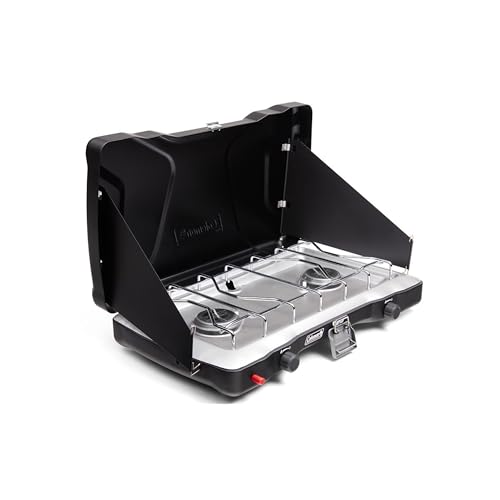
Coleman Triton+ 2-Burner Propane Camping Stove with InstaStart Ignition
Best for cooking the whole catch at a car camp
Coleman Triton+ 2-Burner Propane Camping Stove with InstaStart Ignition
Best for cooking the whole catch at a car camp
What we like
- Dual 11,000 BTU burners let you fry fish on one side and run a pot of sides on the other simultaneously.
- PerfectFlow pressure technology keeps heat steady even as the propane cylinder empties.
- Wind block panels fold out to shield both burners and adjust wide enough to fit a 12-inch cast iron pan.
- Push-button InstaStart ignition lights without matches — no fumbling in the dark after a late session.
What we don't
- At 12 lbs it is a car-camping-only stove — it does not go in a pack.
- Runtime on a single 16.4 oz cylinder is roughly one hour on high, so multi-day trips need extra canisters.
- Wind guards are effective but not sealed — sustained gusts above 20 mph can still disrupt the flame.
Two burners is not a luxury when you are trying to fry a full catch and heat sides for four people — it is a necessity, and the Coleman Triton+ gives you that setup at a price that leaves room in the budget for more bait. This stove belongs in any fishing party that drives to camp and wants real outdoor cooking, not just boiling water.
Pass on it if you are hiking in, kayaking to your site, or cooking solo — the weight and size make it the wrong tool for those trips.
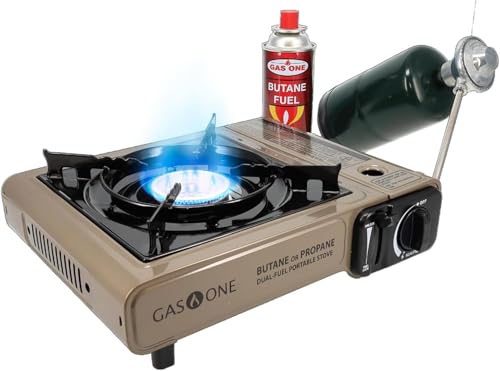
Gas One GS-3400P Propane or Butane Dual Fuel Camping Stove
Best for fishing trips when resupply fuel is uncertain
Gas One GS-3400P Propane or Butane Dual Fuel Camping Stove
Best for fishing trips when resupply fuel is uncertain
What we like
- Accepts both 8 oz butane cartridges and standard 16.4 oz propane cylinders via included adapter — the most fuel-flexible single-burner stove at this price.
- Carrying case included, making it one of the few stoves in this price range that packs neatly for transport.
- Built-in pressure sensor ejects the butane cartridge if it detects irregular pressure, preventing dangerous flare-ups.
- At under $50 it is the easiest stove to replace if it gets dropped off a dock or left behind at camp.
What we don't
- Single burner limits you to one cooking task at a time — slow for group meals.
- Build quality is noticeably lighter than Coleman or Camp Chef at this price point.
- Butane performance drops in cold weather, same limitation as isobutane canister stoves.
The Gas One GS-3400P solves a real problem: you are three days into a remote fishing trip, you burned through your isobutane canisters, and the only fuel available at the closest gas station is a propane cylinder — this stove switches over with the included adapter and keeps cooking without missing a beat. At under $50 with a carrying case included, it is also the best stove if you want a capable backup that lives in the truck permanently.
Do not rely on it as your only stove for a group — one burner is not enough for cooking a full catch for four people.
Camp Chef Explorer Two Burner Stove
Best for serious basecamp cooking and big group fish fries
Camp Chef Explorer Two Burner Stove
Best for serious basecamp cooking and big group fish fries
What we like
- Two 30,000 BTU cast-aluminum burners — 60,000 BTUs total is enough output to run a fish fry for six people without losing heat mid-cook.
- Detachable steel legs fold down for transport and snap on quickly at camp, setting up a stable cooking platform on uneven ground.
- Compatible with the full Camp Chef 14-inch accessory line including a cast iron griddle, pizza oven, and grill box for serious camp cooking.
- Three-sided windscreen shields both burners and handles coastal or lake wind better than the open-frame Coleman design.
What we don't
- At 20 lbs it is the heaviest stove on this list — this is a drive-to-camp-only setup.
- Requires a separate 20 lb propane tank for best value; the 16 oz cylinders drain quickly at 60,000 BTU output.
- No built-in igniter — you need a lighter or fire steel to start it.
When you are feeding a fishing party of five or six and cooking a full catch with sides, the Camp Chef Explorer is the stove that does not make you compromise — 60,000 BTUs across two burners means you run a full fish fry on one side and a pot of corn on the other without either losing heat. This is basecamp infrastructure, not a day-trip stove, and it earns its 20-lb weight if your fishing camp is a true camp with a table and a truck nearby.
If you are cooking for fewer than four people, the Coleman Triton+ gives you similar capability at 8 lbs less.
What to Look For
Wind resistance is the single most important spec for fishing stoves. Lakes create consistent crosswind, and an unshielded flame loses 20-40 percent of its heat output in a 10 mph breeze.
Boil time matters more on fishing trips than almost any other camping use case. You want coffee fast before you're on the water and a hot meal ready fast when you're off it — anything over four minutes for a liter of water is too slow.
Fuel type determines how you plan your trip. Isobutane canisters are cleaner and easier for weekend trips, but dual-fuel stoves give you more options when you're resupplying at a gas station instead of a gear shop.
Who Should Skip This
If you never cook anything more complex than boiling water for instant coffee, an integrated canister system like the Jetboil is all you need and everything else is overkill. If you're kayak fishing and weight is an absolute ceiling, even the lightest stoves here may push your limit — an alcohol stove might be the better call.
And if you only fish from a boat with a built-in cooker, skip this category entirely.
What the Community Actually Uses
On r/kayakfishing, stove recommendations come up constantly in trip prep threads and the consensus is almost always the same: wind resistance beats raw BTU output when you're cooking on or near the water. Integrated canister systems get the most love for solo day trips, while two-burner propane setups dominate the car camping and group fishing camp threads.
A recurring tip is to test your stove at home in windy conditions before a trip — not after.
Quick Picks — In Case You've Already Decided
Frequently Asked Questions
What fuel is best for a fishing camp stove?
Isobutane canisters are the most convenient for weekend fishing trips — clean, no priming, and widely available at outdoor stores. For remote or multi-week trips, propane from a standard cylinder gives you more fuel for less money. Dual-fuel stoves that accept both give you the most flexibility when resupply options are limited.
Can I cook fish directly on a camping stove?
Yes, with the right cookware — a cast iron skillet or a portable fry pan works well on any two-burner propane stove with enough BTU output. Single-burner canister stoves can do it too, but the smaller cooking surface limits what you can fry at once. Make sure your stove has a stable pot support wide enough to hold a pan without tipping.
How much wind resistance do I actually need?
Enough to maintain a consistent flame in a 10-15 mph crosswind, which is common on open water. Integrated systems like the Jetboil and Fire-Maple have built-in heat exchangers that handle wind well. Open-burner stoves like the Coleman and Camp Chef rely on their wind guards, which work fine for car camping but can struggle in sustained gusts.
How do I keep my stove from rusting if I fish near saltwater?
Rinse your stove with fresh water after every coastal trip and dry it completely before storing. Stainless steel construction like the Camp Chef Stainless Explorer is purpose-built for coastal environments. For standard stoves, a light coat of cooking oil on cast aluminum parts prevents surface corrosion.
Is a two-burner stove worth it for a fishing trip?
For solo or duo fishing trips with light cooking, a single-burner system is lighter and easier to manage. Two-burner stoves earn their weight when you're cooking a full fish fry for a group or need to run a pan and a pot simultaneously — which is almost every time you cook fresh catch at camp.
Buying Guide
You need fast boil for coffee before the bite, low simmer for cooking your catch, and wind resistance because lakes are always breezy. Weight matters if you're hiking in.
BTU output matters if you're car camping and cooking for a group. Fuel flexibility is a bonus when you're far from a gear shop.