A standard canister stove loses up to 50% of its output below freezing — that sputtering flame isn't user error, it's physics. The five stoves below use pressure regulators, radiant burners, or liquid-feed systems to hold full power at -20°C.
| Photo |
Top Pick

|
Versatile
|
Budget

|
Best Value

|
Best for Reliability

|
|---|---|---|---|---|---|
| Product | MSR WindBurner Personal Stove System | SOTO WindMaster Backpacking Stove with 4Flex | Jetboil Flash Camping Stove Cooking System | MSR WhisperLite Universal Compact Hybrid Fuel Camping and Backpacking Stove | Optimus Vega 4-Season Remote Canister Stove |
| Fuel | Canister (isobutane-propane) | Canister (isobutane-propane) | Canister (isobutane-propane) | Canister or liquid (white gas, kerosene, unleaded) | Canister (isobutane-propane) |
| Weight | 14.9 oz (system) | 2.3 oz (67g, stove only) | 13.1 oz (system) | 11.2 oz (stove only) | 6.3 oz (178g) |
| Seasons | 3-4 season | 3-4 season | 3 season | 4 season | 4 season |
| Boil time | 4.5 min / 1L | 2.5 min / 2 cups | 100 seconds / 0.5L | 3.5 min / 1L (white gas) | 3 min / 1L (4-season mode) |
| Buy Now | Check Price → | Check Price → | Check Price → | Check Price → | Check Price → |
Quick Tips
Warm your fuel canister in your sleeping bag or jacket pocket before cooking — cold canisters lose pressure fast even with regulated stoves.
Isobutane-propane blends (like MSR IsoPro) outperform straight butane in cold; always check what blend you're running.
Shield your stove from wind even if it claims to be windproof — a rock or pack wall cuts fuel consumption significantly.
If temps are consistently below -10°C, seriously consider a liquid fuel stove; canister performance becomes unreliable no matter the regulator.
MSR WindBurner Personal Stove System
Best for fast solo boils in wind and cold
MSR WindBurner Personal Stove System
Best for fast solo boils in wind and cold
What we like
- Radiant burner and pressure regulator work together to hold consistent output in wind and sub-freezing temps.
- Fully enclosed system means wind effectively does nothing to boil times — genuinely rare in canister stoves.
- Integrated 1L pot, bowl, and strainer nest into one compact package with room for a 4oz canister inside.
- Boil-to-simmer control lets you actually cook, not just boil water.
What we don't
- Only compatible with WindBurner cookware — you can't use your existing pots.
- 14.9 oz system weight is heavy compared to a bare burner-and-separate-pot setup.
- Canister fuel still struggles below -15°C even with the regulator.
When your standard stove is sputtering at 2°C and everyone else is already eating, the WindBurner's radiant burner and pressure regulator are doing the work yours isn't. You get consistent flame from a full canister down to the last cold dregs, in wind that would kill any top-mounted burner.
This is the pick if you're a solo camper or backpacker who wants maximum simplicity — one system, one fuel type, no fiddling. If you cook for groups or need pots larger than 1L, look at the WhisperLite instead.
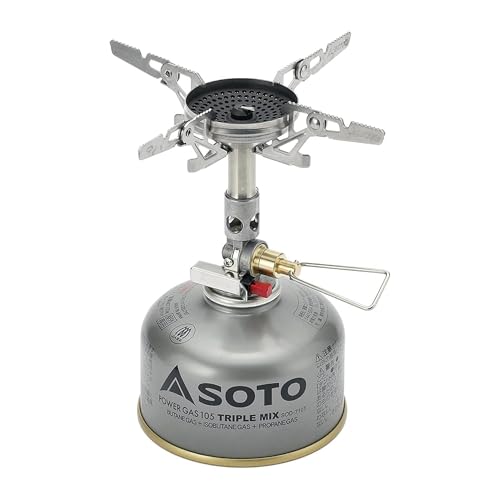
SOTO WindMaster Stove with 4Flex
Best for ultralight backpackers who actually cook
SOTO WindMaster Stove with 4Flex
Best for ultralight backpackers who actually cook
What we like
- Micro regulator holds consistent output in cold and low-fuel conditions without the integrated pot penalty.
- At 2.3 oz it's one of the lightest regulated stoves available — essentially weightless in a backpacking context.
- 4Flex pot support handles large pots and pans stably; TriFlex (sold separately) covers small Ti mugs.
- Stealth igniter built into the burner post survives rough handling better than exposed piezo systems.
What we don't
- Canister is top-mounted, so it gets warm during use — not ideal for extreme cold below -10°C.
- No integrated cookware means you need a separate pot, adding pack organization complexity.
- Small burner head needs a windscreen in sustained wind despite the regulator.
The WindMaster gives you regulated cold-weather performance without forcing you into an integrated system — you use whatever pot you already own, keep the weight to 2.3 oz, and still get consistent flame when temps drop. It's the stove serious ultralight hikers pick when they also want to cook real food, not just rehydrate bags.
If you're doing base camp meals for a group, step up to the WhisperLite. If you want the simplest possible boil system, the WindBurner is faster.
The WindMaster is for the backpacker who wants cold-weather reliability without giving up flexibility.
Jetboil Flash Camping Stove Cooking System
Best for fast boils on a budget
Jetboil Flash Camping Stove Cooking System
Best for fast boils on a budget
What we like
- FluxRing heat exchanger boils water in 100 seconds — faster than almost any canister stove at this price.
- Thermochromatic color-change indicator tells you when water is hot without lifting the lid.
- All components nest into the 1L cup for a compact, self-contained kit.
- Push-button igniter is reliable and eliminates the need to carry a separate lighter.
What we don't
- No pressure regulator means output drops noticeably below 0°C — this is a 3-season stove pushed into 4-season territory.
- Proprietary cup system limits cooking to boiling; no simmering or frying possible.
- Cold weather performance lags behind regulated stoves by a meaningful margin below freezing.
The Flash is the fastest and cheapest way to boil water in the lineup — it earns its place on cold shoulder-season trips where temps hover around freezing but don't dive below it. The FluxRing heat exchanger is genuinely impressive for the price; you'll outboil more expensive stoves in calm, mild conditions.
This is not the pick for true winter camping or consistent temps below -5°C. If that's your use case, pay up for the WindBurner or SOTO WindMaster — the Flash will frustrate you when the canister cools down.
MSR WhisperLite Universal Hybrid Fuel Stove
Best for extreme cold and international travel
MSR WhisperLite Universal Hybrid Fuel Stove
Best for extreme cold and international travel
What we like
- Runs on canister or liquid fuel — switch between isobutane and white gas depending on temperature and availability.
- Liquid-feed canister mode delivers consistent cold-weather performance that regulated canister stoves can't match.
- Self-cleaning Shaker Jet technology clears clogs in the field without tools.
- Made in the USA with field-serviceable parts — this stove can last decades with maintenance.
What we don't
- Requires priming when used with liquid fuel — there's a learning curve compared to canister-only stoves.
- At 11.2 oz stove-only (plus fuel bottle weight), it's heavier than any canister system here.
- Simmering is possible but less precise than a canister stove with a good valve.
When it's -15°C and your canister stove has given up, the WhisperLite is still cooking. Switch to liquid fuel and you've got a stove that runs on white gas, kerosene, or even unleaded — no canister logistics, no pressure problems, no excuses.
It's the choice for mountaineers, winter campers, and international travelers who can't rely on finding canister fuel. If you're car camping or doing mild three-season trips, this is more stove than you need.
But for anyone pushing into genuine winter conditions or remote destinations, no canister stove competes with it on reliability.
Optimus Vega 4-Season Remote Canister Stove
Best budget pick for true 4-season canister performance
Optimus Vega 4-Season Remote Canister Stove
Best budget pick for true 4-season canister performance
What we like
- Inverted canister design delivers liquid fuel to the burner, holding strong output to -20°C — rare at this price.
- Remote canister via hose gives the stove an ultra-low center of gravity, dramatically improving stability with large pots.
- Dual mode: upright for fuel efficiency and simmering, inverted for maximum cold-weather power.
- Included windscreen and low profile work together to shelter the flame better than top-mount designs.
What we don't
- No piezo igniter — you need a lighter or matches, which is annoying in gloves at -10°C.
- Remote canister hose setup takes longer to configure than a direct-mount stove.
- Less common brand means fewer online resources if something goes wrong in the field.
The Vega does something most canister stoves under $100 can't: flip the canister upside down and deliver liquid fuel to the burner, cutting your boil time by 20% and keeping pressure consistent to -20°C. You get the convenience of isobutane with cold-weather performance that should cost more.
The catch is the setup — a hose and inverted canister takes more time to configure than twisting a stove onto a canister. If you want the simplest possible camp kitchen, the WindBurner or WindMaster win.
If you want true 4-season canister performance and a lower price, the Vega is the better call.
What to Look For
A pressure regulator is the single most important cold-weather feature in a canister stove. Without it, output drops as the canister cools and empties, leaving you with a weak flame exactly when you need heat most.
Liquid fuel stoves bypass this problem entirely by running on white gas or multi-fuel blends that don't lose pressure in the cold. They require priming and more maintenance, but they're the benchmark at extreme temperatures.
Windproofing matters as much as cold performance — a stove that holds pressure but loses heat to wind is still slow. Look for an enclosed burner design or a stove paired with a serious windscreen.
Who Should Skip This
If you're only camping in spring and fall with mild temps above 5°C, a cold-weather stove is overkill — a simple canister top stove like the MSR PocketRocket 2 will serve you better at half the price. These picks are built for shoulder-season and winter use where performance under pressure, literally, is non-negotiable.
What the Community Actually Uses
On r/ultralight and r/CampingandHiking, cold-weather stove threads get heated fast. The consensus there generally breaks down to WindBurner or SOTO WindMaster for canister users, and WhisperLite for anyone going below -15°C or traveling internationally where canister fuel isn't guaranteed.
Quick Picks — In Case You've Already Decided
Frequently Asked Questions
Why does my canister stove lose power in cold weather?
Canister fuel is a pressurized liquid that vaporizes into gas for combustion. When the canister gets cold, vaporization slows and pressure drops, starving the flame. Regulators and radiant burners compensate — but they can't fully overcome severe cold without an inverted or liquid-feed design.
What's the coldest temp a canister stove will work at?
A basic canister stove struggles below 0°C. A regulated canister stove like the MSR WindBurner or SOTO WindMaster holds reasonable output to around -10°C to -15°C. Below that, liquid fuel is the reliable choice.
Is the MSR WhisperLite hard to use for a beginner?
It's more involved than a canister stove — you need to prime it and occasionally clean the jet. That said, the technique takes about five minutes to learn and becomes automatic. For genuine cold-weather reliability, it's worth the small learning curve.
Can I use a cold-weather stove in summer too?
Absolutely. All five picks here work in warm weather — you'll just consume a bit more fuel per boil with regulated stoves vs. bare-bones canister stoves. The trade-off is worth it if you camp across multiple seasons.
Should I get a stove with an integrated pot or a separate burner?
Integrated systems like the Jetboil Flash or MSR WindBurner are faster to boil and more fuel-efficient but limit your cooking flexibility. A separate burner like the SOTO WindMaster or Optimus Vega works with any pot and suits real cooking — not just boiling water.
Buying Guide
Cold kills canister pressure — you need a stove that compensates. Look for a pressure regulator, a radiant burner, or an inverted canister design.
Windproofing matters just as much as cold performance. Match your stove to your fuel plan: canister is convenient, liquid fuel goes everywhere and works colder.