Picking the wrong stove as a beginner means eating cold food on night one — and that problem has a straightforward fix. These five options cover every setup from solo backpacking to car camping, with the simplest lighting one liter of water in 3.5 minutes.
| Photo |
Top Pick

|
Versatile
|
Budget

|
Best Value

|
Best for Reliability

|
|---|---|---|---|---|---|
| Product | MSR PocketRocket 2 Ultralight Camping and Backpacking Stove | Coleman Classic 2-Burner Propane Camping Stove | Jetboil Flash Camping Stove Cooking System | Camp Chef Everest 2X Two-Burner Stove | Primus Classic Trail Backpacking Stove |
| Fuel | Isobutane-propane canister | Propane (1-lb cylinder) | Isobutane-propane canister | Propane (1-lb or bulk adapter) | Isobutane-propane canister |
| Weight | 2.6 oz | 11.5 lbs | 13.1 oz | 12 lbs | 8.8 oz |
| Seasons | 3-season | 3-season | 3-season | 3-season | 3-season |
| Boil time | 3.5 min per liter | ~4 min per liter | 100 sec per liter | ~3 min per liter | ~4 min per liter |
| Buy Now | Check Price → | Check Price → | Check Price → | Check Price → | Check Price → |
Quick Tips
Buy your fuel canister at the same time as your stove — most canister stoves need isobutane-propane blends, and hardware store propane canisters will not fit.
Test your stove at home before the trip — light it in the backyard so the first time you troubleshoot is not in the dark at camp.
Wind kills canister stove output fast — position your stove behind a rock or pack as a windbreak before you turn it on.
Never store a propane or canister stove with the fuel attached — thread it off after every use and store separately.
MSR PocketRocket 2 Ultralight Backpacking Stove
Best for solo backpacking trips where weight and pack space matter
MSR PocketRocket 2 Ultralight Backpacking Stove
Best for solo backpacking trips where weight and pack space matter
What we like
- At 2.6 oz it disappears into any pack without a second thought about weight.
- No priming, no preheating — screw it onto a canister, turn the valve, and light it.
- Flame adjusts from a full rolling boil down to a true simmer for actual cooking.
- Folds to the size of a tennis ball and fits inside most cookpots.
What we don't
- No built-in igniter means you need a separate lighter every single time.
- Wind kills output quickly — it needs a windbreak in anything above a light breeze.
- Canister fuel is not always available at small rural gas stations or remote trailheads.
If you are going backpacking for the first time and need exactly one stove to learn on, this is it — it is the same stove most experienced backpackers still carry after years of trying alternatives, because nothing simpler exists at this weight. This is the right pick for anyone heading out solo or with one partner on trips where pack weight matters.
If you are car camping and want to cook real meals with two pans going at once, look at the Coleman or Camp Chef options instead.
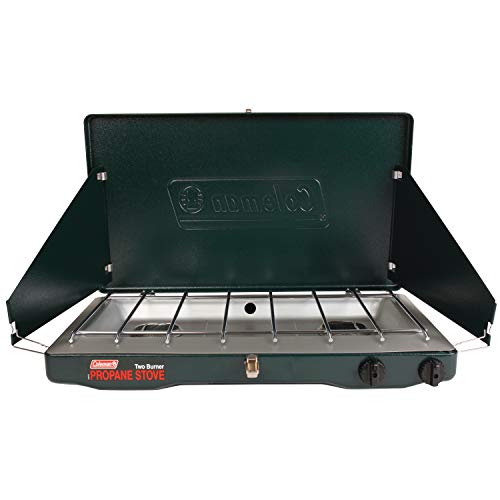
Coleman Classic Propane Camp Stove 2-Burner
Best for car camping families cooking real meals at the site
Coleman Classic Propane Camp Stove 2-Burner
Best for car camping families cooking real meals at the site
What we like
- Two independent burners let you boil water and cook bacon at the same time without timing tricks.
- Runs on standard 1-lb propane cylinders available at virtually any hardware or grocery store.
- Wind-blocking panels on three sides keep the flame steady in camp breezes.
- Has sold millions of units for decades — parts, fuel, and replacement grates are everywhere.
What we don't
- At 11.5 lbs it stays in the car — not a realistic option for any trail or backpacking use.
- No built-in igniter on the classic version — you need a lighter or matches to start it.
- Cooking surface is sized for 10-inch pans, which feels limiting when cooking for four or more.
You show up at the campsite, unfold it like a suitcase, screw on a propane canister, and start cooking eggs — that is the entire setup process, which is exactly what a beginner needs on a first trip when everything else is already unfamiliar. This is built for the family car camper who wants to cook actual food, not just boil water for instant meals.
If you are backpacking even occasionally, you will need a separate stove — this one does not leave the car.
Jetboil Flash Camping and Backpacking Stove System
Best for beginners who want the fastest, most foolproof setup possible
Jetboil Flash Camping and Backpacking Stove System
Best for beginners who want the fastest, most foolproof setup possible
What we like
- Boils 16 oz of water in 100 seconds — the fastest system in its class for dehydrated meals and hot drinks.
- Cooking cup locks directly onto the burner in one twist — no separate pot, no balancing act.
- Color-change heat indicator on the cozy tells you visually when water is ready without checking.
- Push-button igniter built in — no lighter required, no fumbling at 6am.
What we don't
- The integrated cup system is optimized for boiling water, not actual cooking with a pan.
- At $110+ it costs twice as much as the MSR PocketRocket for similar trail functionality.
- 1-liter cup is sized for one person — groups of two or more will be taking turns.
The Jetboil eliminates every variable a beginner might mess up: the cup locks on, the igniter is built in, and the color indicator removes the guesswork of when water is actually boiling — it is the closest thing to an idiot-proof trail stove that exists. This is the pick if your main camp cooking is hot drinks, instant coffee, and freeze-dried meals and you want them done fast with zero hassle.
If you want to actually cook — scrambled eggs, pasta, real food — the open-flame stoves give you more flexibility.
Camp Chef Everest 2X 2-Burner Portable Camping Stove
Best for group car camping where serious cooking output matters
Camp Chef Everest 2X 2-Burner Portable Camping Stove
Best for group car camping where serious cooking output matters
What we like
- 40,000 total BTUs across two burners puts out nearly twice the heat of the Coleman Classic.
- Matchless ignition built into both burners — no lighter needed for either side.
- Folds flat and latches like a suitcase for transport with a carry handle built in.
- Compatible with a bulk propane adapter so you can run it off a 20-lb tank for longer trips.
What we don't
- At 12 lbs it is strictly a car camping stove — there is no trail use case here.
- Cooking surface of 215 sq in is generous but the legs are not height-adjustable, which can be awkward.
- Costs $30-50 more than the Coleman Classic for features most beginner car campers will not immediately notice.
If you are showing up to a campsite with four people and want to cook real food without the stove being the bottleneck, 40,000 BTUs gets water boiling before you finish setting up chairs — and the built-in ignition on both burners means no fumbling with lighters. This is for the car camper who has graduated from 'just boiling water' and wants a stove that handles actual group cooking.
If you are a beginner who is not sure how often you will camp, start with the Coleman and upgrade here once you know you want the output.
Primus Classic Trail Backpacking Stove
Best budget canister stove for beginners who want simple and durable
Primus Classic Trail Backpacking Stove
Best budget canister stove for beginners who want simple and durable
What we like
- Under $30 makes it the lowest-stakes entry point for anyone testing whether they enjoy camp cooking.
- No folding parts or moving components — it attaches to a canister and works, every time.
- Wide static flame distributes heat more evenly across a pot base than narrow canister stoves.
- Has been in production since the early 1980s — the design is proven over decades of outdoor use.
What we don't
- No built-in igniter — you need a separate lighter or matches to start it.
- At 8.8 oz it weighs more than the MSR PocketRocket for essentially the same core function.
- No simmering precision — flame control is basic, which limits it to boiling and high-heat cooking.
If you want to find out whether camp cooking is something you will actually do before spending $50 or more, this stove removes the financial risk entirely — screw it onto a canister, bring a lighter, and it works without any learning curve. This is the first stove for someone who camps occasionally and wants something simple and nearly indestructible.
Once you know you love it, the PocketRocket or Jetboil become obvious upgrades — but many people never feel the need to switch.
What to Look For
Fuel type determines everything else you buy. Canister stoves run on isobutane-propane blends, which screw directly onto the burner — easy and clean, but canisters cost more per cook and are not always available at small rural stores.
Ignition system matters more than beginners expect. A built-in piezo igniter means one button press to start; stoves without one require a lighter or matches, which becomes a problem in wet or windy conditions.
Boil time and BTU output tell you how fast you can actually eat. A stove that takes 8 minutes to boil water at altitude is not slower than one that takes 3 minutes — it is a different experience entirely, especially when you are cold and hungry.
Who Should Skip This
Skip this category entirely if you are cooking for groups larger than four people regularly — a full camp kitchen setup with a standalone burner and large pot will serve you better than any stove on this list. Also skip canister stoves if you camp in very cold temperatures below 20°F frequently, as canister pressure drops sharply in the cold and boil times become unpredictable.
What the Community Actually Uses
On r/CampingandHiking and r/ultralight, the beginner stove question comes up weekly and the answer is almost always the same: start with a canister stove, learn your fuel consumption, then decide if you need something more specialized. The MSR PocketRocket 2 and Jetboil Flash dominate those threads for good reason — both are near-foolproof.
Quick Picks — In Case You've Already Decided
MSR PocketRocket 2 Ultralight Camping and Backpacking Stove
Check Price on AmazonFrequently Asked Questions
What fuel do beginner camp stoves use?
Most beginner stoves use either isobutane-propane canisters (for backpacking stoves) or standard 1-lb propane bottles (for car camping stoves like Coleman). Canister stoves screw directly onto threaded Lindal valve canisters — the same type sold at REI, outdoor stores, and most sporting goods chains.
Do I need a separate lighter for a camp stove?
It depends on the stove. Stoves with a piezo igniter have a built-in spark button and light with one press. Stoves without one — including the MSR PocketRocket 2 — require a separate lighter or matches. Always carry a backup lighter regardless.
Can I use a camp stove inside a tent?
No. Camp stoves produce carbon monoxide and present a fire risk — never use one inside a tent, vestibule, or enclosed space. Even vented spaces like a truck camper or van require proper ventilation and a CO detector.
How long does a fuel canister last?
A standard 100g canister lasts roughly 1 to 2 hours of cook time, depending on output and wind. A 230g canister covers most 3-day solo trips at typical use. Track your canisters on a weight scale to know how much fuel remains.
Is a two-burner stove worth it for a beginner?
Yes, if you car camp and cook real meals. Two burners let you boil water and cook food at the same time — a game changer when you are hungry after a long day. If you backpack, a two-burner adds too much weight and a single canister stove is the right call.
Buying Guide
You need to decide two things before buying: how you camp and how many people you feed. Car campers do better with a two-burner propane stove — more cooking surface, no fiddly canisters.
Backpackers need a canister stove that fits in a pack. Everything else is secondary to those two questions.