A wind-killed flame is a solved problem, not a camping reality you have to accept. The five stoves here use radiant burners, pressure regulators, or folding windscreens to boil a liter of water in under three minutes even in a 20 mph headwind.
| Photo |
Top Pick

|
Versatile
|
Budget

|
Best Value

|
Best for Reliability

|
|---|---|---|---|---|---|
| Product | MSR WindBurner Personal Stove System | SOTO WindMaster Backpacking Stove with 4Flex | Jetboil Flash Camping Stove Cooking System | Camp Chef Everest 2X Two-Burner Stove | BRS-3000T Ultralight Titanium Backpacking Stove |
| Fuel | Isobutane/propane | Isobutane/propane blend | Isobutane/propane | Propane | Isobutane/propane |
| Weight | 14.9 oz (with 1L pot) | 2.3 oz (67g) stove only | 13.1 oz (full system) | 12 lbs | 0.9 oz (25g) stove only |
| Boil time | 4.5 min per liter | Under 2.5 min per liter | 100 seconds per liter | Fast (40,000 BTU total output) | Approx. 3 min per liter (ideal conditions) |
| Windscreen | Integrated radiant burner | Built-in micro wind resistance burner | FluxRing heat exchanger with cozy | Three-sided panel windscreen | Separate titanium ring (sold separately) |
| Buy Now | Check Price → | Check Price → | Check Price → | Check Price → | Check Price → |
Quick Tips
Angle your stove so the natural windscreen panels face directly into the wind before you light — reorienting mid-cook wastes fuel and time.
At altitude above 10,000 feet, a pressure-regulated stove (MSR WindBurner, SOTO WindMaster) maintains consistent output where unregulated stoves lose up to 30% efficiency.
Pre-boil water at camp before a hike so your mid-trail meal only needs hot water added — cuts fuel use and exposure time in bad weather.
If you are using a two-burner propane stove in high wind, drop the lid windscreen on the side facing the gusts and cook on the sheltered burner first.
MSR WindBurner Personal Stove System
Best for solo backpackers who cook in exposed, windy terrain
MSR WindBurner Personal Stove System
Best for solo backpackers who cook in exposed, windy terrain
What we like
- Radiant burner enclosed in a sealed combustion chamber means wind literally cannot reach the flame.
- Pressure regulator keeps output steady from a full canister down to the last 20% of fuel.
- System nests completely — stove, canister, and 1L pot pack into one compact unit with no loose parts.
- Heat exchanger on the pot bottom significantly boosts fuel efficiency over standard pots.
What we don't
- Poor simmering control — it runs hot and is optimized for boiling, not precise cooking.
- Proprietary pot system means you cannot use it as a bare burner with your existing cookware.
- At $120-140 it is one of the most expensive solo backpacking stoves on the market.
When wind is the specific problem you are trying to solve, the WindBurner addresses it at the hardware level — the radiant burner and sealed combustion chamber mean you can light this in a full headwind without cupping your hands around it or finding a rock to hide behind. This is the right stove if you are consistently cooking in exposed alpine or ridge-top terrain and boiling water is your primary task.
If you want to actually cook meals with variable heat, look at the SOTO WindMaster instead.
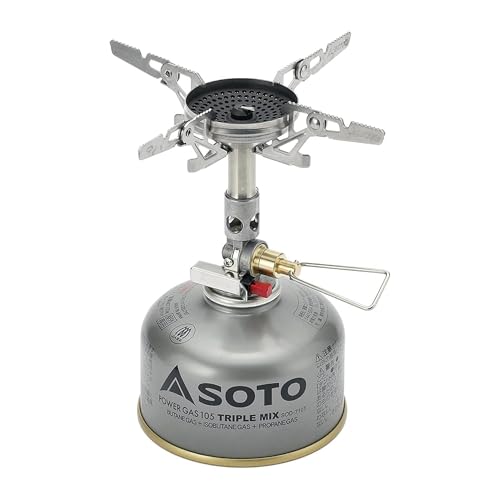
SOTO WindMaster Backpacking Stove with 4Flex
Best for backpackers who want wind resistance plus simmer control
SOTO WindMaster Backpacking Stove with 4Flex
Best for backpackers who want wind resistance plus simmer control
What we like
- Micro-regulator maintains consistent flame output in gusts that shut down most open-burner canister stoves.
- At 2.3 oz it is half the weight of enclosed systems while still handling real wind well.
- 4Flex pot support stabilizes larger cookware — you are not limited to a narrow backpacking pot.
- Stealth igniter is recessed into the burner post so it will not snap off in a pack like exposed igniters do.
What we don't
- Does not match the windproof performance of fully enclosed systems like the MSR WindBurner in extreme gales.
- Requires a SOTO or compatible canister — not universal across all isobutane brands.
- Stove only listing means you need to source your own pot separately.
The WindMaster is the stove for people who want wind protection but also want to actually cook — the micro-regulator gives you a real simmer range that enclosed boiling systems lack entirely. You can reduce a sauce or brown onions; the MSR WindBurner cannot do either.
Choose this over the WindBurner if you eat real camp meals rather than rehydrated pouches, or if you want to shave weight while still handling the wind you would encounter on a three-season alpine trip.
Jetboil Flash Camping Stove Cooking System
Best for speed-focused hikers who want an all-in-one solution
Jetboil Flash Camping Stove Cooking System
Best for speed-focused hikers who want an all-in-one solution
What we like
- FluxRing technology concentrates heat at the pot base and dramatically reduces the wind-surface exposure of the flame.
- 100-second boil time is the fastest in this roundup when conditions are even moderate.
- Thermochromatic color indicator on the cozy tells you when water is ready without lifting the lid.
- Push-button ignition means one-handed lighting in gloves — critical in cold windy conditions.
What we don't
- Like the WindBurner, simmering is limited — it is optimized entirely for fast boiling.
- Cozy and insulated cup add bulk compared to a bare stove-and-pot setup.
- Wind performance lags behind the MSR WindBurner in sustained heavy gusts.
The Jetboil Flash wins on raw speed — if your priority is getting hot coffee or a rehydrated meal done in the shortest possible time, nothing in this roundup touches 100 seconds per liter. The FluxRing design shrinks the exposed flame footprint so moderate wind has little effect on boil time.
This is the right pick for hikers who start early, eat fast, and move on — not for people who want to cook real meals at a relaxed pace. If you have ever stood over a stove waiting for water while your group is already packed up, this solves that problem immediately.
Camp Chef Everest 2X 2-Burner Camp Stove
Best for car campers and overlanders cooking real meals in the wind
Camp Chef Everest 2X 2-Burner Camp Stove
Best for car campers and overlanders cooking real meals in the wind
What we like
- 40,000 total BTUs across two burners gives serious cooking power for group meals even in a stiff breeze.
- Three-sided folding windscreen panels are built into the lid design — no separate windscreen to forget at home.
- Matchless push-button ignition on both burners means no lighter required in cold or wet conditions.
- Full cooking surface fits a 12-inch skillet and a large pot simultaneously.
What we don't
- At 12 lbs it is car camping only — not a stove anyone is backpacking with.
- Three-sided windscreen is good but not sealed — a direct crosswind will still affect the far burner.
- Propane canisters add weight and cost over a multi-week trip compared to canister stoves.
The Everest 2X is the answer when you are cooking for a group out of a truck or van and do not want to play the wind-angle game with a tiny backpacking stove. Two independent burners plus the folding windscreen panels mean you can run both burners in gusty conditions without babysitting the flame.
If you are overlanding, car camping, or hunting camp cooking, this is the right stove. If you are counting ounces or cooking for one, step down to the SOTO WindMaster and save both weight and money.
BRS-3000T Ultralight Titanium Backpacking Stove
Best budget pick for ultralight hikers willing to add a separate windscreen
BRS-3000T Ultralight Titanium Backpacking Stove
Best budget pick for ultralight hikers willing to add a separate windscreen
What we like
- At 25 grams it is the lightest canister stove available — you are essentially adding nothing to pack weight.
- Sub-$20 price point makes it the most accessible wind-capable setup in this roundup when paired with a titanium windscreen ring.
- Titanium construction is genuinely durable for the price — not a stove that bends on first use.
- Nests inside a 750ml pot with a 110g canister for a minimal all-in-one setup.
What we don't
- No built-in wind protection — you must add a separate windscreen ring to match the performance of other stoves here.
- No igniter — you need a lighter or firestarter every single time.
- In sustained heavy wind even with a windscreen ring, performance drops more than with a regulated stove.
The BRS-3000T is the stove for the ultralight obsessive who has already accepted that grams are the only currency that matters. At 25 grams and under $20, the trade-off is simple: add a titanium windscreen ring for around $8 more and you have a sub-30g wind-capable system that costs less than a single canister refill.
This is not the stove for cold-weather backpacking or for someone who wants hassle-free lighting — it rewards experienced hikers who cook efficiently and already know how to manage a canister stove in the field. If you want simplicity, spend up to the SOTO WindMaster.
What to Look For
Windscreen design is the first decision. Enclosed radiant burners (like MSR WindBurner) wrap the flame entirely so wind cannot touch it at all — the most effective option for backpackers cooking in exposed conditions.
Pressure regulation matters in cold weather and at altitude. Without it, output drops as the canister cools, which compounds the wind problem — a regulated stove keeps BTUs consistent even when the canister is half-empty at 28 degrees.
For car camping or overlanding, fold-out side panels on a two-burner stove do the job without any trade-off in cooking surface area. Make sure the panels extend high enough to shield the burner heads, not just the sides of the grate.
Who Should Skip This
Lightweight wood-burning stoves are a poor fit for windy conditions — they require airflow to sustain combustion and cannot be enclosed. If you are cooking primarily in sheltered forest camping or road-side spots with natural wind breaks, any standard canister stove will serve you well and save money over a wind-specialized system.
What the Community Actually Uses
On r/ultralight, the SOTO WindMaster consistently comes up when members compare grams-to-wind-resistance ratio — several trip reports note it outperforming heavier enclosed systems in moderate gusts because the 4Flex pot support holds large cookware steady in wind without a separate tripod. The BRS-3000T with an aftermarket titanium windscreen ring shows up in budget threads as the go-to starter combo for hikers who want sub-$30 wind protection.
Quick Picks — In Case You've Already Decided
Frequently Asked Questions
Does a windscreen actually make a big difference on a camp stove?
Yes — in a 20 mph wind an unprotected canister stove can take 8 to 10 minutes to boil a liter of water versus under 3 minutes with an enclosed or wind-protected burner. The fuel savings over a week-long trip are also significant.
Is it safe to use a foil windscreen around a canister stove?
No — wrapping a foil windscreen tightly around an isobutane canister traps heat against the canister and can cause a pressure explosion. Only use foil windscreens with liquid-fuel or alcohol stoves, or keep them positioned away from the canister body.
What fuel type works best in cold windy conditions?
Isobutane/propane blends outperform pure butane in the cold because butane stops vaporizing reliably below 32 degrees F. A pressure-regulated stove using an iso/propane blend is the most reliable cold-and-wind combination.
Can I use a backpacking stove with a windshield for group cooking?
Enclosed systems like the MSR WindBurner and Jetboil Flash are sized for one to two people. For groups of three or more, a two-burner camp stove with folding wind panels will be far more practical and faster overall.
How much extra fuel does wind actually waste?
Studies from MSR and independent testers show that moderate wind can increase fuel consumption by 50 to 75% on an unshielded canister stove. On a multi-day trip that difference can mean carrying an extra canister.
Buying Guide
You need to match windscreen design to how you camp. Integrated systems like the MSR WindBurner or Jetboil Flash build the shield into the burner itself — nothing to set up, nothing to forget.
Open two-burner stoves with fold-out panels suit car camping where you need cooking real estate, not grams saved.