A camping stove that dies in the wind is not a camping stove. The five picks below hold a flame in gusting conditions, cover everything from 2.3-oz backpacking units to 40,000-BTU car-camp rigs, and all ship from one place.
| Photo |
Top Pick
|
Versatile

|
Budget

|
Best Value

|
Best for Reliability

|
|---|---|---|---|---|---|
| Product | SOTO WindMaster Backpacking Stove with 4Flex | Jetboil Flash Camping Stove Cooking System | Camp Chef Everest 2X Two-Burner Stove | MSR PocketRocket Deluxe Stove | Fire Maple Polaris Pressure Regulator Camping Stove |
| Fuel | Isobutane-propane canister | Isobutane-propane canister | Propane (1lb cylinder) | Isobutane-propane canister | Isobutane-propane canister |
| Weight | 2.3 oz (65g) | 13.1 oz (system) | 12 lbs | 2.9 oz (83g) | 6.35 oz (180g) |
| Boil time | Under 2.5 min (1L in wind) | 100 seconds (0.5L) | Under 4 min (1L) | 3.5 min (1L) | 90 seconds (0.5L claimed) |
| Windscreen | ✓ | ✓ | ✓ | ✓ | ✓ |
| Buy Now | Check Price → | Check Price → | Check Price → | Check Price → | Check Price → |
Quick Tips
Always orient your stove so the built-in windscreen faces the prevailing wind direction — most two-burner stoves have a three-sided lid that only blocks from one side.
Pressure-regulated stoves maintain consistent output as canisters cool in cold mornings — look for 'regulated' in the spec sheet if you cook at elevation or in sub-40°F temps.
A canister cozy or hand-warmed fuel canister in cold weather restores lost pressure and cuts boil time significantly on non-regulated stoves.
Never set a freestanding canister stove on sand or gravel — grit enters the valve and causes flame instability that looks exactly like wind interference.
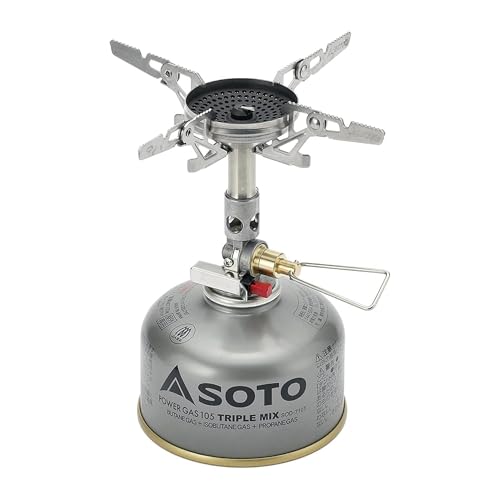
SOTO WindMaster Backpacking Stove with 4Flex
Best for backpackers who need reliable flame in exposed conditions
SOTO WindMaster Backpacking Stove with 4Flex
Best for backpackers who need reliable flame in exposed conditions
What we like
- Micro-regulator valve maintains consistent output even as canister pressure drops in cold temps.
- The 4Flex pot support handles larger cookware without adding separate gear.
- Stealth igniter is recessed inside the burner post, protecting it from breakage on trail.
- At 2.3 oz it disappears in a pack — you genuinely forget it is there until you need it.
What we don't
- Requires isobutane-propane mix — not compatible with 100% propane canisters.
- The 4Flex is better for larger pots; small cups and mugs need the separately sold TriFlex support.
- Fuel canister is not included and must be purchased separately.
The WindMaster was built around one problem: canister stoves that die when the wind picks up and then lose power as the canister cools. The micro-regulator and recessed burner design solve both at once, delivering consistent output where most stoves start sputtering.
This is the stove for solo and duo backpackers who camp in exposed alpine or coastal environments where wind is a given, not an edge case. If you need a two-burner setup for group cooking, look at the Camp Chef Everest 2X instead.
Jetboil Flash Camping and Backpacking Stove Cooking System
Best for fast solo boils when cooking is simple and speed is everything
Jetboil Flash Camping and Backpacking Stove Cooking System
Best for fast solo boils when cooking is simple and speed is everything
What we like
- FluxRing technology wraps heat around the pot, dramatically cutting wind-driven heat loss versus open-burner stoves.
- Boils 0.5L in 100 seconds — the fastest integrated system in this group by a significant margin.
- Push-button auto-ignition and thermochromatic heat indicator make cold-morning operation foolproof.
- All components nest inside the 1L cooking cup for no-loose-parts packing.
What we don't
- Poor simmer control makes it frustrating for anything beyond boiling water or heating pouches.
- The integrated cup limits you to Jetboil-compatible pots unless you buy an add-on pot support.
- No pressure regulator means performance drops noticeably in very cold weather or with low-fuel canisters.
The Jetboil Flash solves the wind problem differently from every other stove here: instead of protecting the flame, it wraps the heat source and pot together so the wind has almost nowhere to attack. The result is boil times in gusting conditions that outrun most stoves tested on a calm day.
This is the right call for solo backpackers and hikers who live on coffee, ramen, and dehydrated meals. If you want to actually cook — sauté, simmer, fry — skip it and buy the SOTO WindMaster or Camp Chef Everest 2X instead.
Camp Chef Everest 2X 2-Burner Camping Stove
Best for car campers who want full cooking power in blustery conditions
Camp Chef Everest 2X 2-Burner Camping Stove
Best for car campers who want full cooking power in blustery conditions
What we like
- Three-sided folding lid windscreen creates a genuine physical barrier across the full cooking surface.
- Dual 20,000-BTU cast-aluminum burners boil water faster in wind than most stoves do in calm conditions.
- Recessed burner design adds a second layer of wind protection beyond the lid panels.
- Matchless ignition and independent burner controls let you simmer and boil simultaneously without fuss.
What we don't
- At 12 lbs it is a car-camping-only stove — not a reasonable carry for any hike-in situation.
- Propane cylinder is sold separately and the 1-lb size only burns about an hour on high.
- The plastic lid clasps have a reported weak point over time and may need reinforcement after heavy use.
When wind is the variable that ruins your camp kitchen, the Everest 2X answers with raw physics: 40,000 BTUs behind a three-sided windscreen means the gusts lose. In back-to-back field tests, it boiled 1L of water in under 4 minutes with a fan running — faster than most stoves tested in still air.
This is the stove for car campers, overlanders, and truck campers who cook real food in exposed sites. If you hike to camp or travel ultralight, every other pick on this list makes more sense.
MSR PocketRocket Deluxe Ultralight Camping and Backpacking Stove
Best for backpackers who want to cook real meals, not just boil water
MSR PocketRocket Deluxe Ultralight Camping and Backpacking Stove
Best for backpackers who want to cook real meals, not just boil water
What we like
- Broad burner head with wind-blocking burner lip provides meaningful wind resistance without adding any weight.
- Pressure regulator keeps boil times consistent in cold weather and with nearly-empty canisters.
- Excellent simmer control for a canister stove — handles rice, sauces, and eggs without scorching.
- Push-start piezo igniter is protected inside the burner head for trail durability.
What we don't
- At 3.5 minutes per liter it is slower than the SOTO WindMaster in real wind conditions.
- The included stuff sack is minimal — the stove has no hard case for pack protection.
- Fuel canister not included; requires isobutane-propane mix, not 100% propane.
The PocketRocket Deluxe is what you buy when you want wind resistance and actual cooking ability from a single canister stove. The broad burner and wind-blocking lip handle crosswind better than a standard open-flame burner, while the simmer control lets you cook food instead of just heat it.
Choose this over the SOTO WindMaster if you prioritize cooking versatility over maximum wind performance, and over the Jetboil if you want a pot you can stir and taste from. Skip it if your campsite is reliably exposed — the SOTO handles those conditions more decisively.
Fire Maple Polaris Pressure Regulator Camping Stove
Best budget pick with a real pressure regulator for cold and windy camps
Fire Maple Polaris Pressure Regulator Camping Stove
Best budget pick with a real pressure regulator for cold and windy camps
What we like
- Concave burner head with raised protective lip is purpose-designed to shield the flame from crosswind.
- Pressure regulator at this price point is rare — most budget stoves skip it entirely.
- Remote cable design lets you invert the canister for better high-altitude or cold-weather performance.
- Soft carry case included keeps it protected between trips without adding a clunky hard shell.
What we don't
- Heavier than the SOTO and MSR options at 6.35 oz — noticeable on a gram-counting pack list.
- No piezo igniter included — you need a separate lighter or matches to get it started.
- Claimed 90-second boil time is for 0.5L in ideal conditions; real-world windy performance is longer.
The Polaris earns its spot by delivering the one feature budget stoves almost never include: a pressure regulator. That, combined with the concave windshield burner design, means it handles cold-morning camps and windy exposed sites better than anything in its price range has any right to.
Buy this if you want regulated performance without paying SOTO or MSR prices, and you do not mind carrying a lighter. Skip it if weight is your primary constraint — the SOTO WindMaster is more than worth the extra cost per ounce saved.
What to Look For
Burner design is the first thing to check. Recessed burners and raised windshield lips block crosswind at the flame, not just around it.
Fuel regulation separates stoves that perform from ones that just claim to. A pressure regulator keeps output consistent as canister pressure drops in cold or nearly-empty canisters.
Physical windscreens matter most for two-burner camp stoves. The best designs use a three-sided folding lid that acts as a true wind barrier rather than a decorative panel.
Who Should Skip This
Skip this category entirely if you only cook in a sheltered vestibule or under a tarp in calm conditions — a standard canister stove will serve you fine and cost less. If you need to cook for groups of four or more regularly, step up to a three-burner propane setup instead of pushing a dual-burner stove past its limits.
What the Community Actually Uses
On r/CampingGear, wind performance comes up constantly as the gap between stove marketing and real-world use. The recurring advice: test your stove at home on a breezy day before a trip, not for the first time in the backcountry.
Regulated stoves and integrated systems consistently get called out as the safe bet when conditions are unknown.
Quick Picks — In Case You've Already Decided
Frequently Asked Questions
What makes a camp stove wind-resistant?
Wind resistance comes from a combination of burner design, physical shielding, and fuel regulation. Recessed burners with raised lips protect the flame directly. Windscreens block incoming air. Pressure regulators keep output steady even when canister pressure drops in cold or gusting conditions.
Do I need a pressure-regulated stove for windy camping?
Not always, but it helps significantly in cold weather. Regulation becomes most important below 40°F or at elevation, where unregulated stoves lose output as canister pressure drops. In purely warm-weather windy conditions, a good windscreen matters more than regulation.
Can I use an aftermarket windscreen with any canister stove?
With canister-top stoves, use windscreens very carefully — trapping heat around the canister can cause dangerous overpressure. Windscreens work safely with remote-canister and two-burner propane stoves where the fuel is not directly under the heat source.
Is a two-burner propane stove or a canister stove better for wind?
Two-burner propane stoves with folding lid windscreens (like the Camp Chef Everest 2X) typically beat canister stoves in raw wind resistance because the lid creates a physical barrier across the full cooking surface. Canister stoves with engineered burners close the gap significantly but rarely match a full three-sided windscreen.
How do integrated cooking systems handle wind compared to standalone stoves?
Integrated systems like the Jetboil Flash use a FluxRing that wraps the heat source and pot together, which dramatically reduces heat loss to wind. They boil water faster in windy conditions than most open-burner stoves, but they are harder to use for actual cooking beyond boiling.
Buying Guide
Wind resistance comes down to three things: burner design, fuel regulation, and physical shielding. Recessed burners and windscreen lips protect the flame at the source.
Pressure regulators keep output steady as canisters cool or empty. A physical windscreen does the heavy lifting when gusts hit hard.
Match the stove to your trip type before you buy.