A stove that folds under wind pressure or chokes in the cold is not a survival stove, it is dead weight. These five hold flame in real conditions — the lightest tips the scale at 2.3 oz and the most resilient runs on white gas, kerosene, or whatever fuel you can source.
| Photo |
Top Pick

|
Versatile
|
Budget

|
Best Value

|
Best for Reliability

|
|---|---|---|---|---|---|
| Product | MSR PocketRocket 2 Ultralight Camping and Backpacking Stove | SOTO WindMaster Backpacking Stove with 4Flex | Jetboil Flash Camping Stove Cooking System | MSR WhisperLite Universal Hybrid Fuel Camping and Backpacking Stove | Solo Stove Lite Portable Wood Burning Backpacking Stove |
| Fuel | Isobutane-propane canister | Isobutane-propane canister | Isobutane-propane canister | White gas, kerosene, canister | Wood, twigs, pinecones |
| Weight | 2.6 oz | 2.3 oz | 13.1 oz (system) | 11.2 oz | 9 oz |
| Seasons | 3-season | 4-season | 3-season | 4-season | 4-season |
| Boil time | 3.5 min / liter | 2.5 min in wind | 100 seconds | 3.5 min / liter | 8-10 min / 34 oz |
| Buy Now | Check Price → | Check Price → | Check Price → | Check Price → | Check Price → |
Quick Tips
Always carry a backup ignition source — a lighter plus a ferro rod weighs almost nothing and eliminates the single biggest failure point of any stove system.
In wind above 15 mph, an integrated windscreen cuts fuel consumption by up to 40 percent — prioritize stoves with built-in protection over aftermarket shields.
At altitude above 8,000 feet, liquid fuel stoves outperform canister stoves because pressure regulators struggle in low-oxygen environments.
Test your stove in your backyard in cold weather before any serious trip — cold-weather canister performance drops fast below 20 degrees Fahrenheit.
MSR PocketRocket 2 Ultralight Backpacking Stove
Best for ultralight survival kits where every gram counts
MSR PocketRocket 2 Ultralight Backpacking Stove
Best for ultralight survival kits where every gram counts
What we like
- At 2.6 oz it is among the lightest canister stoves on the market without sacrificing durability.
- Boils one liter in 3.5 minutes, making water purification fast even in cold conditions.
- Serrated pot supports grip cookware securely on uneven terrain without shifting.
- Folds to 2x2x3 inches and stores inside most cook pots, taking up almost no pack space.
What we don't
- No built-in windscreen means performance drops in strong crosswinds without a separate shield.
- Depends entirely on isobutane-propane canisters, which are not always available in remote resupply points.
- Below 20 degrees Fahrenheit, canister pressure drops and boil times increase noticeably.
When your survival priority is moving fast and cooking faster, the PocketRocket 2 removes every excuse to skip hot meals or delay water purification — it lights on the first try and boils in 3.5 minutes without ceremony. This is the right call for three-season backpackers, bug-out scenarios where you are moving on foot, and anyone building a kit where ounces translate directly to miles.
If your scenario involves extreme cold below 20 degrees or remote locations where canisters are unavailable, look at the WhisperLite instead.
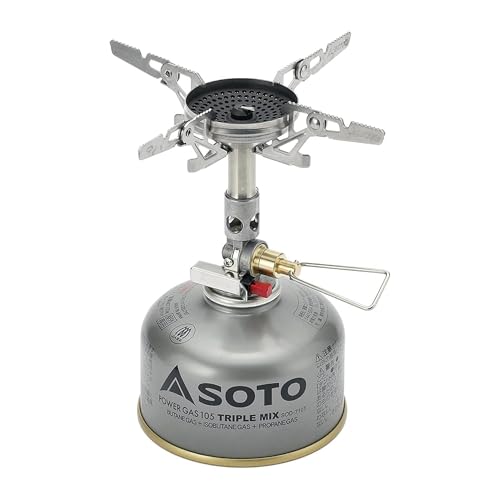
SOTO WindMaster Canister Stove with 4Flex
Best for high-wind and alpine survival conditions
SOTO WindMaster Canister Stove with 4Flex
Best for high-wind and alpine survival conditions
What we like
- Micro-regulator valve maintains consistent output across a wide temperature range including cold conditions.
- Built-in windscreen design boils 2 cups of water in under 2.5 minutes even in strong winds.
- At 2.3 oz it is lighter than the PocketRocket 2 while adding meaningful wind resistance.
- 4Flex pot supports accommodate large pots, giving you real cooking flexibility at basecamp.
What we don't
- More expensive than comparable canister stoves without a windscreen upgrade kit.
- Valve system requires keeping the canister cap on during storage or transport to stay clean.
- Like all canister stoves, struggles below 20 degrees Fahrenheit without canister warming.
The WindMaster is the stove that exposes every other canister stove's weakness — when wind flattens a standard flame and you are still waiting on water 15 minutes later, a micro-regulated burner with built-in wind protection is not a luxury, it is a different category of tool. Choose this if your survival scenarios involve exposed ridgelines, alpine terrain, or coastal environments where consistent headwinds are the norm.
If you are mostly in sheltered forest camps, the PocketRocket 2 saves you $20 for the same result.
Jetboil Flash Camping and Backpacking Stove Cooking System
Best for solo survival cooking with no wasted heat
Jetboil Flash Camping and Backpacking Stove Cooking System
Best for solo survival cooking with no wasted heat
What we like
- FluxRing technology boils one liter in 100 seconds, the fastest integrated system available.
- Color-change heat indicator tells you when water is at temperature without guessing or wasting fuel.
- Everything nests into one compact unit with no loose parts to lose in a survival situation.
- Pushbutton igniter means no separate lighter required for standard use, reducing kit complexity.
What we don't
- At 13.1 oz for the full system it is significantly heavier than standalone canister stoves.
- Integrated cup limits cooking to one liter at a time, which is constraining for groups.
- Poor simmering control makes it useful for boiling but awkward for actual meal cooking.
For solo survival scenarios where speed of water purification is the priority and weight is secondary — think emergency kit in a vehicle, or a base camp where you are not moving daily — the Jetboil Flash removes the waiting entirely and a 100-second boil changes your entire hydration and cooking rhythm. This is the wrong pick for ultralight kits or groups of more than one — the system weight and single-liter cup make both scenarios frustrating.
It earns its weight for solo car campers and truck overlanders who need water fast without the fuss of a separate pot and stove.
MSR WhisperLite Universal Hybrid Fuel Camping and Backpacking Stove
Best for long-duration survival where fuel supply is uncertain
MSR WhisperLite Universal Hybrid Fuel Camping and Backpacking Stove
Best for long-duration survival where fuel supply is uncertain
What we like
- Burns white gas, kerosene, and isobutane canisters, making it the most fuel-flexible stove in this roundup.
- AirControl technology switches between fuel types without tools, adapting to whatever is available.
- Liquid fuel performance stays consistent well below freezing where canister stoves lose pressure.
- Proven in decades of alpine and expedition use — this is what mountain guides bring on serious trips.
What we don't
- Requires priming with liquid fuel before use, which adds 60 to 90 seconds to every cook cycle.
- At 11.2 oz it is heavier than canister-only stoves, a meaningful penalty for ultralight kits.
- Maintenance cleaning is required periodically, which adds complexity most weekend campers skip.
The WhisperLite Universal is the stove you want when your survival scenario extends beyond a weekend and you cannot guarantee isobutane canisters at the other end — white gas stores indefinitely, kerosene is available globally, and the stove will outlast most of the gear around it with basic maintenance. If you are a weekend backpacker doing 3-season trips near trailheads, the priming ritual and extra weight are not worth it — the PocketRocket 2 is a better fit.
This is for serious preppers, expedition users, and anyone whose survival plan includes extended off-grid duration.
Solo Stove Lite Portable Wood Burning Backpacking Stove
Best for fuel-free survival with no canister dependency
Solo Stove Lite Portable Wood Burning Backpacking Stove
Best for fuel-free survival with no canister dependency
What we like
- Burns sticks, twigs, and pinecones found on-site — zero fuel to carry, zero fuel to run out of.
- Double-wall gasification design produces a secondary combustion that significantly reduces smoke output.
- Made of premium stainless steel with nichrome wire — built to outlast most disposable canister systems.
- Nylon stuff sack included and the stove nests inside companion pots, keeping pack organization clean.
What we don't
- Boil time of 8 to 10 minutes is two to three times slower than canister stoves under ideal conditions.
- Wet wood severely degrades performance and in rain-soaked conditions starting a fire can take real effort.
- Not viable in alpine, desert, or above-treeline terrain where burnable material is scarce or absent.
If you ever genuinely cannot resupply fuel, the Solo Stove Lite is the only stove here that never fails that test — it burns what the forest gives you and the double-wall design makes it efficient enough to actually work, not just in theory but on a wet Tuesday in the woods. This is not the right tool for alpine or desert survival where wood is scarce, and the slower boil time means it loses to canister stoves in any scenario where speed matters.
For forested environments and preppers who want zero dependency on manufactured fuel, nothing in this price range touches it.
What to Look For
Fuel type determines everything in a survival context. Canister stoves are fast and clean but depend on isobutane supplies you may not have.
Weight is your second filter. If you are moving on foot, every gram compounds — a 2.3 oz stove versus a 14 oz stove matters after 10 miles.
Boil time under wind load is what separates survival-rated stoves from camp stoves. A stove that boils in 3.5 minutes in a lab but 12 minutes in a headwind is a problem waiting to happen.
Who Should Skip This
Skip this category entirely if your survival plan is car-based and weight is irrelevant — a two-burner propane stove gives you more cooking surface for less hassle at the campsite. Skip canister stoves if you are prepping for long-duration off-grid scenarios where resupply is uncertain — liquid fuel or wood burning is the only reliable option when you cannot source isobutane canisters.
What the Community Actually Uses
On r/Ultralight, the MSR PocketRocket 2 comes up constantly as the benchmark for ultralight canister stoves, with members routinely comparing its 3.5-minute boil against heavier integrated systems. The SOTO WindMaster has built a dedicated following among alpine users who have learned the hard way that a standard canister stove in a mountain pass headwind is effectively useless.
Quick Picks — In Case You've Already Decided
MSR PocketRocket 2 Ultralight Camping and Backpacking Stove
Check Price on AmazonFrequently Asked Questions
What is the most reliable camping stove for survival situations?
The MSR WhisperLite Universal is the most field-reliable option because it burns multiple fuel types including white gas, kerosene, and canister fuel — so you are not dependent on one supply chain. Liquid fuel stoves also perform better in extreme cold where canister pressure drops.
Can canister stoves work in cold weather survival scenarios?
Yes, but with limitations. Isobutane canisters lose pressure below 20 degrees Fahrenheit, which reduces flame output significantly. Warming the canister in your sleeping bag before use restores pressure temporarily. For consistent cold-weather performance, a liquid fuel or regulated canister stove is more dependable.
How much fuel should I carry for a 3-day survival scenario?
For a canister stove, one 100-gram canister supports roughly 10 to 12 boils, which covers 3 days of water purification and one hot meal per day for one person. Carry two canisters for any trip with cold weather or altitude, both of which burn through fuel faster.
Is a wood-burning stove actually viable for survival?
In forested environments, yes — a wood-burning stove like the Solo Stove Lite eliminates fuel dependency entirely. In alpine, desert, or treeline-and-above terrain, finding burnable fuel is difficult and wet wood is nearly unusable. Know your environment before relying on it.
Does boil time actually matter for survival cooking?
Boil time matters most for water purification speed and fuel efficiency — a stove that takes 8 minutes instead of 3 uses significantly more fuel over a week. For cooking actual food, simmering control matters more than raw boil speed.
Buying Guide
You need a stove that lights first try, holds flame in wind, and works with fuel you can actually find in an emergency. Weight matters if you are moving.
Fuel availability matters if you are not near a gear shop. Boil time matters when hypothermia is a factor.
Pick based on your most likely worst-case scenario.