The right wood-burning stove turns a hot tent from a cold gamble into a genuinely warm camp — and the difference between a $90 box and a $300 Winnerwell is not subtle. Five stoves under $350 heated tents down to -20°C in our research, and the one that fits your setup depends on a single variable: how far you're carrying it.
| Photo |
Top Pick
|
Versatile

|
Budget

|
Best Value

|
Best for Reliability

|
|---|---|---|---|---|---|
| Product | Winnerwell Nomad Medium Tent Stove | Winnerwell Nomad PLUS M-Sized Hot Tent Stove | POMOLY Ti 0.6 Titanium Tent Stove | OneTigris Tiger Roar Tent Stove | Camp Chef Alpine CS14 Cylinder Tent Stove |
| Weight | ~13.5 lbs | ~16 lbs | 5.73 lbs | ~11 lbs | ~74 lbs |
| Firebox | 800 cu in | 800 cu in | ~400 cu in | ~500 cu in | 2,940 cu in |
| Material | 304 stainless steel | AISI 304 stainless steel | Titanium | 304 stainless steel | Heavy-duty steel (10-12 gauge) |
| Pipe diameter | 2.5 in | 2.5 in | 2.36 in | 2.4 in | 5-6 in |
| Buy Now | Check Price → | Check Price → | Check Price → | Check Price → | Check Price → |
Quick Tips
Burn dry, seasoned hardwood only — green wood produces creosote that clogs chimney pipes fast and reduces heat output by up to 30%.
Set your chimney pipes with the small opening facing down to prevent tree oil and condensation from dripping outside the stove.
Place a fireproof mat under the stove legs even on dirt — ground moisture can create steam burns and destabilize the stove base.
Crack the tent door 2 inches when first lighting to prevent CO buildup — once the chimney draw is established, close it down.
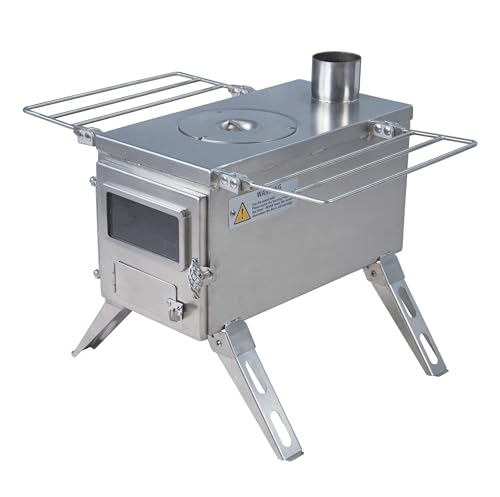
Winnerwell Nomad Medium Tent Stove
Best for 3–4 person hot tents and year-round basecamp use
Winnerwell Nomad Medium Tent Stove
Best for 3–4 person hot tents and year-round basecamp use
What we like
- 304 stainless construction holds up to years of hard outdoor use without warping or rusting.
- 800 cubic inch firebox comfortably heats a 4-person tipi or bell tent at temps below -15°C.
- Compact nesting design packs the pipe sections and accessories inside the stove body for transport.
- Front-door air damper gives you precise control over burn rate without cracking the door.
What we don't
- No secondary combustion system means slightly lower fuel efficiency than the PLUS version.
- 2.5-inch pipe diameter is narrower than some wall tent jacks — verify compatibility before ordering.
- At 13.5 lbs it is manageable but not a backpacking stove.
The Nomad Medium has become the default recommendation in hot tent communities for good reason — it heats reliably, packs without drama, and the 304 stainless holds up after hundreds of burns where cheaper alloys start warping. This is the stove for someone who wants a proven, maintenance-friendly option for a 3–4 person tipi or bell tent.
If you need secondary combustion for maximum cold-weather efficiency, step up to the PLUS; if you want to save $100 and get 90% of the same performance, this is your stove.
Winnerwell Nomad PLUS M-Sized Hot Tent Stove
Best for extreme cold with maximum fuel efficiency
Winnerwell Nomad PLUS M-Sized Hot Tent Stove
Best for extreme cold with maximum fuel efficiency
What we like
- Secondary combustion system re-burns exhaust gases for noticeably better fuel efficiency in sub-zero temps.
- External air intake draws combustion air from outside the tent, reducing oxygen depletion inside your shelter.
- Dual view windows let you monitor burn status without opening the door and losing heat.
- Same proven 304 stainless build as the standard Nomad with significantly upgraded combustion engineering.
What we don't
- Costs $100 more than the standard Nomad for features most users only notice below -10°C.
- Slightly heavier than the base Nomad at around 16 lbs.
- External air intake adds a setup step that first-time stove users sometimes fumble.
The external air intake is the feature that separates this from the standard Nomad — it pulls combustion air from outside, so your tent oxygen levels stay stable during long burns and you wake up with a headache-free camp. Choose this over the standard Nomad if you camp consistently below -10°C or plan to keep the stove running through the night.
For three-season or mild winter use, the price premium is hard to justify.
POMOLY Ti 0.6 Titanium Hot Tent Stove
Best for backpacking and ultralight hot tent setups
POMOLY Ti 0.6 Titanium Hot Tent Stove
Best for backpacking and ultralight hot tent setups
What we like
- 5.73 lbs total with accessories makes it one of the lightest functional tent stoves available on Amazon.
- Titanium construction resists corrosion and handles repeated high-heat cycles without structural degradation.
- Collapsible foldable design packs flat for backpack or bikepacking integration.
- Sliding vent control on the door gives precise airflow adjustment without removing a separate damper piece.
What we don't
- Smaller firebox means more frequent reloading — expect to add wood every 45–60 minutes in cold conditions.
- Titanium walls are thinner than stainless steel and can develop minor distortion after extended hard use.
- Not suitable for wall tents or large group shelters — sized for 1–2 person setups.
If you're hiking into your camp and every pound matters, this is the only stove on this list that makes practical sense — at 5.73 lbs you can actually carry it without reorganizing your entire pack. Be clear-eyed about the tradeoff: the smaller firebox means more fire management, not less.
This is the stove for solo and duo backpackers who want a real wood-burning setup, not car campers looking for a bargain.
OneTigris Tiger Roar Tent Stove
Best for hunters and car campers who want a glass viewing window
OneTigris Tiger Roar Tent Stove
Best for hunters and car campers who want a glass viewing window
What we like
- German Schott ROBAX glass-ceramic fire window is more heat-resistant and durable than standard glass panels.
- 304 stainless body at 3mm thickness at the top actively reduces warping compared to thinner competitor stoves.
- Included air intake valve design prevents carbon and sparks from falling back out through the inlet.
- Comes with a replacement glass panel in the box — a practical touch most brands skip.
What we don't
- Chimney pipes are 201 stainless steel rather than 304 — adequate but less corrosion-resistant long-term.
- No secondary combustion means higher wood consumption on long overnight burns.
- The elbow pipe setup requires attention to get the correct angle — instructions are thin on this point.
You get Schott ROBAX glass and 304 stainless steel at a price that undercuts the Winnerwell Nomad by $80 — for a hunter running a tipi or a car camper who wants a real viewing window, that math works. This is the smart budget pick for people who do moderate winter camping and want glass-window ambiance without paying $200 for it.
Skip it if you camp below -15°C regularly — the lack of secondary combustion adds wood management work in extreme cold.
Camp Chef Alpine CS14 Cylinder Tent Stove
Best for large wall tents and outfitter basecamp setups
Camp Chef Alpine CS14 Cylinder Tent Stove
Best for large wall tents and outfitter basecamp setups
What we like
- Massive 2,940 cubic inch cylindrical firebox heats large wall tents up to 20x24 feet without effort.
- Damper, spark arrestor, grate, and nesting pipe all included — no hunting for accessories after purchase.
- 10-foot chimney height with 6-inch diameter provides excellent draft in cold still-air conditions.
- Wide flat top surface doubles as a serious cooking platform with room for multiple pots or pans.
What we don't
- 74 pounds makes this a truck or ATV-only proposition — not movable without a vehicle.
- Large pipe diameter requires a wall tent with a compatible large stove jack — most hot tents are too small.
- Setup is a two-person job and takes significantly longer than folding stainless stoves.
This is not a portable stove — it is a basecamp heater that happens to pack into itself for transport. At 74 lbs and with a 6-inch pipe requirement, you need a wall tent and a truck to make this work, and when those conditions are met, it is genuinely excellent.
Pick this if you are running an elk camp or a fixed hunting basecamp with a canvas wall tent. If your tent is a tipi, a bell tent, or anything under 16x20 feet, one of the smaller stoves above will serve you far better.
What to Look For
Firebox size is the primary spec to match against your tent volume. A stove with 400–600 cubic inches of firebox handles a 4-person tipi; go up to 800–1500 cubic inches for a wall tent or group shelter.
Pipe diameter and chimney length determine how well the stove drafts in cold conditions. Most hot tent stoves use 2.5-inch or 3-inch pipe — confirm your stove jack diameter before ordering.
Weight only matters if you're carrying it in. For truck or ATV access, a heavier steel stove runs hotter and longer per load; for backpacking, titanium is the only real option.
Who Should Skip This
Skip a hot tent stove entirely if you're car camping with a propane heater already set up — the setup time and wood sourcing make this a poor trade for convenience camping. These stoves reward people who want all-night heat on a single load of wood and are willing to manage a fire.
If you just want warmth without management, a propane catalytic heater is a better fit.
What the Community Actually Uses
On r/CampingGear and r/wintercamping, the Winnerwell Nomad comes up constantly as the benchmark mid-range pick, but experienced users push back hard on newcomers who skip seasoned wood — threads about creosote fires in cheap pipe setups are a recurring warning. The general consensus is: buy a decent stove and don't cheap out on dry wood.
Quick Picks — In Case You've Already Decided
Frequently Asked Questions
What size stove do I need for a 4-person hot tent?
A firebox in the 600–900 cubic inch range handles most 4-person tipi or bell tent setups in temperatures down to -15°C. Go larger if your tent is a wall tent or you camp in consistently extreme cold.
Are these stoves safe to run while sleeping?
Only if your tent is properly vented and the stove jack seals tightly around the chimney pipe. Let the fire burn down to coals before sleeping and crack a vent — never seal the tent completely with a live fire.
Can I cook on a hot tent stove?
Yes — all five stoves here have a flat top surface suitable for boiling water, heating food, and basic camp cooking. A cast-iron pan works well directly on the stove top.
What is secondary combustion and do I need it?
Secondary combustion re-burns gases that would otherwise escape unburned, improving fuel efficiency and reducing smoke. It makes a noticeable difference in -10°C conditions. It adds cost but is worth it for frequent winter use.
How do I stop my chimney pipes from leaking smoke inside the tent?
Make sure pipe sections are seated with the small end down, not up. A poorly seated joint is the most common cause of interior smoke. Check each joint after assembly before lighting.
Buying Guide
You need to match firebox size to tent volume, not just tent capacity rating. A stove that heats a 4-person tent in calm conditions may struggle at -15°C or in wind.
Check pipe diameter compatibility with your tent's stove jack before you buy — mismatches are the number one return reason for this category.