Your stove isn't the problem — a backpacking burner running 10,000 BTUs was never designed to support 8 pounds of cast iron at high heat. The stoves here run 20,000–30,000 BTUs per burner, with cast-aluminum grates engineered to hold heavy cookware without warping.
| Photo |
Top Pick
|
Versatile

|
Budget

|
Best Value

|
Best for Reliability
|
|---|---|---|---|---|---|
| Product | Camp Chef PRO60X Two-Burner Stove | Coleman 1900 Collection 3-in-1 Propane Camping Stove | Camp Chef Everest 2X Two-Burner Stove | Camp Chef Explorer Two Burner Stove | Coleman Triton+ 2-Burner Propane Camping Stove |
| Ignition | Matchless | Matchless | Matchless | Match-start | InstaStart push-button |
| Windscreen | ✓ | ✓ | ✓ | ✓ | ✓ |
| Btu per burner | 30,000 | 12,000 | 20,000 | 30,000 | 11,000 |
| Cooking surface | 448 sq in | Standard 2-burner | 215 sq in | 448 sq in | Standard 2-burner |
| Buy Now | Check Price → | Check Price → | Check Price → | Check Price → | Check Price → |
Quick Tips
Preheat cast iron for at least 5 minutes before adding oil — a cold skillet on a camp stove leads to uneven hot spots and sticking
Run your stove on medium heat with cast iron — 30,000 BTU burners hit searing temps at half throttle, and full blast risks burning seasoning
Use a 1-pound propane canister on lower BTU stoves to extend run time when slow-cooking in a Dutch oven
Check your grate gap against your cast iron handle width before you pack — a 10-inch skillet sitting on a 12-inch grate is an unstable setup
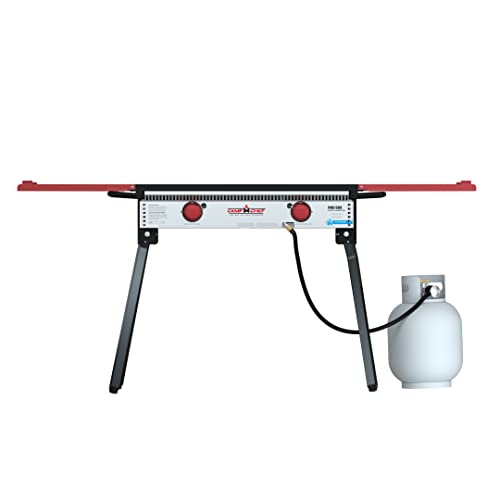
Camp Chef PRO60X Two-Burner Stove
Best for serious cast iron cooking at basecamp
Camp Chef PRO60X Two-Burner Stove
Best for serious cast iron cooking at basecamp
What we like
- Two 30,000 BTU cast-aluminum burners hold consistent high heat under a loaded cast iron skillet without dropping temperature
- Wide 14x32-inch cooking surface gives a 12-inch skillet and a Dutch oven room to run simultaneously
- Three-sided windscreen keeps flame output stable even in gusty campsite conditions
- Leg levelers let you set a stable, flat cooking plane on uneven ground — critical when a heavy pan is on the grate
What we don't
- Heavier and bulkier than compact stoves, so it stays at the trailhead or car camp
- Uses bulk propane with a hose and regulator — not the quickest setup if you're only boiling water
- At the higher end of the price range for a two-burner camp stove
The PRO60X runs 30,000 BTUs per burner through cast-aluminum construction rated for heavy cookware — it's the stove that doesn't flinch when you drop a 12-inch skillet on it and crank the heat. This is the right stove if you're cooking real meals at basecamp — searing elk backstrap, running a Dutch oven low-and-slow, or doing breakfast for a group with multiple pans going.
If you need something compact for one person, look at the Everest 2X instead.
Coleman 1900 Collection 3-in-1 Propane Stove
Best for cast iron cooking with accessories included
Coleman 1900 Collection 3-in-1 Propane Stove
Best for cast iron cooking with accessories included
What we like
- Ships with removable cast-iron grill and griddle accessories built to handle the weight of heavy cast iron cookware
- Retro metal design is more durable than plastic-housing stoves and handles high campsite heat without warping
- Wind guards shield both burners effectively for consistent flame output in breezy conditions
- Compact carry case with built-in handle makes it genuinely portable for weekend trips
What we don't
- 12,000 BTUs per burner is lower output than Camp Chef stoves — searing performance is adequate but not exceptional
- Cast-iron accessories add weight and bulk to an already solid stove
- Cooking surface is smaller than Camp Chef 14-inch systems, limiting pan size combinations
This is the only stove on this list that ships with cast-iron accessories — a grill and griddle designed to sit directly over the burners, so you're not improvising a cast iron setup from day one. It's the right choice if you want a complete out-of-box solution at a mid-range price point, or if you're cooking for two and don't need 30,000 BTU output for a 12-inch skillet.
If you regularly cook for groups or need searing power, step up to the PRO60X.
Camp Chef Everest 2X Two-Burner Stove
Best for cast iron cooking when space is limited
Camp Chef Everest 2X Two-Burner Stove
Best for cast iron cooking when space is limited
What we like
- Two 20,000 BTU burners deliver legitimate searing output in a stove that closes like a suitcase for transport
- Folding lid doubles as a three-sided windscreen — keeps flame stable without adding external panels
- Stainless steel drip tray makes cleanup after cast iron cooking significantly easier
- Matchless ignition lights first try even in cold morning conditions
What we don't
- 215 sq in cooking surface is tight — a 12-inch skillet takes up most of one burner zone
- High BTU output with limited throttle range makes precise simmering in a Dutch oven tricky
- Lighter frame than the PRO60X means it's less stable on uneven ground with a heavy pan
The Everest 2X gives you 20,000 BTUs per burner in a package that packs flat and latches shut — it's the stove that actually fits in a truck bed shell or van buildout without taking over the kitchen. This is the right pick if you're limited on space but still want real BTU output for a 10-inch skillet or a small Dutch oven.
If you're regularly running a 12-inch skillet plus a saucepan at the same time, you'll want the PRO60X's larger cooking surface.
Camp Chef Explorer EX60LW Two-Burner Stove
Best value cast iron camp stove with modular upgrades
Camp Chef Explorer EX60LW Two-Burner Stove
Best value cast iron camp stove with modular upgrades
What we like
- Same 30,000 BTU cast-aluminum burners as the PRO60X at a noticeably lower price point
- 448 sq in cooking surface handles two large cast iron pans running simultaneously without crowding
- Compatible with Camp Chef's 14-inch accessory system — add a griddle or grill box later without buying a new stove
- Detachable legs make it usable on a tailgate, table, or ground stand depending on your setup
What we don't
- Match-start ignition instead of matchless — you'll need a lighter or matches to get it going
- No leg levelers like the PRO60X, so a slightly tilted camp table affects pan stability
- Older design means fewer quality-of-life features compared to the upgraded PRO60X
The Explorer runs identical burner output to the PRO60X — 30,000 BTUs on each side through the same cast-aluminum construction — for about $70-80 less, making it the clearest value play for cast iron camp cooking. Choose this if you want maximum BTU output without paying for PRO60X extras like leg levelers and matchless ignition.
Skip it if you cook in low-light conditions or on uneven terrain where those features actually matter.
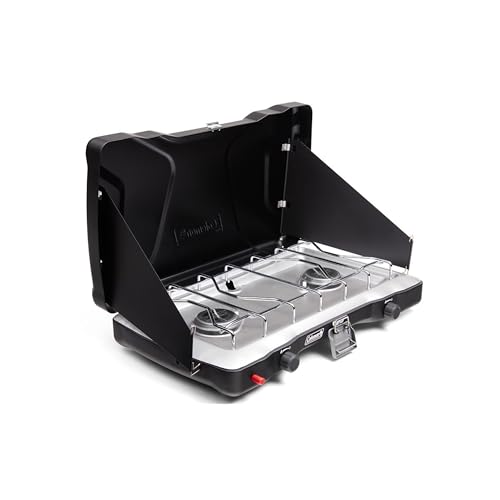
Coleman Triton+ Two-Burner Propane Stove
Best budget option for occasional cast iron camp use
Coleman Triton+ Two-Burner Propane Stove
Best budget option for occasional cast iron camp use
What we like
- Push-button InstaStart ignition is the easiest lighting system in this roundup — one press, no fumbling
- PerfectFlow pressure control keeps flame output consistent even as the propane canister empties
- Rust-resistant aluminized steel cooktop holds up against the heat transfer from cast iron cookware
- Lightest and most compact stove in this roundup — easy to throw in with the camp kit
What we don't
- 11,000 BTUs per burner is half the output of Camp Chef stoves — adequate for heating, limited for searing
- Chrome-plated wire grates can flex under the weight of a large cast iron Dutch oven
- Runs on 1-pound canisters rather than bulk propane, so fuel costs add up on longer trips
The Triton+ works for cast iron cooking — it'll heat a 10-inch skillet and hold temperature for eggs, hash, and stews — but at 11,000 BTUs per burner it hits a ceiling before you get to real searing heat on a loaded pan. This is the right stove if cast iron is a once-in-a-while thing and you're not buying a dedicated stove for it.
If cast iron is your primary camp cookware, the Explorer gives you three times the output for about $30-50 more.
What to Look For
BTU output is the single most important number for cast iron camp cooking. A stove running fewer than 20,000 BTUs per burner can't generate the sustained heat a cast iron skillet needs to sear — it'll heat unevenly and lose temperature the moment food hits the pan.
Grate width and stability determine whether your cast iron sits flat or rocks. A 10- or 12-inch skillet needs a grate that spans at least that distance, and cast-aluminum grates hold up better under heavy pans than chrome-plated wire options that flex under load.
Windscreen design is more important for cast iron than any other cookware. A heavy pan drops ambient temperature around the burner, so a three-sided windscreen is the difference between consistent heat and a flame that keeps hunting for output.
Who Should Skip This
If you're cooking freeze-dried meals on a backpacking trip, none of these stoves belong in your pack — they're heavy, they run on 1-pound canisters or bulk propane, and a titanium pot on a 3,000-BTU canister stove gets the job done at a fraction of the weight. These are basecamp and car-camping stoves built for people who want to cook real food outdoors, not ultralight hikers counting grams.
What the Community Actually Uses
On r/castiron, the camping sub-thread comes up a few times a month — and the consistent advice is to stop trying to run cast iron on a backpacking stove and get something with actual output. The Camp Chef Explorer comes up constantly as the benchmark recommendation, while Coleman stoves get flagged for their lower BTU ceiling on tasks like searing steaks or running a Dutch oven at temperature for hours.
Quick Picks — In Case You've Already Decided
Coleman 1900 Collection 3-in-1 Propane Camping Stove
Check Price on AmazonFrequently Asked Questions
How many BTUs do I need to cook with cast iron camping?
At minimum, 20,000 BTUs per burner. Cast iron absorbs and radiates a lot of heat, so lower-output stoves struggle to maintain searing temperatures once the pan is loaded with food. 30,000 BTUs per burner gives you headroom to cook at medium heat and still get a proper sear.
Can I use a cast iron Dutch oven on a camp stove?
Yes, but your grate needs to support it. A 6-quart Dutch oven full of food can weigh 20-plus pounds — chrome wire grates flex under that load. Cast-aluminum grates on Camp Chef stoves handle it without issue. Check weight ratings if listed.
Will cast iron damage my camp stove grates?
Heavy cast iron can bend or warp chrome-plated wire grates over time, especially at high heat. Cast-aluminum grates found on most Camp Chef models hold up significantly better. Avoid dragging the pan across the grate when repositioning.
Is propane or butane better for cast iron camp cooking?
Propane. It delivers higher output and maintains pressure better in cold weather, which matters when you're running a heavy pan at sustained high heat. Butane loses pressure below 50°F and most butane stoves max out below 15,000 BTUs — not ideal for cast iron.
Can I use cast iron on a Coleman camp stove?
Yes, with caveats. The Coleman 1900 Collection includes cast-iron accessories and handles it fine. The Triton series works but tops out at 11,000 BTUs per burner, which limits searing performance. If cast iron is your primary cookware, go with a Camp Chef stove.
Buying Guide
Cast iron needs two things your average camp stove doesn't deliver: enough BTUs to actually sear and enough grate surface to hold a heavy pan steady. Look for 20,000 BTUs per burner minimum, wide grate spacing, and a windscreen that keeps the flame consistent.
Anything under those numbers and you're just warming food, not cooking it.