The right camping stove for a boat doesn't just need to boil water — it needs to ignore the wind trying to stop it. The MSR WindBurner boils a liter in under 2.5 minutes in 30 mph gusts, and four of the five picks here use propane or pressure-regulated isobutane that won't flame out mid-cook.
| Photo |
Top Pick

|
Versatile

|
Budget

|
Best Value

|
Best for Reliability
|
|---|---|---|---|---|---|
| Product | MSR WindBurner Personal Stove System | Jetboil Flash Camping Stove Cooking System | Camp Chef Everest 2X Two-Burner Stove | Fire-Maple Fixed Star 1 Stove System | Coleman Triton+ 2-Burner Propane Camping Stove |
| Fuel | Isobutane canister | Isobutane canister | Propane cylinder | Isobutane canister | Propane cylinder |
| Weight | 14.9 oz (system) | 13.1 oz (system) | 12 lbs | 18 oz (system) | 7.8 lbs |
| Boil time | 2.5 min/liter | 1.7 min/liter | N/A (40,000 BTU dual burner) | 3.5 min/liter | N/A (22,000 BTU dual burner) |
| Windproof | ✓ | ✗ | ✓ | ✗ | ✓ |
| Buy Now | Check Price → | Check Price → | Check Price → | Check Price → | Check Price → |
Quick Tips
Secure your stove to a flat, stable surface before lighting — a rocking boat can tip an open-flame setup in seconds
Always light the stove before turning up the gas, especially in wind — use a long lighter if your igniter fails
Isobutane canisters lose pressure in cold water temps below 45°F — store the canister in your pocket for 5 minutes before use
On an anchored boat, position your stove on the leeward side and use your cooler or a dry bag as a wind block
MSR WindBurner Personal Stove System
Best for solo boat camping in wind and cold
MSR WindBurner Personal Stove System
Best for solo boat camping in wind and cold
What we like
- Radiant burner is fully enclosed — wind genuinely cannot reach the flame
- Integrated pressure regulator keeps output consistent even as the canister empties
- Pot locks onto the stove and canister, preventing tipping on an unsteady surface
- Entire system nests into the 1-liter pot for tight hatch or dry bag packing
What we don't
- Solo capacity only — the 1-liter pot isn't enough for cooking real meals for two
- Compatible only with MSR WindBurner cookware, limiting what you can cook in
- Higher cost than open-burner alternatives that do the same job on calm days
On an anchored boat in a coastal breeze, most stoves just struggle — the WindBurner's radiant enclosed burner design means the wind has nothing to reach, and you're boiling water in under 3 minutes regardless of conditions. This is the pick for solo kayak anglers, paddleboarders, and anyone packing into a hatch — if you're cooking for a group or want to fry something, step up to the two-burner options below.
Jetboil Flash Camping Stove Cooking System
Best for fast boils on the water with minimal fuss
Jetboil Flash Camping Stove Cooking System
Best for fast boils on the water with minimal fuss
What we like
- Boils 1 liter in under 100 seconds — fastest in this category on calm days
- Push-button ignition is one-handed and reliable, important when you're managing a boat
- Color-change heat indicator shows exactly when water is ready without guessing
- Compact nested system with stabilizer fits a standard dry bag or tackle box side pocket
What we don't
- FluxRing design helps but it's not a fully enclosed radiant burner — serious wind does impact performance
- 1-liter cup limits you to solo boiling; group cooking requires the separate pot support accessory
- Plastic push-button igniter is the first part to fail in heavy saltwater exposure over time
If you're mostly in protected water — rivers, coves, inland lakes — the Flash's 100-second boil is hard to beat for morning coffee or a quick freeze-dried meal on the boat. If your fishing grounds are exposed coastline or open bays with regular wind, step up to the WindBurner — the Flash's FluxRing helps but it won't fully block a stiff coastal breeze.
Camp Chef Everest 2X 2-Burner Camping Stove
Best for group boat camping and real cooking
Camp Chef Everest 2X 2-Burner Camping Stove
Best for group boat camping and real cooking
What we like
- Dual 20,000 BTU burners handle simultaneous cooking — eggs on one side, coffee on the other
- Folding lid converts into a three-sided windscreen that genuinely shields both burners
- Matchless ignition fires on the first push every time, no lighter required
- Propane cylinder fuel means no canister hunting — standard 1 lb cylinders are at every marina
What we don't
- 12 lbs is heavy and bulky — it belongs on a pontoon or at a beachside basecamp, not a kayak hatch
- Propane output drops noticeably below 40°F, more so than isobutane blends
- No carry case included — you need a separate bag to keep it clean between trips
When you're running a group out to an island or anchoring the pontoon for the night, the Everest 2X is the move — 40,000 BTUs and two independent burners let you cook a real meal instead of heating water in shifts. This stove lives on boats with storage: center consoles, pontoons, or beach carts — it's overkill for a kayak and exactly right for anything with a cooler strapped to it.
Fire-Maple Fixed Star 1 Stove System
Best value for solo boat campers on a budget
Fire-Maple Fixed Star 1 Stove System
Best value for solo boat campers on a budget
What we like
- Heat exchange base reduces wind impact and cuts boil times by up to 30% vs standard canister stoves
- Integrated pot and stove system all nests together — nothing loose rattling around a hatch
- Built-in piezo ignition means no searching for a lighter on a wet morning
- Sub-$60 entry point is significantly cheaper than Jetboil and MSR at similar compact size
What we don't
- No enclosed burner — open flame will struggle in sustained coastal wind above 15 mph
- Only compatible with most standard canisters; Coleman-branded canisters do not fit
- Boil time is slower than the Jetboil Flash on calm days at the same fuel canister size
If you don't fish exposed coastline and you want a compact integrated stove system for under $60, the Fixed Star 1's heat exchange base actually does meaningful work — you get noticeably faster boils than a bare-burner stove at the same price. In sustained coastal wind it'll struggle, and it won't replace the WindBurner or Jetboil for serious open-water use — but for a river tripper or protected bay angler, it's a sharp budget move.
Coleman Triton+ 2-Burner Propane Camping Stove
Best budget two-burner for dock and basecamp cooking
Coleman Triton+ 2-Burner Propane Camping Stove
Best budget two-burner for dock and basecamp cooking
What we like
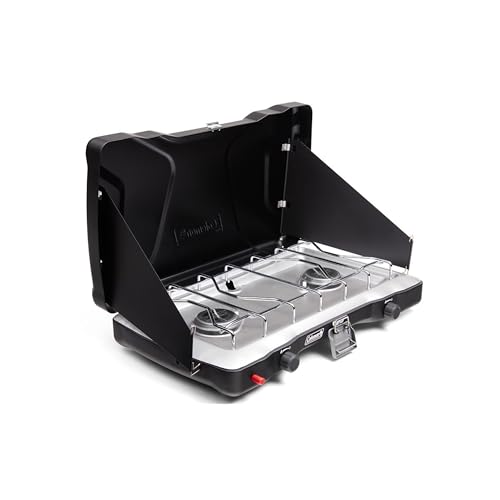
- Dual wind guards fold out and block both burners — effective in moderate coastal breeze
- PerfectFlow pressure control keeps heat consistent even as the propane cylinder drains
- InstaStart push-button ignition requires no matches or lighter to fire up
- At under $75 it's the most accessible two-burner propane option for occasional boat campers
What we don't
- 22,000 BTUs total is underpowered vs the Camp Chef Everest 2X at 40,000 BTUs for the same form factor
- Rust-resistant aluminized steel holds up on freshwater trips but needs rinsing after saltwater exposure
- Wind guards are helpful but not as enclosed as the Camp Chef's folding lid windscreen design
If you're dockside, beachside, or parked at a campsite near the water, the Coleman Triton+ gives you two burners and matchless ignition for under $75 — it's the stove most boat campers already have in the truck. For serious open-water or exposed island camping, step up to the Camp Chef Everest 2X for double the BTUs and a better windscreen — but for casual weekend use, the Triton+ is hard to argue with at this price.
What to Look For
Wind resistance is the single most important spec for a boat stove. Enclosed burner designs and built-in windscreens matter more than raw BTU output.
Fuel type determines how you pack and how the stove performs in cold temps. Isobutane canisters are light and clean but lose pressure below 45°F; propane cylinders stay consistent from a dock or truck.
Stability under load matters more on a moving platform than it does on solid ground. Look for wide pot supports, low center of gravity, or a pot-locking system if you're underway.
Who Should Skip This
This list skips alcohol and wood-burning stoves entirely — they don't work reliably in coastal or river wind. If you're on a motorboat with a built-in galley, a dedicated marine stove is a better investment than any portable camping unit.
Ultralight backpacking stoves without any windscreen or enclosed burner are also a poor fit for open-water camping.
What the Community Actually Uses
On r/kayakfishing, wind-proofing comes up constantly — anglers running overnight trips to barrier islands are trying to boil water in 20-knot wind with a stove they squeezed into a hatch. The consensus there consistently points to enclosed integrated systems over bare-burner designs for exposed campsites.
Quick Picks — In Case You've Already Decided
Frequently Asked Questions
Can you use a camping stove on a boat safely?
Yes, with the right precautions. Always cook on a stable, flat surface away from fuel lines and cushions. Enclosed burner designs are safest in a marine environment because they reduce open flame exposure in wind.
What fuel type is best for boat camping?
Isobutane-propane blended canisters are the most convenient — no liquid fuel, no spill risk, clean burn. If you're running a two-burner stove off a truck or large vessel, a standard 1 lb propane cylinder works well and is available at most marinas and hardware stores.
Will a regular backpacking stove work on a boat?
A standard canister stove without a windscreen will struggle badly in any coastal or river wind. It'll boil eventually, but you'll waste fuel and patience. An enclosed system like the WindBurner or an integrated pot like the Jetboil Flash is a much better call.
How do I stop my stove from tipping on a rocking boat?
Use a non-slip silicone mat under the stove and anchor the canister separately from the burner head. Stoves with integrated pot-locking systems like the Jetboil Flash are the most stable option because the pot can't slide off.
Can I use a two-burner propane stove on a small boat?
You can, but most two-burner propane stoves are meant for dockside or beach use, not the deck of a moving kayak or small skiff. They're ideal for boat camping where you anchor up and cook on shore or a stable platform.
Buying Guide
On a boat, wind is your stove's main enemy. You need either a fully enclosed radiant burner or a two-burner propane stove with fold-up windscreens.
Canister isobutane stoves outperform liquid propane in cold water temps. Pick based on group size: solo kayak needs compact, basecamp boat needs two burners.