Simmer control is the single feature that separates trail cooking from trail surviving, and only a handful of backpacking stoves actually deliver it. The five options here weigh between 2.3 and 6.6 oz, all verified on Amazon, and every one of them gives you a real low flame — not just a dial that goes from inferno to off.
| Photo |
Top Pick

|
Versatile
|
Budget

|
Best Value

|
Best for Reliability

|
|---|---|---|---|---|---|
| Product | MSR PocketRocket Deluxe Ultralight Backpacking Stove | SOTO WindMaster Backpacking Stove with 4Flex | Jetboil MightyMo Ultralight Backpacking Stove | Fire-Maple Greenpeak 2 Backpacking Stove | MSR WindPro II All-Condition Backpacking Stove |
| Fuel | Isobutane-propane | Isobutane-propane | Isobutane-propane | Isobutane-propane | Isobutane-propane |
| Weight | 2.9 oz (83g) | 2.3 oz (67g) | 3.3 oz (94g) | 3.4 oz (95g) | 6.6 oz (187g) |
| Seasons | 3-4 season | 4 season | 4 season | 3-4 season | 4 season |
| Boil time | 3.5 min/liter | 2.5 min/2 cups | Regulated to 20°F | ~3 min/liter | ~3.5 min/liter |
| Buy Now | Check Price → | Check Price → | Check Price → | Check Price → | Check Price → |
Quick Tips
Test your simmer before your trip by holding your hand 6 inches above the flame — a true simmer should feel like a hair dryer, not a blowtorch.
Isobutane-propane blends outperform pure butane below 40°F — check the label on your canister, not just the stove spec.
Pair a pressure-regulated stove with an insulating canister sleeve in cold weather to maintain consistent output as fuel runs low.
Remote canister stoves like the WindPro II can use a windscreen safely — top-mount canister stoves cannot, as heat buildup creates a pressure risk.
MSR PocketRocket Deluxe Ultralight Backpacking Stove
Best for hikers who want precision cooking without sacrificing weight
MSR PocketRocket Deluxe Ultralight Backpacking Stove
Best for hikers who want precision cooking without sacrificing weight
What we like
- Pressure regulator maintains consistent output in cold weather and with a low canister — a feature most stoves in this price range lack.
- Broad burner head delivers noticeably better heat distribution and simmer sensitivity than the standard PocketRocket 2.
- Built-in piezo igniter lights reliably even in cold conditions, and the igniter is recessed into the burner to protect it from damage.
- Collapsible pot supports grip most cookware sizes securely, including wider pots for group cooking.
What we don't
- Top-mount design means you cannot use an enclosed windscreen — in exposed conditions this costs efficiency.
- Slightly heavier than competitors at this price point due to the pressure regulator and igniter.
- Piezo igniters can eventually fail — worth packing a lighter on longer expeditions.
The PocketRocket Deluxe solves the single biggest frustration with cheap backpacking stoves: the flame that becomes unpredictable the colder it gets or the lower the canister runs. The pressure regulator means the burner output you dialed in at the start of the trip is the output you get on day four.
This is the right stove for someone who wants a genuinely capable setup without crossing into specialist territory — it handles everything from pasta to sauteed vegetables without complaint. If you are a serious gram-counter below 3 oz or you cook primarily in groups that need a remote-canister design, look at the SOTO or WindPro II instead.
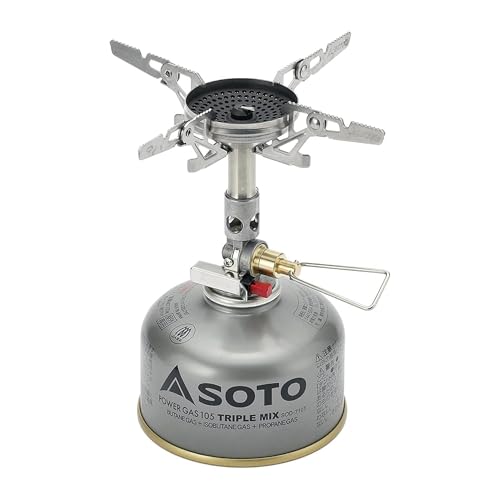
SOTO WindMaster Canister Stove with 4Flex
Best for exposed ridgelines and wind-exposed alpine cooking
SOTO WindMaster Canister Stove with 4Flex
Best for exposed ridgelines and wind-exposed alpine cooking
What we like
- Micro regulator valve delivers the most precise low-flame adjustment of any stove in this class — legitimate simmer, not just a reduced high.
- At 2.3 oz it is the lightest regulated stove here, making it the default choice for serious gram-counters who still want real cooking capability.
- Built-in windscreen design performs in sustained wind where most canister stoves become unreliable without external shielding.
- 4Flex support included in the box adds large-pot stability without requiring a separate purchase.
What we don't
- The stealth igniter is durable but harder to access for manual lighting if it ever fails in the field.
- Small burner head can create hot spots on wide pots — less forgiving than the PocketRocket Deluxe's broad burner for large cookware.
- Higher price than the PocketRocket Deluxe for features most hikers will not fully use unless cooking in consistently windy conditions.
The WindMaster is what you bring when you know you will be cooking on exposed ridgelines where a conventional top-mount stove becomes an exercise in frustration — it consistently outperforms everything else in wind without requiring an external windscreen. The micro regulator valve also gives you the kind of fine-grained simmer control that makes it genuinely useful for anything beyond boiling water.
This is the pick for ultralight alpine hikers and experienced backpackers who cook real food in challenging conditions. If your trips are mostly forested, sheltered sites, the PocketRocket Deluxe delivers nearly identical cooking performance at a lower price.
Jetboil MightyMo Ultralight Backpacking Stove
Best for backpackers who want maximum simmer range in one stove
Jetboil MightyMo Ultralight Backpacking Stove
Best for backpackers who want maximum simmer range in one stove
What we like
- Four-turn regulator valve gives you the widest simmer-to-boil range of any stove here — the difference between each turn is meaningfully distinct.
- Pressure regulator maintains consistent output down to 20°F, making it a reliable four-season choice without the weight penalty of liquid fuel.
- Open platform design works with Jetboil FluxRing cookware and standard pots, giving you more flexibility than a closed cooking system.
- Reliable push-button igniter lights consistently even in cold conditions.
What we don't
- At 3.3 oz it is the heaviest canister-mount stove in this roundup — noticeable over a week-long trip.
- Does not include a pot, so budget for cookware separately unless you already have Jetboil accessories.
- The open design offers less wind protection than the SOTO WindMaster — expect slower boil times in breezy conditions.
The MightyMo earns its place here on valve quality alone: the four-turn regulator is the most intuitive simmer control of any stove in this field, giving you enough range to cook a risotto on one end and blast water to boiling on the other without hunting for the sweet spot. If simmer control is the primary reason you are upgrading from a basic stove, this is the most satisfying option to actually use.
It is the right pick for the basecamp-style backpacker who prioritizes cooking range over saving every gram, and who wants full Jetboil accessory compatibility for future upgrades. Ultralight minimalists and hikers facing consistent headwinds should look at the SOTO WindMaster instead.
Fire-Maple Greenpeak 2 Backpacking Stove
Best regulated budget stove for three-season hikers
Fire-Maple Greenpeak 2 Backpacking Stove
Best regulated budget stove for three-season hikers
What we like
- Micro regulated valve delivers consistent output in cold conditions — uncommon at this price point and what separates it from basic budget stoves.
- Durable stainless steel, ceramic, and aluminum alloy construction feels significantly more substantial than competitors in this price bracket.
- Compact fold-down profile fits inside a 110g canister cup for minimal pack footprint.
- Built-in piezo igniter reduces the need to carry a separate lighter on shorter trips.
What we don't
- Not compatible with the Fire-Maple Z1 adapter, limiting your canister options to standard EN417 thread canisters.
- Less wind resistance than the SOTO WindMaster — in open exposed terrain you will notice the difference in boil times.
- Newer brand with less long-term field data than MSR or Jetboil — worth noting for extended expeditions.
The Greenpeak 2 is the answer to the question most beginners ask: do you actually have to spend $60 to get a regulated stove that simmers properly? At this price, the micro regulated valve is genuinely impressive and gives you real cooking capability, not a token feature listed in the bullet points. This is the right pick for someone outfitting their first proper cook system who wants the capability to grow into, or for a backup stove that does not embarrass itself when the primary breaks.
For year-round alpine use or demanding wind exposure, the investment in the PocketRocket Deluxe or SOTO WindMaster pays for itself quickly.
MSR WindPro II All-Condition Backpacking Stove
Best for group cooking and large pot stability in all conditions
MSR WindPro II All-Condition Backpacking Stove
Best for group cooking and large pot stability in all conditions
What we like
- Remote canister design allows inverted liquid-feed mode for dramatically improved cold-weather and low-fuel performance — a genuine technical advantage over top-mount stoves.
- Supports pots up to 10 inches in diameter, making it the only stove here suited to serious group cooking without a stability compromise.
- Includes windscreen in the box — and because the canister is remote, it is safe to use it, unlike with top-mount designs.
- Inverted canister mode extends usable fuel life significantly, extracting more from each canister than vapor-feed stoves can manage.
What we don't
- At 6.6 oz it is more than double the weight of the SOTO WindMaster — this is a stove for people who prioritize cooking performance over pack weight.
- The remote canister setup takes longer to configure than a top-mount stove — not ideal for quick morning boils when you just want coffee.
- Higher price for a stove primarily justified by group cooking and cold-condition capability that casual three-season hikers will never need.
The WindPro II solves two problems simultaneously that no other stove here handles: large pot stability for cooking for a group, and reliable cold-weather performance via liquid-feed inverted canister mode. The included windscreen is the final piece — you can actually use it safely, meaning this stove maintains output in conditions that would leave a top-mount stove sputtering.
This is the pick for the group trip leader or the winter hiker who wants canister convenience with liquid-fuel cold-weather capability. Solo fast-and-light hikers will find it overkill — the weight penalty only makes sense if you are regularly cooking for three or more or dealing with sub-freezing temperatures.
What to Look For
A regulated burner maintains consistent output even as canister pressure drops in cold weather or at altitude — this is what makes precise simmering possible. Without regulation, your flame weakens as the canister empties, making temperature control increasingly frustrating over a multi-day trip.
Valve sensitivity determines whether you can actually dial down to a low simmer or just toggle between high and medium. Look for stoves with four-turn or micro-regulator valves — they give you far more granular heat adjustment than a standard two-turn valve.
Weight is relative to how you cook: solo fast-and-light hikers should stay under 3 oz, while group basecamp cooks can afford a heavier remote-canister design that supports larger pots. Never trade simmer capability for a lighter stove unless all you ever make is instant oatmeal.
Who Should Skip This
If your entire cook system is rehydrated freeze-dried meals and instant coffee, you do not need simmer control — a lighter boil-only stove will save you money and grams. Ultralight purists counting every tenth of an ounce may find even the lightest options here too heavy once fuel is included.
Anyone cooking primarily in below-freezing temps on extended winter routes should also consider a liquid-fuel stove, which handles extreme cold better than any canister system.
What the Community Actually Uses
On r/ultralight, simmer control is one of the most debated topics in the cook-system thread — the consensus leans hard toward regulated stoves for anything beyond simple rehydration, with the SOTO WindMaster and MSR PocketRocket Deluxe consistently cited as the two benchmarks every other option gets measured against.
Quick Picks — In Case You've Already Decided
MSR PocketRocket Deluxe Ultralight Backpacking Stove
Check Price on AmazonFrequently Asked Questions
What does simmer control actually mean on a backpacking stove?
It means you can turn the flame low enough to cook without scorching — think maintaining a sauce at a gentle bubble rather than a rolling boil. True simmer control requires a sensitive valve and ideally a pressure regulator to keep output consistent as the canister empties.
Are canister stoves good enough for four-season backpacking?
In temperatures above 20°F, a regulated isobutane-propane canister stove handles four-season conditions well. Below that threshold, liquid fuel stoves maintain better output because they are not dependent on canister vapor pressure.
Can I use any isobutane canister with these stoves?
All five stoves here use the standard EN417 thread and work with major canister brands including MSR IsoPro, Jetboil JetPower, and Snow Peak. Always match fuel type — isobutane-propane blends outperform pure butane in cold conditions.
How much does a backpacking stove weigh with fuel?
The stove alone ranges from 2.3 oz to 6.6 oz across these five picks. Add a 100g canister (which weighs about 3.5 oz) for a realistic total starting weight of roughly 6 to 10 oz depending on the stove.
Is a windscreen safe to use with canister stoves?
Only with remote-canister designs like the MSR WindPro II, where the burner is separated from the fuel canister. Never use an enclosed windscreen with top-mount canister stoves — heat buildup around the canister creates a serious pressure risk.
Buying Guide
You need a stove that matches how you actually cook. If you boil and pour, almost anything works.
If you saute, simmer sauces, or cook real food after long days, you need a regulated burner with a sensitive valve. Weight and wind resistance matter too — check both before you buy.